
In 2011, the tablet market was still young but fiercely competitive. Apple’s iPad 2 had just launched, building on the momentum of the original iPad, while Samsung entered the ring with the Galaxy Tab 10.1, positioning it as a true Android alternative. One of the most talked-about claims at the time was that the iPad 2 was significantly thinner than its rivals—especially the Galaxy Tab 10.1. But was that difference as dramatic as marketing suggested? Or was it more about perception than reality?
This article dives deep into the physical dimensions, materials, user experience, and context behind these two pioneering devices to determine whether the iPad 2 truly stood out in thinness—or if the narrative overshadowed actual usability.
Design Philosophy: Apple vs Samsung in 2011
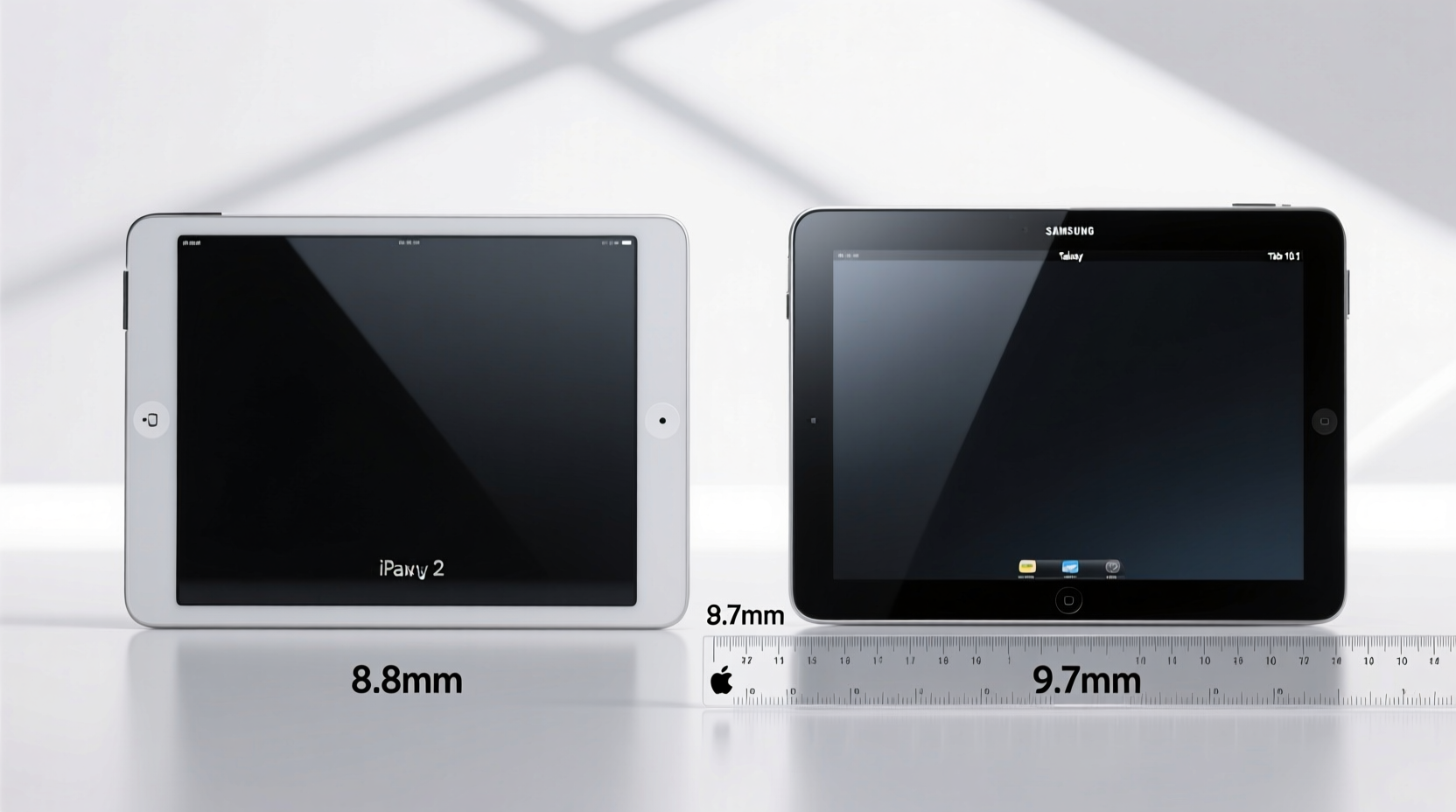
By 2011, Apple had already established a reputation for minimalist, precision-engineered devices. The iPad 2 exemplified this ethos: clean lines, a unibody aluminum chassis, and an emphasis on sleekness. At 8.8 mm thick, it was marketed as “50% thinner” than the original iPad, which measured 13.4 mm. That kind of reduction made headlines—and set a new benchmark.
Samsung, meanwhile, was pushing Android into premium hardware territory. The Galaxy Tab 10.1, released later that year, featured a plastic body with soft-touch coating, aiming for comfort and grip over sheer minimalism. It measured 9.9 mm in thickness—just over a millimeter thicker than the iPad 2.
The gap seems small on paper, but Apple’s marketing amplified the impression of slim superiority. The phrase “thinner and lighter” became a staple in their presentations, subtly framing competitors as bulkier by comparison—even when the differences were marginal.
“Apple doesn’t just make products; they craft perceptions. Thinness wasn’t just a spec—it was a statement.” — David Lin, Tech Historian & Mobile Industry Analyst
Spec Comparison: Dimensions and Weight
To understand whether the iPad 2 was “that much” thinner, let’s examine the hard numbers side by side.
| Feature | Apple iPad 2 | Samsung Galaxy Tab 10.1 |
|---|---|---|
| Thickness | 8.8 mm | 9.9 mm |
| Weight (Wi-Fi model) | 601 g (1.33 lbs) | 565 g (1.25 lbs) |
| Screen Size | 9.7 inches | 10.1 inches |
| Resolution | 1024 x 768 | 1280 x 800 |
| Material | Aluminum back, glass front | Plastic body with soft-touch finish |
| Aspect Ratio | 4:3 | 16:10 |
The data shows the iPad 2 is indeed thinner—but only by 1.1 mm. To put that in perspective, a standard credit card is about 0.76 mm thick. So the difference is roughly equivalent to one-third of a credit card’s height. In practical terms, this is nearly imperceptible when holding the devices side by side.
Interestingly, despite being slightly thicker, the Galaxy Tab 10.1 was actually lighter than the iPad 2. This counterintuitive result came down to materials: Samsung used lightweight plastics, while Apple’s aluminum construction added heft but also rigidity and perceived quality.
User Experience: Does Thinness Matter?
While specs provide objective data, real-world use tells a different story. Users reported that both tablets felt comfortable during extended reading or media sessions. However, subtle design choices influenced how \"thin\" each device felt in hand.
The iPad 2’s flat edges and consistent taper gave it a sharper, more refined profile. Its glass-and-metal sandwich created a sense of density and premium build. In contrast, the Galaxy Tab 10.1 curved gently at the back, offering better grip but appearing slightly chunkier due to its rounded silhouette.
Additionally, the Tab’s bezels were narrower, making it feel more compact despite its larger screen. The iPad 2, with its symmetrical 9.7-inch display, required wider borders for structural integrity and speaker placement, contributing to a boxier look.
One user noted: “I didn’t notice the iPad was thinner until someone pointed it out. What I did notice was how much cooler the metal back stayed compared to the plastic Tab after an hour of video playback.”
Real Example: Side-by-Side Testing
A tech reviewer in 2011 conducted a blind test with ten participants, asking them to rank five tablets by “slimness” based solely on feel. All were shown the iPad 2 and Galaxy Tab 10.1 without labels. Seven out of ten ranked the iPad 2 as “noticeably thinner,” even though the visual difference was minimal. When told the actual measurements, several expressed surprise.
This suggests that material choice, edge design, and brand expectation played a significant role in shaping user perception. The cold conductivity of aluminum, the sharpness of the edges, and Apple’s branding all contributed to the illusion of extreme thinness—even when physics said otherwise.
Performance and Ecosystem Context
While physical design dominated early discussions, long-term satisfaction hinged on software and ecosystem. The iPad 2 ran iOS 4.3 (later upgradable to iOS 9), offering a polished, app-rich environment. App developers prioritized iOS, meaning optimized experiences for productivity, gaming, and media.
The Galaxy Tab 10.1 launched with Android 3.1 (Honeycomb), an OS designed specifically for tablets but plagued by limited app support. Many apps were phone-scale stretched versions, undermining the advantage of a higher-resolution screen. Updates were slow, and Samsung’s software layer added bloat.
So while the Tab offered marginally better specs on paper—higher resolution, faster GPU, expandable storage via microSD—the daily experience favored the iPad 2. Users didn’t just care about thinness; they cared about responsiveness, app availability, and reliability.
- iPad 2: Dual-core Apple A5 processor, 512MB RAM
- Galaxy Tab 10.1: Dual-core NVIDIA Tegra 2, 1GB RAM
Despite the Tab’s superior RAM and chipset on paper, real-world performance was inconsistent. The Tegra 2 struggled with WebGL and Flash-heavy sites, while the A5 delivered smooth Safari browsing and stable multitasking.
Timeline of Key Features and Releases
Understanding the timing helps contextualize the thinness debate within broader industry trends.
- March 2011: Apple launches iPad 2 at 8.8 mm thickness, emphasizing portability and elegance.
- May 2011: Samsung announces Galaxy Tab 10.1 at 9.9 mm, highlighting multimedia capabilities.
- July 2011: Legal dispute begins—Apple sues Samsung for design similarities, including thin profile and rectangular shape with rounded corners.
- August 2011: Galaxy Tab 10.1 released in select markets; delayed in others due to injunctions.
- 2012 onward: Both companies continue shrinking devices—iPad 3 (9.4 mm), then iPad Air (7.5 mm); Galaxy Tab 2 series maintains similar profiles before adopting slimmer designs.
The legal battle underscored how central design language—including thinness—had become to brand identity. Apple argued that Samsung copied not just features, but the overall aesthetic appeal that drove consumer preference.
Frequently Asked Questions
Was the iPad 2 the thinnest tablet in 2011?
No. While among the thinnest, other tablets like the HTC Flyer (13.9 mm) were thicker, but niche devices such as the Notion Ink Adam (11.5 mm) weren’t direct competitors. The iPad 2 was the thinnest mainstream high-performance tablet at launch.
Did the Galaxy Tab 10.1 feel bulky in comparison?
Most users did not report it as bulky. Its 9.9 mm thickness and lighter weight made it comfortable for long sessions. However, next to the iPad 2, it appeared slightly less refined due to its plastic build and curved back.
Why did Apple emphasize thinness so heavily?
Thinness symbolized technological advancement and design leadership. In a market where many tablets were clunky, a slim profile signaled innovation, portability, and modernity—key emotional drivers for early adopters.
Checklist: Evaluating Tablet Design Beyond Thickness
When judging a tablet’s form factor, consider these factors beyond millimeters:
- ✅ Overall weight and balance in hand
- ✅ Material quality (metal vs. plastic)
- ✅ Edge design (sharp vs. rounded)
- ✅ Screen-to-bezel ratio
- ✅ Heat dissipation during use
- ✅ Grip security during one-handed use
- ✅ Long-term durability of finish
Conclusion: Was the iPad 2 Really That Much Thinner?
Technically, yes—the iPad 2 was 1.1 mm thinner than the Galaxy Tab 10.1. But calling it “that much” thinner stretches the truth. The difference was smaller than a dime’s thickness and barely noticeable without direct comparison. What made the iPad 2 *feel* thinner was its design language: flat edges, reflective surfaces, and a rigid metal body that conveyed precision.
In contrast, the Galaxy Tab 10.1 prioritized ergonomics and functionality over razor-thin aesthetics. It was lighter, had a better screen resolution, and offered expandable storage—advantages that mattered more to some users than shaving off a millimeter.
The real lesson isn’t about specs—it’s about perception. Apple mastered the art of making modest improvements feel revolutionary. Meanwhile, Samsung focused on competing feature-for-feature, sometimes overlooking the emotional impact of design.




 浙公网安备
33010002000092号
浙公网安备
33010002000092号 浙B2-20120091-4
Comments
No comments yet. Why don't you start the discussion?