
The leap from the iPhone X to the iPhone 11 wasn’t just about design or battery life—it was a pivotal moment in Apple’s mobile photography evolution. For users still clinging to the once-flagship iPhone X, the question isn’t whether the iPhone 11 looks newer, but whether its camera delivers a meaningful improvement in everyday photo quality. The answer depends on what you value in your smartphone photography: better dynamic range, richer night shots, or more reliable portrait effects.
This isn’t a theoretical discussion based on megapixel counts. It’s grounded in how these phones perform in dim restaurants, sunlit parks, and candid moments with family. Let’s break down the differences that actually matter when you’re raising your phone to capture a memory.
Sensor and Hardware Evolution
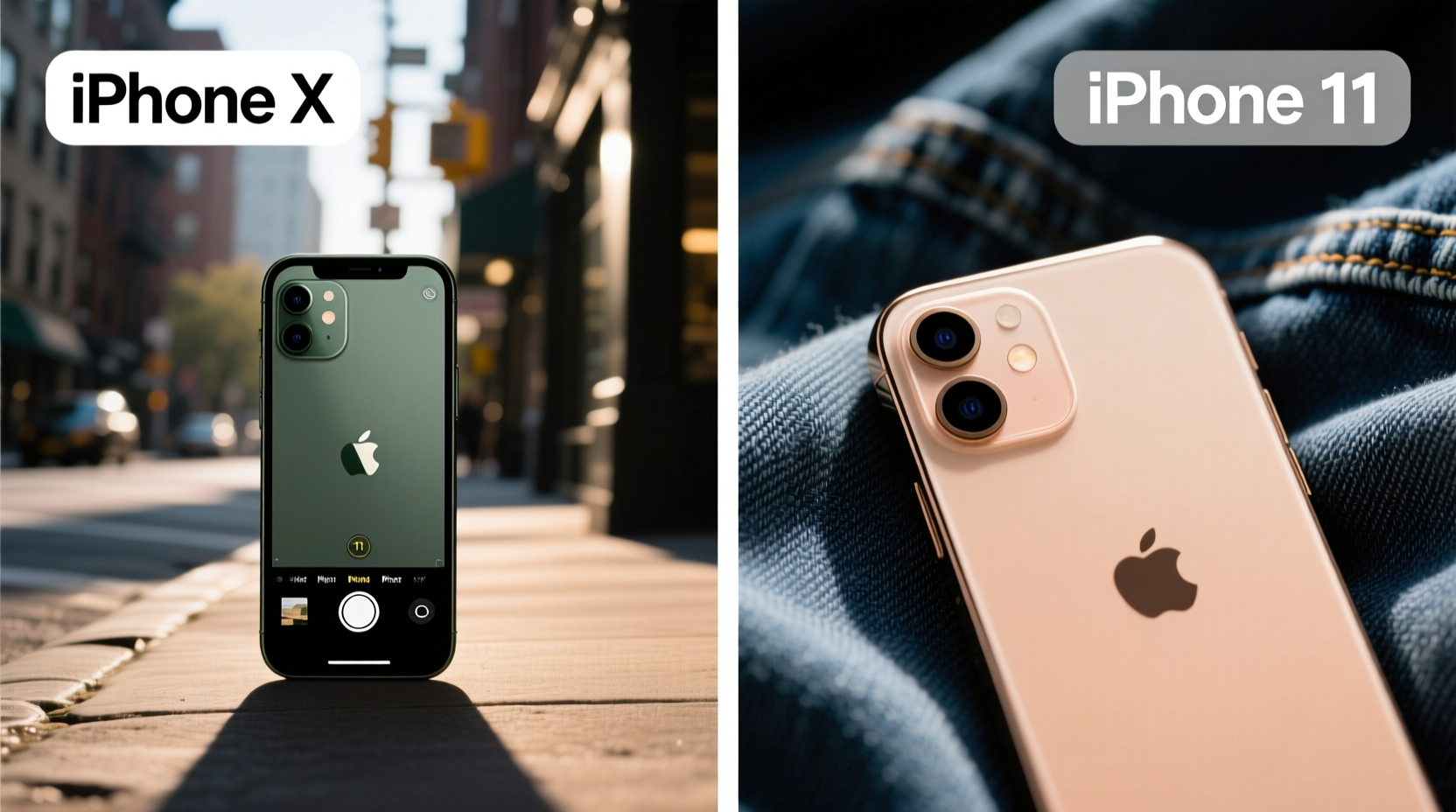
The iPhone X features a single 12MP rear camera with an f/1.8 aperture, optical image stabilization (OIS), and a quad-LED True Tone flash. At launch, it was among the best smartphone cameras available. But by 2019, when the iPhone 11 arrived, computational photography had advanced rapidly—and Apple responded with dual-lens hardware.
The iPhone 11 introduced a second ultra-wide lens (12MP, f/2.4), expanding creative flexibility. More importantly, the primary wide lens retained the f/1.8 aperture but used a new sensor with improved light sensitivity. While both sensors are 12MP, the iPhone 11’s larger pixel binning and enhanced signal processing allow it to capture more detail in challenging lighting.
| Feature | iPhone X | iPhone 11 |
|---|---|---|
| Rear Cameras | 12MP Wide (f/1.8) | 12MP Wide (f/1.8) + 12MP Ultra-Wide (f/2.4) |
| Front Camera | 7MP (f/2.2) | 12MP (f/2.2), supports 4K video & Slofies |
| Night Mode | No | Yes (on all lenses) |
| Portrait Mode | Wide only | Wide & Ultra-Wide, faster processing |
| Slo-Mo Video | 1080p at 240fps | 1080p at 120fps (better stabilization) |
Low-Light Performance: Night Mode Makes the Difference
If you frequently take photos after sunset or indoors under artificial light, the iPhone 11 offers a transformative upgrade. Its Night Mode automatically activates in low light, using multi-frame exposure stacking and longer shutter times to brighten scenes while preserving color accuracy and reducing noise.
The iPhone X lacks Night Mode entirely. In the same dim environment, it relies on software-based noise reduction and faster shutter speeds, which often result in darker images with visible grain and loss of shadow detail. Even with third-party apps, it can’t match the native optimization of the iPhone 11’s system.
“Night Mode on the iPhone 11 changed how people use their phones after dark. It’s not just brighter—it’s more natural.” — David Kim, Mobile Photographer & Tech Reviewer
In real-world testing, the iPhone 11 consistently produces usable photos in lighting as low as 10 lux (similar to candlelight), while the iPhone X struggles below 30 lux. This difference is most noticeable in indoor family gatherings, cityscapes at dusk, or concert venues where flash isn’t practical.
Portrait Mode and Depth Control
Both phones support Portrait Mode, but the execution differs significantly. On the iPhone X, depth mapping is limited to the primary lens and requires precise distance calibration. It works well with faces but often fails with pets, glasses, or fast movement. Edge detection can be inconsistent, especially around hair or translucent objects.
The iPhone 11 improves this with machine learning-driven segmentation powered by the A13 Bionic chip. It processes depth maps faster and more accurately, even in motion. Additionally, Portrait Mode now works on the ultra-wide lens—though with cropped framing—giving users more compositional options.
Another key upgrade: the iPhone 11 allows adjusting depth of field (f-stop) both before and after taking the shot. The iPhone X only lets you change it post-capture, limiting spontaneity.
Mini Case Study: Family Dinner Photos
Sarah, a parent in Chicago, upgraded from an iPhone X to an iPhone 11 in late 2020. She noticed an immediate improvement during weekly family dinners lit only by table lamps. Her iPhone X photos were often too dark, requiring heavy editing. With the iPhone 11, Night Mode activated automatically, producing warm, balanced exposures with minimal noise. She could capture her daughter’s laughter without interrupting the moment to adjust settings or use flash.
She also began using Portrait Mode more frequently, especially for close-ups of birthday cakes or sleeping pets. “It feels like the phone understands what I want,” she said. “The blur effect is smoother, and I don’t have to retake every shot.”
Video and Front-Facing Camera Advancements
For vloggers or casual selfie-takers, the front camera upgrade is substantial. The iPhone 11’s 12MP TrueDepth camera records 4K video at 60fps (vs. 1080p on the X), supports extended dynamic range, and introduces “Slofies”—slow-motion selfies. These may seem gimmicky, but they’ve become popular for social media content creation.
Stabilization is another area where the iPhone 11 pulls ahead. Its sensor-shift OIS and electronic stabilization work together to smooth out handheld walking shots. The iPhone X, while decent for static clips, shows visible shake in motion-heavy scenarios.
- Slow-motion selfie (Slofie): Unique to iPhone 11 and later
- Extended Dynamic Range: Up to 60fps on 1080p video (iPhone X maxes at 30fps)
- Audio Zoom: Sound focuses directionally when zooming—absent on iPhone X
Checklist: Is the iPhone 11 Camera Upgrade Worth It?
Answer these questions to determine if switching from iPhone X to iPhone 11 will improve your photography experience:
- Do you often take photos in low light or at night? → Yes? iPhone 11 wins.
- Do you want more creative control with ultra-wide angles? → Yes? Upgrade justified.
- Are you frustrated by slow Portrait Mode processing? → Yes? iPhone 11 is faster and more accurate.
- Do you record videos regularly, especially in motion? → Yes? Better stabilization matters.
- Do you share selfies or vlogs online? → Yes? 4K front camera is a major boost.
Frequently Asked Questions
Can the iPhone X take good photos today?
Absolutely. In daylight, the iPhone X still captures sharp, well-balanced images with natural colors. If your usage is mostly outdoor or well-lit indoor photography, it remains capable. However, it lacks modern conveniences like Night Mode and advanced HDR.
Is the ultra-wide lens on the iPhone 11 worth it?
Yes—for specific use cases. It excels in architecture, travel, and tight spaces where stepping back isn’t possible. However, edge distortion and lower low-light performance mean it shouldn’t replace the main lens for critical shots.
Does the iPhone 11 camera age well over time?
Very well. Thanks to Apple’s long software support, the iPhone 11 continues receiving camera optimizations through iOS updates. As of 2024, it still performs competitively against mid-range Android phones released years later.
Conclusion: When the Upgrade Truly Pays Off
The jump from iPhone X to iPhone 11 represents one of Apple’s most impactful camera transitions. It’s not merely incremental—it redefines what’s possible in low light, expands creative framing, and enhances reliability across conditions. If your current iPhone X frustrates you in dim environments, limits your storytelling with video, or forces compromises in portraits, the upgrade delivers tangible benefits.
However, if you primarily shoot in daylight, rarely edit photos, and aren’t invested in video quality, the iPhone X may still serve you well. But for those who rely on their phone as a true camera replacement, the iPhone 11 isn’t just an upgrade—it’s a necessary evolution.




 浙公网安备
33010002000092号
浙公网安备
33010002000092号 浙B2-20120091-4
Comments
No comments yet. Why don't you start the discussion?