
For years, the Samsung Galaxy Note 8 was a flagship powerhouse—renowned for its stylus precision, expansive display, and productivity-focused design. Fast forward to today, and Apple’s iPhone 11 Pro Max stands as a symbol of refined iOS integration, computational photography, and long-term software support. But if you're still using a Galaxy Note 8 in 2024, is making the switch to the iPhone 11 Pro Max truly worth it? The answer depends on your priorities: longevity, ecosystem preference, camera quality, or everyday functionality.
This isn’t just about specs on paper. It’s about how these devices perform in daily life—handling apps, capturing memories, lasting through the day, and aging over time. Let’s break down the key differences and real-world implications of upgrading from one of Android’s golden-era flagships to a modern iOS powerhouse.
Performance & Software Longevity
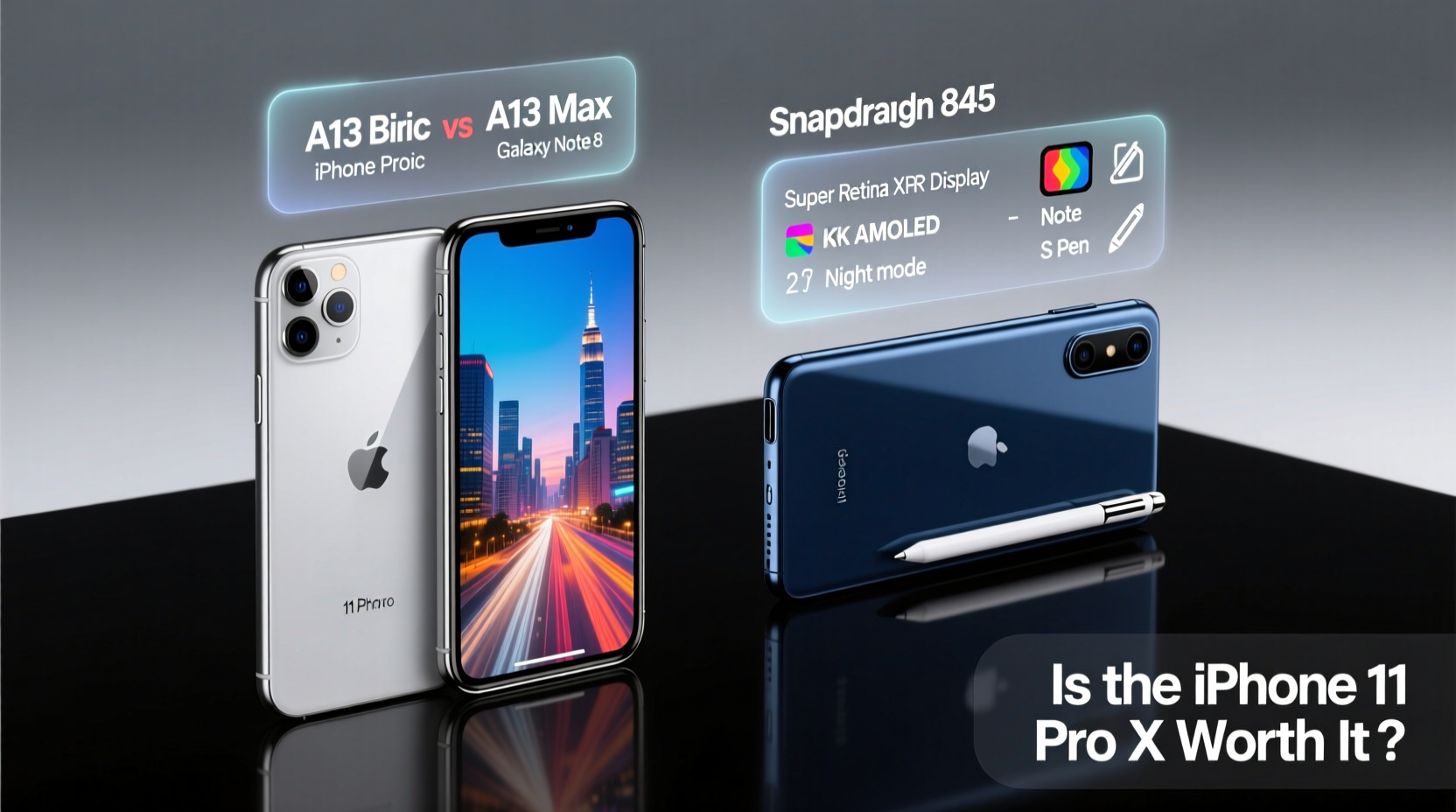
The Galaxy Note 8 launched in 2017 with the Qualcomm Snapdragon 835 (or Exynos 9810 in some regions), which was top-tier at the time. By 2024 standards, however, this chip struggles with multitasking, modern app demands, and even basic OS fluidity. Most users report noticeable lag when opening multiple apps or switching between them. Software updates officially ended with Android 9, meaning no security patches since 2020.
In contrast, the iPhone 11 Pro Max features Apple’s A13 Bionic chip—a 7nm processor designed for efficiency and sustained performance. Even in 2024, the A13 handles demanding tasks like 4K video editing, AR applications, and multitasking with ease. More importantly, Apple supports its devices with iOS updates for up to five years post-release. The iPhone 11 Pro Max received updates through iOS 17 and may see limited support into iOS 18, ensuring continued security, compatibility, and feature access.
Camera Capabilities: Night Mode, Zoom, and Video
The Note 8 featured a dual-camera setup: 12MP wide and 12MP telephoto lenses. While capable in daylight, low-light performance was average, and there was no night mode. Optical zoom was limited to 2x, and video topped out at 4K@30fps without advanced stabilization.
The iPhone 11 Pro Max introduced a triple-lens system: 12MP ultra-wide, wide, and telephoto cameras. This allows for greater creative flexibility—shooting sweeping landscapes or tight architectural shots without moving. Its Night mode automatically activates in dim lighting, producing brighter, more detailed photos than the Note 8 can achieve even in well-lit conditions.
Video recording sees an even starker difference. The iPhone supports 4K@60fps with extended dynamic range and cinematic stabilization. Features like QuickTake (instant video from photo mode) and seamless switching between lenses make it far more versatile for casual creators.
“Smartphone photography has evolved beyond hardware—it's about software intelligence. The iPhone 11 Pro Max leverages machine learning to enhance every shot.” — David Lin, Mobile Imaging Analyst
Battery Life and Charging Realities
The Galaxy Note 8 packed a 3,300mAh battery. In 2017, that was adequate for a full day with moderate use. Today, heavy users often need to charge by mid-afternoon. It supports fast charging (up to 15W) and wireless charging, but lacks reverse wireless charging or optimization for long-term battery health.
The iPhone 11 Pro Max comes with a 3,969mAh battery—the largest in any iPhone at its release. Apple claims up to 20 hours of video playback, which translates to roughly 12–14 hours of mixed usage. Real-world testing shows it consistently outlasts the Note 8 by several hours, especially under LTE and app-heavy loads.
Charging improvements are notable: faster wired charging (with a compatible 18W+ adapter, sold separately), improved wireless charging efficiency, and optimized battery charging in iOS to reduce wear over time.
Daily Usage Battery Comparison
| Device | Battery Capacity | Fast Charging | Wireless Charging | Real-World Endurance |
|---|---|---|---|---|
| Galaxy Note 8 | 3,300 mAh | Yes (15W) | Yes | 6–8 hours screen-on time |
| iPhone 11 Pro Max | 3,969 mAh | Yes (18W+) | Yes (Qi) | 9–11 hours screen-on time |
Ecosystem, Usability, and User Experience
Switching from Android to iOS isn’t just about hardware—it’s a shift in digital lifestyle. The Galaxy Note 8 excelled in productivity thanks to the S Pen, split-screen multitasking, DeX support, and deep customization. For professionals who took handwritten notes, annotated PDFs, or used Air Command shortcuts, it was unmatched.
The iPhone 11 Pro Max doesn’t have a stylus, but compensates with ecosystem cohesion. iMessage, FaceTime, iCloud, AirDrop, and Handoff create a seamless experience across Macs, iPads, and Apple Watches. Notifications sync instantly. Files move effortlessly. Messages stay encrypted and backed up.
iOS also prioritizes simplicity and consistency. While less customizable, it’s generally more intuitive for non-tech-savvy users. App store curation reduces malware risks, and privacy features like app tracking transparency give users more control.
Mini Case Study: From Note 8 to iPhone 11 Pro Max
Sarah, a freelance designer, used her Galaxy Note 8 for four years. She loved the S Pen for sketching wireframes and appreciated multi-window browsing. However, by 2022, her phone began slowing down during client calls and failed to export large design files smoothly. After switching to the iPhone 11 Pro Max, she missed the stylus initially but adapted quickly using iPad alongside her iPhone. She now uses Notes with Apple Pencil on iPad, while relying on her iPhone for communication, scheduling, and high-quality client photos. The improved camera helped her document physical prototypes with richer detail, and the longer battery life meant fewer midday charges during site visits.
Should You Upgrade? A Practical Checklist
Before making the jump, consider these factors:
- Are you experiencing slowdowns? If your Note 8 lags frequently, crashes apps, or takes seconds to open messages, upgrading improves daily usability.
- Do you value camera quality? The iPhone 11 Pro Max captures dramatically better photos in low light and offers more lens options.
- Is battery life a pain point? If you carry a power bank daily, the iPhone offers stronger endurance.
- Are you in the Apple ecosystem? Using a Mac or planning to buy an Apple Watch? Seamless integration adds tangible value.
- Can you live without the S Pen? If note-taking, drawing, or precise input is essential, this loss may outweigh other gains.
Frequently Asked Questions
Can I transfer my data from Galaxy Note 8 to iPhone 11 Pro Max?
Yes. Apple provides the “Move to iOS” app on the Google Play Store, which securely transfers contacts, messages, photos, calendars, and free apps during initial setup. Paid apps must be repurchased, and some settings require manual adjustment.
Is the iPhone 11 Pro Max still supported in 2024?
While no longer receiving major feature updates beyond iOS 17, it continues to get critical security patches. Most apps still support it, though future compatibility depends on developer policies. It remains functional for everyday use.
Does the iPhone 11 Pro Max have a headphone jack?
No. Like most modern iPhones, it uses Lightning for audio output. You’ll need either wireless headphones or a Lightning-to-3.5mm adapter for wired earbuds.
Final Verdict: Is the Upgrade Worth It?
For most Galaxy Note 8 users still relying on their device in 2024, upgrading to the iPhone 11 Pro Max represents a meaningful improvement—not just in raw power, but in reliability, camera performance, and long-term usability. Yes, you lose the S Pen and some Android-specific features, but you gain a more responsive system, superior low-light photography, longer battery life, and years of continued software support.
If you’re deeply embedded in Google’s ecosystem or depend on stylus input, staying with Android—or upgrading to a modern Note-series successor like the Galaxy S23 Ultra—might be smarter. But if you value ecosystem synergy, build quality, and consistent performance, the iPhone 11 Pro Max delivers a compelling next step.




 浙公网安备
33010002000092号
浙公网安备
33010002000092号 浙B2-20120091-4
Comments
No comments yet. Why don't you start the discussion?