
The smartphone market moves fast. Devices that were once flagship leaders can quickly become legacy models. If you're still using a Galaxy S9 Plus—launched in 2018—and considering a jump to the iPhone 11 Pro Max (released in 2019), the question isn't just about specs. It's about whether this upgrade delivers meaningful improvements in 2024. With both phones now several years old, assessing their real-world performance, longevity, and ecosystem fit becomes critical.
While neither device is cutting-edge today, the transition from Samsung’s Android powerhouse to Apple’s iOS flagship represents more than hardware—it involves software support, app ecosystems, and long-term usability. This analysis breaks down key areas to help determine if the move makes sense for your needs right now.
Performance & Longevity: Real-World Speed and Software Support
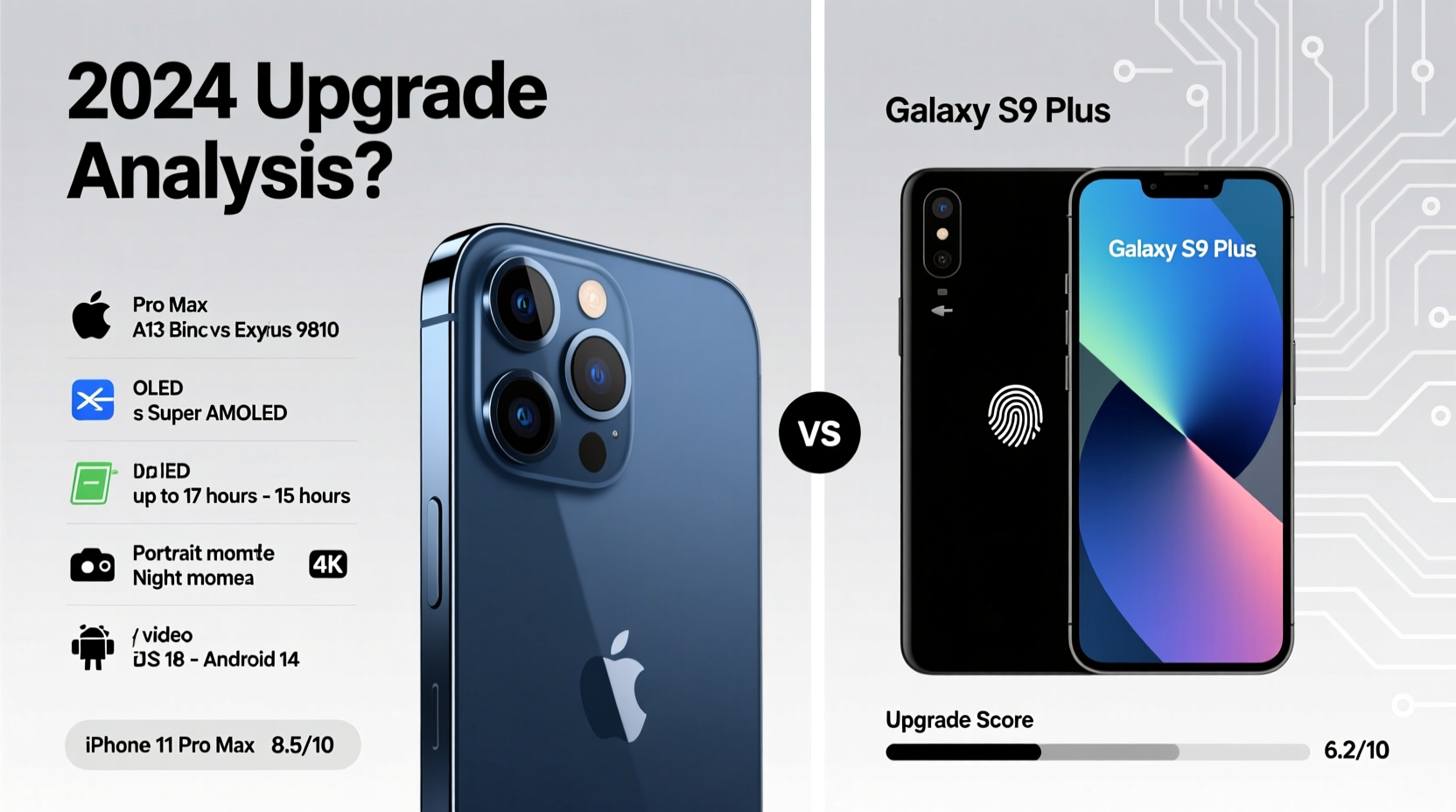
The Galaxy S9 Plus was powered by the Qualcomm Snapdragon 845 (or Exynos 9810, depending on region), a top-tier chipset in its time. Paired with 6GB of RAM, it handled multitasking and gaming well through 2021. However, by 2023, updates ceased, leaving the device without security patches or OS upgrades beyond Android 10.
In contrast, the iPhone 11 Pro Max runs Apple’s A13 Bionic chip—an architecture renowned for efficiency and sustained performance. Even in 2024, iOS 17 continues to support the device, offering new features, security updates, and optimized app performance. The combination of tight hardware-software integration and Apple’s longer support cycle gives the iPhone a clear edge in longevity.
For users still relying on the S9 Plus, slowdowns during app launches, delayed notifications, and compatibility issues with newer apps are common. The iPhone 11 Pro Max mitigates these problems thanks to ongoing optimization and faster processing across daily tasks like photo editing, web browsing, and navigation.
Camera Comparison: Low Light, Zoom, and Video Quality
Camera technology has evolved significantly since 2018. The S9 Plus featured a single 12MP rear sensor with variable aperture (f/1.5–f/2.4) and dual-pixel autofocus—a standout at launch. Its low-light performance was impressive for its era, but lacks computational photography enhancements standard today.
The iPhone 11 Pro Max introduced a triple-camera system: 12MP wide, ultra-wide, and telephoto lenses. More importantly, it leveraged Apple’s Deep Fusion and Night mode processing, dramatically improving dynamic range, noise reduction, and detail retention in dim lighting. For video, the iPhone supports 4K at 60fps with extended dynamic range and stereo audio recording—features absent on the S9 Plus.
“Even older iPhones outperform many modern mid-range phones in video stabilization and color accuracy due to Apple’s consistent processing pipeline.” — David Lin, Mobile Imaging Analyst at TechScope Weekly
In practical terms, the iPhone delivers crisper zoom (optical 2x, digital up to 10x), better portrait mode depth mapping, and more natural skin tones. While the S9 Plus holds up decently in daylight, indoor and nighttime shots reveal noticeable grain and over-sharpening compared to the richer, balanced output from the 11 Pro Max.
Battery Life and Charging: All-Day Usability Revisited
Battery degradation affects all smartphones after three+ years of use. The S9 Plus originally had a 3,500mAh battery, which under light usage could last a full day in 2018. By 2024, even with optimal charging habits, most units show reduced capacity—often below 70%—leading to frequent recharging.
The iPhone 11 Pro Max comes with a larger 3,969mAh battery and more efficient power management. In independent tests, it consistently achieves 8–10 hours of screen-on time, even with moderate to heavy usage. Additionally, iOS background app refresh controls reduce unnecessary drain.
| Feature | Galaxy S9 Plus | iPhone 11 Pro Max |
|---|---|---|
| Battery Capacity | 3,500 mAh | 3,969 mAh |
| Charging Speed | Fast charging (15W) | Fast charging (~18W with adapter) |
| Wireless Charging | Yes (Qi-compatible) | Yes (Qi-compatible) |
| Reverse Charging | No | No |
| Estimated Daily Use (2024) | 4–6 hrs screen time (degraded) | 7–9 hrs screen time |
Though peak charging speeds are similar, real-world endurance favors the iPhone. Users upgrading from a worn S9 Plus often report regaining confidence in leaving home without a portable charger.
Ecosystem Shift: Android to iOS Transition Challenges
Moving from Android to iOS isn’t just about hardware—it’s a shift in ecosystem logic. iMessage, FaceTime, iCloud Photos, and seamless AirDrop sharing with Macs or iPads create a tightly integrated experience. However, data migration can be tricky.
Contact transfer, message history, app preferences, and photo organization require careful planning. Google services remain functional on iOS, but integrations aren’t as smooth. For example, default calendar or reminder apps may not sync instantly, and some third-party apps behave differently.
Checklist: Preparing for Android-to-iOS Migration
- Back up all photos and videos to Google Photos or computer
- Ensure contacts are synced to Google account
- Download the “Move to iOS” app before setup
- Deactivate Samsung Smart Switch auto-backups to avoid conflicts
- Verify two-factor authentication methods for key accounts
- Prepare Apple ID and payment methods ahead of time
Once settled, iOS offers greater consistency across devices, fewer intrusive ads in free apps, and generally cleaner UI navigation. But muscle memory for gestures, settings layout, and notification handling takes adjustment.
Mini Case Study: Sarah’s Upgrade Decision
Sarah used her Galaxy S9 Plus daily for work and travel from 2018 to 2023. By early 2024, she noticed constant lag when switching between Zoom, Gmail, and Slack. Her battery died by noon, and night photos from family events looked blurry. After researching options, she considered buying a refurbished iPhone 11 Pro Max instead of a new mid-range Android phone.
She prioritized reliability, camera quality, and long-term support. Within a week of switching, she adapted to iOS gestures and appreciated the quieter notification system. The improved low-light photography allowed her to capture clearer memories, and the extra battery life meant less anxiety during commutes. Most importantly, receiving iOS 17 gave her confidence the phone would remain secure and functional into 2025.
Her verdict: yes, the upgrade was worthwhile—not because the iPhone 11 Pro Max is cutting-edge, but because it restored reliability and usability lost on her aging S9 Plus.
Frequently Asked Questions
Can the iPhone 11 Pro Max still run modern apps smoothly in 2024?
Yes. The A13 Bionic chip remains capable of handling most current apps, including social media, streaming, productivity tools, and even demanding games. While not ideal for future AAA mobile titles, everyday performance is fluid and responsive.
Is the Galaxy S9 Plus obsolete in 2024?
Functionally, yes. Without official software updates since 2021 and limited app optimizations for older Android versions, the S9 Plus struggles with modern security standards and app compatibility. It can serve as a backup or secondary device but isn’t recommended as a primary phone.
Does switching from Android to iPhone cause data loss?
Not if done correctly. Using Apple’s “Move to iOS” app during initial setup transfers contacts, messages, photos, and calendars securely. However, app data (like game progress) often doesn’t carry over unless backed up within the app itself.
Final Verdict: Is the Upgrade Worth It?
Upgrading from the Galaxy S9 Plus to the iPhone 11 Pro Max in 2024 isn’t about chasing the latest tech—it’s about reclaiming functionality. The S9 Plus, while once excellent, no longer meets basic expectations for speed, security, or camera performance. The iPhone 11 Pro Max, despite being a 2019 model, benefits from Apple’s extended software support, superior computational photography, and stronger day-to-day battery life.
If you’re holding onto an S9 Plus due to sentiment or cost concerns, consider a refurbished or second-hand iPhone 11 Pro Max. It offers a tangible improvement in user experience, security, and peace of mind. For those embedded in Google’s ecosystem, staying on Android with a newer device might make more sense—but simply refreshing hardware within the same platform won’t solve underlying obsolescence.




 浙公网安备
33010002000092号
浙公网安备
33010002000092号 浙B2-20120091-4
Comments
No comments yet. Why don't you start the discussion?