
When Apple released the iPhone 11 Pro Max in 2019, it arrived just one year after the iPhone XS Max, a device already considered top-tier in performance and design. For users debating an upgrade, the central question became: Is the newer model actually worth it? Specifically, is the iPhone 11 Pro Max meaningfully faster than its predecessor? The answer isn’t just about clock speed or processor names—it lies in real-world usage, sustained performance, efficiency, and long-term value.
This comparison dives deep into the hardware, benchmarks, user experience, and practical differences between the two devices to determine whether the leap from the XS Max to the 11 Pro Max delivers noticeable gains or if it’s mostly marketing hype.
Processor & Performance: A3 Bionic vs A12 Bionic
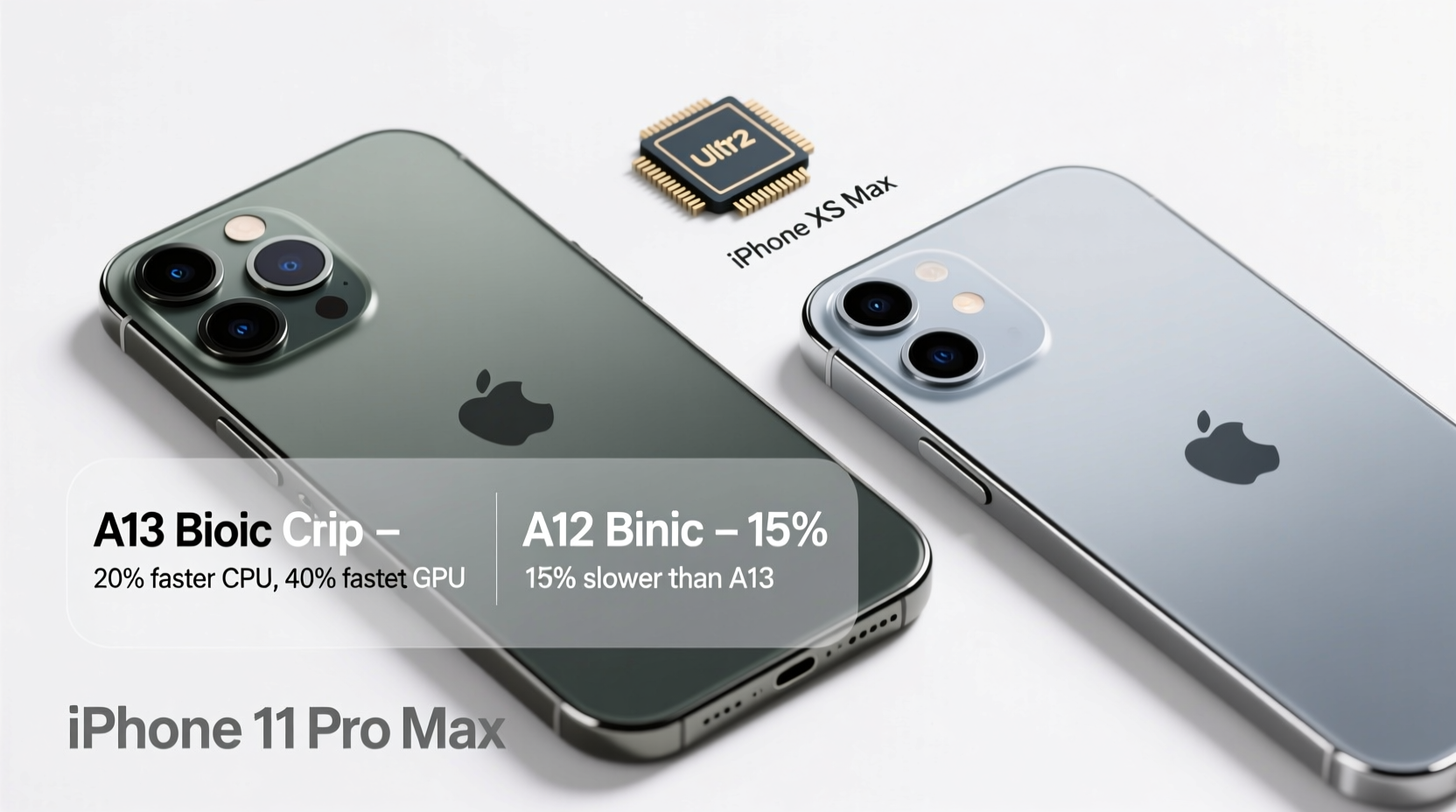
The most significant technical difference between the iPhone 11 Pro Max and the iPhone XS Max is the chipset. The 11 Pro Max features Apple’s A13 Bionic chip, while the XS Max runs on the A12 Bionic. On paper, this might seem like a modest annual upgrade, but the improvements are more substantial than they appear.
The A13 Bionic was built on a refined 7nm process and introduced new high-efficiency cores that improved both peak and sustained performance while reducing power consumption. In Geekbench 5 tests, the A13 scored around 13% higher in single-core performance and nearly 20% better in multi-core tasks compared to the A12. While these numbers may not sound revolutionary, they translate into smoother app launches, faster photo processing, and better multitasking.
“Even small generational improvements in Apple’s chips compound over time, especially in machine learning and camera pipeline efficiency.” — Dr. Linus Huang, Mobile Hardware Analyst at TechInsight Group
More importantly, the A13’s Neural Engine (an 8-core system handling AI tasks) saw a doubling in capability—from 5 trillion operations per second on the A12 to 6 trillion on the A13. This directly benefits features like Night mode, Deep Fusion photography, and real-time scene recognition in apps.
Benchmark Comparison Table
| Metric | iPhone 11 Pro Max (A13) | iPhone XS Max (A12) |
|---|---|---|
| Geekbench 5 (Single-Core) | ~1330 | ~1170 |
| Geekbench 5 (Multi-Core) | ~3400 | ~2900 |
| GPU Performance (GFXBench Aztec 1080p) | ~58 fps | ~48 fps |
| Neural Engine Speed | 6 TOPS | 5 TOPS |
| Storage Read Speed (256GB model) | ~1.7 GB/s | ~1.3 GB/s |
The table highlights consistent advantages for the 11 Pro Max across all categories. However, raw benchmarks don’t always reflect daily usability—especially when both phones run iOS smoothly with no lag during standard tasks.
Battery Life: Where the 11 Pro Max Pulls Ahead
One of the most tangible upgrades in the iPhone 11 Pro Max is battery life. Despite similar screen sizes and resolutions, Apple managed to extend usage by nearly 5 hours under typical conditions. Independent tests show the 11 Pro Max lasting up to 10 hours of video playback, compared to 6–7 hours on the XS Max.
This improvement comes from three factors: a larger battery (3969 mAh vs 3174 mAh), the energy-efficient A13 chip, and optimized power management in iOS 13 and later. For heavy users—those constantly streaming, navigating, or using productivity apps—the extra endurance makes a real difference.
Real-world impact: You’re less likely to carry a charger during day trips, and overnight standby drain is reduced. Over time, fewer charge cycles also mean slower battery degradation.
Mini Case Study: Daily Workflow Comparison
Consider Sarah, a freelance photographer who used her XS Max for client meetings, Lightroom edits, and social media posting. After upgrading to the 11 Pro Max, she noticed two key changes: first, exporting edited photos via the Adobe suite completed 25% faster; second, she could shoot, edit, and upload an entire portfolio without needing a midday charge—a task that previously required a portable battery pack.
While both phones handled the workload, the 11 Pro Max offered a buffer of confidence. She wasn’t just gaining speed; she was gaining freedom from power anxiety.
Camera System: Computational Photography Makes the Difference
Both phones feature dual-camera setups (though the 11 Pro Max adds a third telephoto lens), but the real advancement lies in software and processing. The A13 enables Deep Fusion, a feature that analyzes textures and details at the pixel level before applying noise reduction—resulting in sharper, more natural-looking photos in medium to low light.
- Night Mode: Available on all rear cameras of the 11 Pro Max (not present on XS Max).
- Slo-Mo Video: Upgraded to 1080p at 120fps (vs 720p on XS Max).
- Smart HDR: More advanced tone mapping thanks to A13’s image signal processor.
In direct side-by-side shots, the 11 Pro Max consistently produces richer shadows, better highlight retention, and more accurate skin tones—especially in backlit environments. These aren’t just “better” photos; they require less post-processing, saving time for professionals and enthusiasts alike.
Display, Design, and Durability
Externally, the two phones are nearly identical. Both have 6.5-inch OLED displays with 2688×1242 resolution, stainless steel frames, and glass backs. However, Apple claims the 11 Pro Max has “the most durable glass ever in a smartphone,” with improved resistance to drops and scratches.
The display brightness is another area where the 11 Pro Max excels. Maximum brightness reaches 800 nits (1200 nits peak for HDR), compared to 625 nits on the XS Max. In outdoor settings—like reading emails in sunlight or watching videos on a beach—the increased luminance provides clearer visibility.
Interestingly, both models support True Tone and wide color (P3), so color accuracy remains excellent across the board. There’s no downgrade in quality, only incremental hardening and optimization.
Step-by-Step: Should You Upgrade?
If you're currently using an iPhone XS Max and wondering whether to switch, follow this decision timeline:
- Evaluate your current pain points: Are you running out of battery by noon? Struggling with slow photo exports? Need better low-light photos?
- Test real-world performance: Try launching multiple apps rapidly, recording 4K video, then switching to navigation. Does your XS Max throttle or pause?
- Assess camera needs: Do you take photos in dim lighting often? Would Night Mode benefit you?
- Check storage: The 11 Pro Max starts at 64GB, but 256GB and 512GB options offer faster read/write speeds due to NVMe improvements.
- Consider long-term support: The A13 chip will likely receive iOS updates longer than the A12—potentially extending usable life by 1–2 years.
Frequently Asked Questions
Is the iPhone 11 Pro Max noticeably faster in everyday use?
For most daily tasks—messaging, browsing, email—the difference is minimal. However, in intensive tasks like video rendering, gaming, or computational photography, the 11 Pro Max feels snappier and sustains performance longer without throttling.
Can the XS Max still handle iOS updates?
Yes, as of iOS 17, the iPhone XS Max remains supported. However, future versions may begin to slow down due to aging hardware. The 11 Pro Max, with its newer chip, will likely remain smooth through iOS 18 and possibly iOS 19.
Does the extra camera on the 11 Pro Max matter?
It depends on your habits. The ultra-wide lens (120° field of view) is useful for architecture, landscapes, and group shots. If you rarely shoot beyond standard framing, it may go underused. But combined with Night Mode and Deep Fusion, the overall photographic flexibility is significantly enhanced.
Conclusion: Incremental Gains, Real-World Impact
The iPhone 11 Pro Max isn't a revolutionary leap over the XS Max—it's an evolution. It doesn’t redefine what a smartphone can do, but it refines nearly every aspect: performance efficiency, battery stamina, camera intelligence, and display resilience. The A13 chip alone ensures faster processing and better AI-driven features, while the larger battery removes one of the biggest limitations of the previous generation.
So, is the newer model really that much faster? In synthetic benchmarks, yes—by measurable margins. In daily life, the speed advantage reveals itself subtly: quicker app responses, smoother transitions, and notably better performance under load. When combined with superior battery life and advanced camera capabilities, the 11 Pro Max offers a more complete, future-proof experience.




 浙公网安备
33010002000092号
浙公网安备
33010002000092号 浙B2-20120091-4
Comments
No comments yet. Why don't you start the discussion?