
When Apple introduced the iPhone 12 Mini, it reignited a long-standing debate in the smartphone world: should you prioritize size and convenience, or compromise on compactness for superior camera performance? For users torn between the iPhone 11 Pro and the iPhone 12 Mini, this decision isn’t just about specs—it’s about lifestyle. The 11 Pro offered a professional-grade triple-camera system and a slightly larger form factor, while the 12 Mini brought back true one-handed usability with modern internals. But at what cost?
This article breaks down the real-world trade-offs between these two devices, focusing on how the camera downgrade impacts daily use, whether the smaller size enhances usability, and who should ultimately choose which phone.
Design and Usability: The Case for Compactness
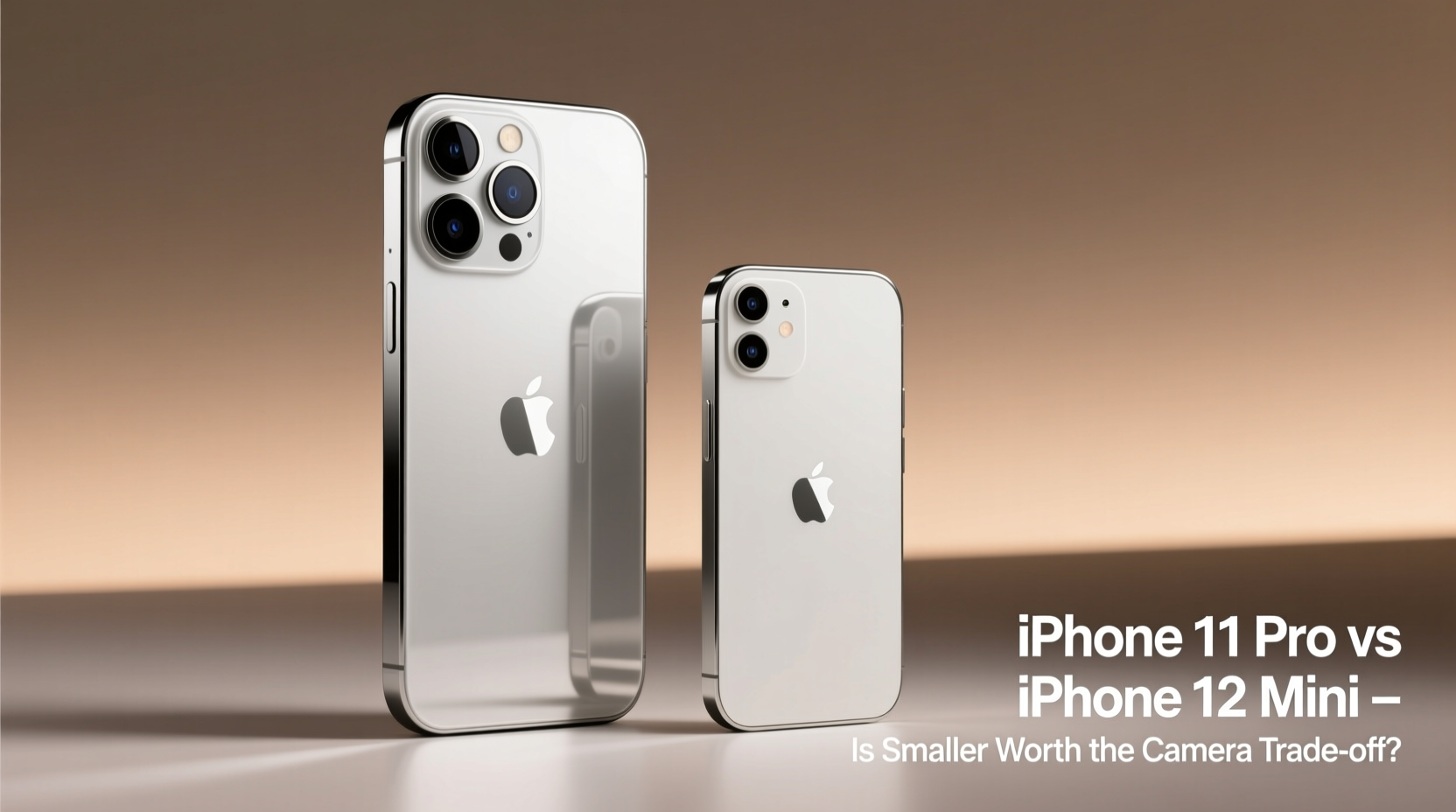
The iPhone 12 Mini measures 5.18 x 2.53 x 0.29 inches and weighs just 4.76 ounces. In contrast, the iPhone 11 Pro is slightly larger at 5.67 x 2.81 x 0.31 inches and weighs 6.84 ounces. While the differences may seem minor on paper, they translate into a noticeably more pocketable and lightweight experience with the 12 Mini.
For users with smaller hands, those who frequently use their phones one-handed, or commuters who value minimalism, the 12 Mini’s size is a significant advantage. It slips easily into tight pockets, requires less stretching to reach screen edges, and feels less fatiguing during extended use.
However, the 11 Pro’s larger body accommodates a bigger battery and offers more screen real estate—benefits that shouldn’t be dismissed. The Super Retina XDR display on the 12 Mini is technically superior (OLED vs OLED), but its 5.4-inch screen is still smaller than the 11 Pro’s 5.8-inch panel. For media consumption or multitasking, the difference is tangible.
Camera Comparison: What You’re Giving Up
The most critical difference lies in the camera systems. The iPhone 11 Pro features a triple-lens setup: 12MP wide, 12MP ultra-wide, and 12MP telephoto with 2x optical zoom. This configuration allows for greater creative control, better low-light performance via Deep Fusion, and consistent portrait quality across all lenses.
The iPhone 12 Mini, despite being newer, uses a dual-camera system: 12MP wide and 12MP ultra-wide. It lacks the dedicated telephoto lens, meaning no native 2x zoom. Instead, digital zoom is used beyond 1x, resulting in reduced detail and clarity when cropping in.
“While computational photography has narrowed the gap, having a physical telephoto lens still matters for framing flexibility and image fidelity.” — David Kim, Mobile Photography Analyst at TechLens
In practical terms, the 12 Mini performs well in daylight and handles Night mode effectively, but struggles in situations where zoom or depth variation is needed—think concerts, wildlife, or portraits from a distance. The absence of a telephoto lens means users must physically move closer, which isn’t always possible.
Key Camera Differences Summary
| Feature | iPhone 11 Pro | iPhone 12 Mini |
|---|---|---|
| Rear Cameras | Triple: Wide, Ultra-Wide, Telephoto | Dual: Wide, Ultra-Wide |
| Optical Zoom | 2x zoom in, 2x zoom out | 1x only (digital beyond) |
| Night Mode | Available on all rear cameras | Available on wide and ultra-wide |
| Deep Fusion | Yes (all lenses) | Yes (improved processing) |
| Sensor Size | Slightly smaller sensors | Larger pixels on wide sensor |
The 12 Mini does bring improvements: a larger wide sensor with better low-light sensitivity and Dolby Vision HDR video recording up to 4K/30fps—something the 11 Pro lacks. So while it sacrifices telephoto versatility, it gains in dynamic range and video capabilities.
Battery Life and Performance Trade-Offs
Despite its smaller size, the 12 Mini runs on the faster A14 Bionic chip, offering around 15–20% better CPU and GPU performance than the 11 Pro’s A13. Apps launch quicker, multitasking is smoother, and AR experiences are more responsive.
But power efficiency doesn’t overcome physics. The 12 Mini’s battery capacity is approximately 2,278 mAh compared to the 11 Pro’s 3,046 mAh. Real-world usage shows the 12 Mini lasting about 10–11 hours of mixed screen time, whereas the 11 Pro can stretch to 13–14 hours under similar conditions.
If you're someone who travels frequently, works remotely, or dislikes charging midday, this difference matters. The 12 Mini may require a top-up by late afternoon, especially with 5G enabled. The 11 Pro, while not exceptional by today’s standards, provides more breathing room.
Mini Case Study: Urban Commuter Choosing Between Models
Take Sarah, a graphic designer living in Manhattan. She walks everywhere, uses her phone for navigation, messaging, and occasional client calls. She values a phone that fits in her coat pocket without adding weight. She rarely takes zoomed-in photos but often snaps quick shots of inspiration—street art, color palettes, typography.
Sarah tested both phones. She loved the 11 Pro’s camera flexibility but found it cumbersome in tight subway spaces. The 12 Mini felt effortless to pull out and stow, and its camera was sufficient for her casual needs. After two weeks, she chose the 12 Mini—not because it was objectively better, but because it aligned with her mobility-first lifestyle.
When the Size Advantage Outweighs the Camera Downgrade
The core question isn’t technical—it’s behavioral. Ask yourself: do you actively use optical zoom or shoot in varied lighting conditions often enough to justify a larger, heavier phone?
- If you photograph pets, kids, or events from a distance, the 11 Pro’s telephoto lens adds real value.
- If your photography is mostly social media updates, scans, or indoor snapshots, the 12 Mini’s camera is more than capable.
- If you prioritize comfort during long calls or reading sessions, the 11 Pro’s larger screen helps reduce eye strain.
- If you hate bulky pockets or wear tight clothing, the 12 Mini’s footprint is a game-changer.
Checklist: Should You Choose the iPhone 12 Mini Over the 11 Pro?
- ✅ Do you prefer one-handed operation?
- ✅ Is pocket space limited or important to you?
- ✅ Do you rarely use zoomed-in photography?
- ✅ Are you comfortable charging your phone twice a day if needed?
- ✅ Do you value modern features like 5G and Dolby Vision video?
- ❌ Do you frequently take portraits or distant subjects?
- ❌ Do you rely on long battery life throughout the workday?
If you answered “yes” to the first five and “no” to the last two, the 12 Mini likely suits your needs—even with the camera compromise.
Frequently Asked Questions
Can the iPhone 12 Mini match the 11 Pro’s photo quality in daylight?
In standard wide-angle shots, yes. The 12 Mini’s improved sensor and Smart HDR 3 often produce sharper, more vibrant images in good light. However, once you move beyond 1x zoom or enter low-light environments, the 11 Pro’s additional lens and larger sensor give it an edge.
Is the lack of a telephoto lens a dealbreaker?
It depends on usage. Casual photographers will rarely miss it. Enthusiasts who compose with zoom or avoid cropping will find its absence limiting. Third-party apps can't replicate optical zoom—software enhancements only go so far.
Does the 12 Mini feel outdated in 2024?
Not functionally. It runs iOS 17 smoothly and supports most current apps. However, it won’t receive updates beyond 2025, and repair costs are rising due to diminishing part availability. Consider longevity if you plan to keep your phone for three years or more.
Final Verdict: Balancing Priorities
The iPhone 12 Mini isn’t objectively better than the 11 Pro—but for the right user, its compact design justifies the camera downgrade. Technology serves people, not the other way around. If your daily routine rewards portability, comfort, and simplicity, then sacrificing a telephoto lens is a reasonable trade-off.
Conversely, if you value photographic flexibility, longer battery life, and a larger viewing area, the 11 Pro remains a compelling option, even as a used or refurbished device.
Ultimately, this choice reflects personal priorities. There’s no universal answer—only the one that aligns with how you live, work, and create.




 浙公网安备
33010002000092号
浙公网安备
33010002000092号 浙B2-20120091-4
Comments
No comments yet. Why don't you start the discussion?