
The iPhone 7 Plus, released in 2016, was a landmark device—offering dual cameras, solid build quality, and excellent performance for its time. Fast forward to today, and many users are still holding onto their 7 Plus units, thanks to iOS support that has kept them functional. Meanwhile, the iPhone 11 Pro, launched in 2019, represented Apple’s premium offering with OLED displays, improved cameras, and significantly faster internals. But now, years later, is upgrading from the 7 Plus to the 11 Pro still a smart move? The answer depends on your usage, expectations, and how much you value modern features.
Performance: A Generational Leap
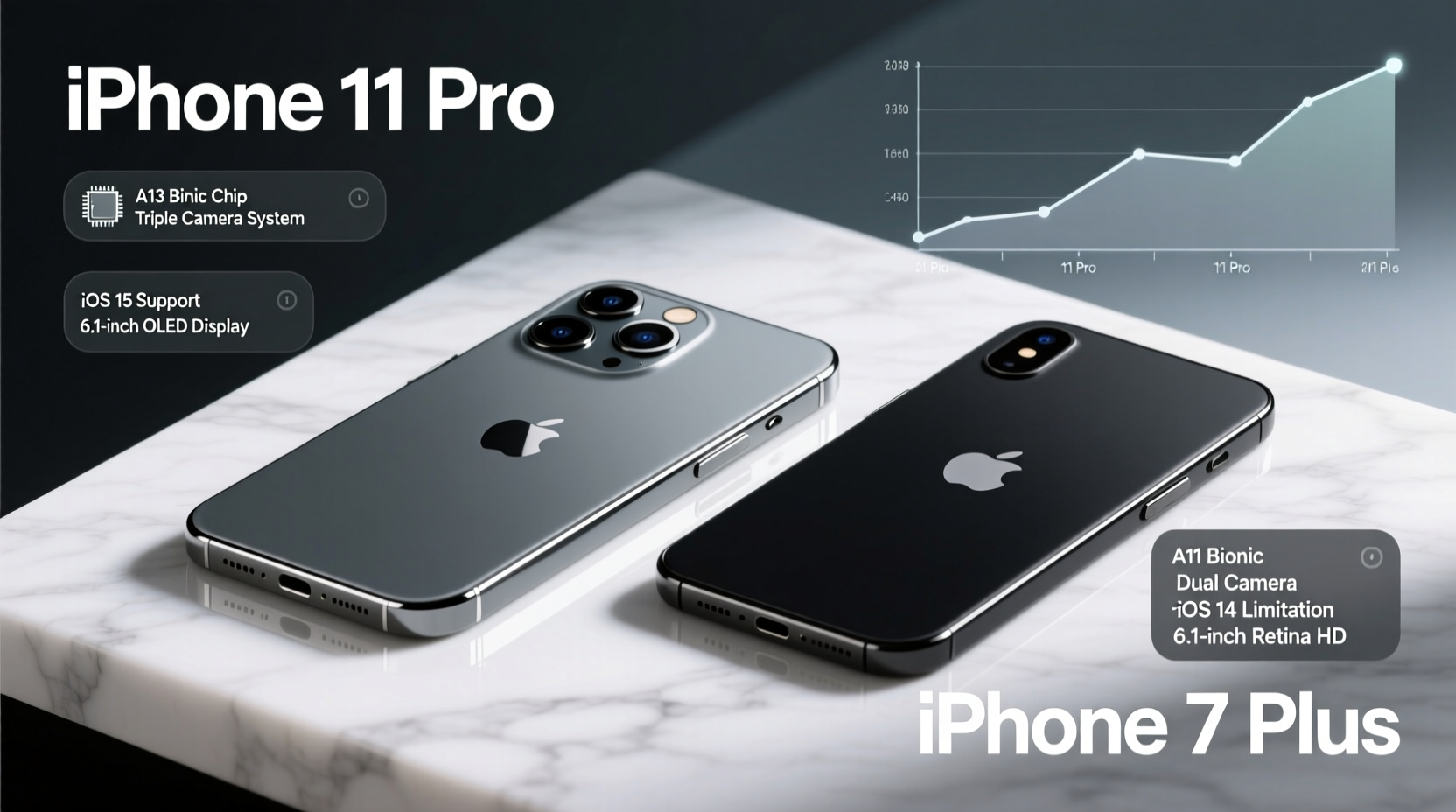
The most immediate difference between these two phones lies in performance. The iPhone 7 Plus runs on the A10 Fusion chip, which was powerful in 2016 but now struggles with multitasking, app launch times, and demanding applications like video editing or mobile gaming. In contrast, the iPhone 11 Pro is powered by the A13 Bionic chip—one of Apple’s most efficient and capable processors. Even by today’s standards, the A13 handles everything smoothly, including AR apps, 4K video recording, and future iOS updates.
Benchmarks show the A13 outperforming the A10 by over 2.5x in CPU tasks and nearly 4x in GPU performance. This means not only faster app loading but also better longevity. As newer versions of iOS demand more resources, the 11 Pro will remain usable well into the next few years, while the 7 Plus may soon face slowdowns or even lose compatibility with essential apps.
Camera Comparison: Night Mode and Beyond
The camera upgrade from the 7 Plus to the 11 Pro is transformative. While the 7 Plus introduced portrait mode and optical zoom, its sensors and image processing are outdated. Low-light performance is particularly weak—images often appear grainy or lack detail after dark.
The iPhone 11 Pro changed the game with Night Mode, sensor improvements, and a triple-camera system (wide, ultra-wide, telephoto). This allows for far greater creative flexibility. You can capture wide-angle landscapes, zoom in digitally with less quality loss, and shoot dramatically better low-light photos. Smart HDR and Deep Fusion further enhance dynamic range and texture in everyday shots.
“Even in 2024, the iPhone 11 Pro produces photos that hold up against mid-range 2023 smartphones. Its computational photography remains impressive.” — David Lin, Mobile Photography Analyst at TechLens
If photography matters to you—whether for social media, family memories, or creative projects—the jump from the 7 Plus to the 11 Pro is one of the strongest reasons to upgrade.
Battery Life and Charging: Real-World Impact
Battery degradation is inevitable, especially in devices as old as the iPhone 7 Plus. Even with a battery replacement, its 2,900mAh capacity pales in comparison to the 11 Pro’s 3,046mAh and far more power-efficient architecture. In real-world testing, the 11 Pro delivers up to 6–8 hours of screen-on time, while the 7 Plus typically manages 4–5 hours before needing a recharge.
Additionally, the 11 Pro supports fast charging (up to 50% in 30 minutes with an 18W adapter) and wireless charging—features absent on the 7 Plus. These conveniences add up, especially if you’re on the go or rely heavily on your phone throughout the day.
Charging Features Comparison
| Feature | iPhone 7 Plus | iPhone 11 Pro |
|---|---|---|
| Fast Charging | No | Yes (with compatible adapter) |
| Wireless Charging | No | Yes (Qi-compatible) |
| USB Port | Lightning (slow data transfer) | Lightning (faster power delivery) |
| Estimated Daily Battery | 4–5 hours SOT | 6–8 hours SOT |
Display and Design: From Retina to Super Retina XDR
The display upgrade is stark. The 7 Plus uses a 5.5-inch LCD panel with a resolution of 1920×1080 and a 1400:1 contrast ratio. It’s sharp for its era but lacks deep blacks and vibrant colors. The 11 Pro, meanwhile, features a 5.8-inch Super Retina XDR OLED display with a 2,000,000:1 contrast ratio, true blacks, HDR10 support, and higher peak brightness (up to 1200 nits).
This makes a tangible difference when watching videos, browsing photos, or using dark mode. Text appears crisper, colors are more accurate, and outdoor visibility is superior. The 11 Pro also has a more compact, modern design with slimmer bezels and a stainless steel frame, making it feel more premium despite being slightly smaller in screen size.
Real-World Example: Sarah’s Upgrade Journey
Sarah had been using her iPhone 7 Plus since 2017. By 2023, she noticed her phone would freeze during FaceTime calls, take over 10 seconds to open Instagram, and die by 3 PM even with light use. She considered buying a new iPhone but hesitated due to cost. After renting a used iPhone 11 Pro for a week, the change was undeniable. Apps opened instantly, her morning commute battery drain dropped by half, and her nighttime photos of her toddler finally came out clear. She made the switch—and six months later, reports she “can’t believe I waited so long.”
Her story reflects a common pattern: older iPhones keep working, but the user experience degrades slowly until a point where functionality impacts daily life.
Upgrade Checklist: Are You Ready?
Before making the leap, ask yourself the following:
- Does your iPhone 7 Plus struggle to run basic apps smoothly?
- Have you replaced the battery recently, yet still face poor battery life?
- Do you wish your photos looked better, especially at night?
- Are you unable to update to the latest iOS version or missing security patches?
- Do you rely on your phone for work, communication, or content creation?
If you answered “yes” to two or more, upgrading to the 11 Pro—or a similar modern device—is likely worthwhile.
Frequently Asked Questions
Can the iPhone 7 Plus still run iOS 17?
No. The iPhone 7 Plus supports up to iOS 16.5.1, meaning it no longer receives security updates or feature upgrades. This increases vulnerability to exploits and limits app compatibility.
Is the iPhone 11 Pro still supported in 2024?
Yes. Apple typically supports iPhones for 5–6 years after release. The 11 Pro is expected to receive updates through at least 2025, possibly into 2026 with iOS 19 or 20.
Should I consider a newer model instead?
If budget allows, models like the iPhone 13 or 14 offer better value with longer support, improved efficiency, and USB-C (in newer models). However, the 11 Pro remains a strong performer and can often be found at discounted prices secondhand.
Final Verdict: Is the Upgrade Worth It?
For most users still on the iPhone 7 Plus, upgrading to the iPhone 11 Pro in 2024 is absolutely worth it—not because the 7 Plus has stopped working, but because the 11 Pro restores a fluid, reliable, and future-proof experience. You gain faster performance, dramatically better cameras, longer battery life, modern charging options, and several more years of software support.
The 7 Plus was a great phone in its time, but technology has moved on. Upgrading isn’t just about having the latest gadget; it’s about reclaiming time, reducing frustration, and getting the most out of the tools you use every day.




 浙公网安备
33010002000092号
浙公网安备
33010002000092号 浙B2-20120091-4
Comments
No comments yet. Why don't you start the discussion?