
For many long-time iPhone users, the jump from the iPhone 6 Plus to the iPhone 11 Pro isn’t just about newer hardware—it’s a generational shift in design, performance, and user experience. While screen size is often a key consideration when upgrading, especially for those who value media consumption and readability, focusing solely on display dimensions misses the broader picture. The iPhone 11 Pro brings far more than a slightly smaller screen; it delivers advancements in processing power, camera technology, battery efficiency, and software support that fundamentally change how you interact with your device.
The iPhone 6 Plus, released in 2014, was revolutionary at the time for introducing Apple’s first large-screen flagship. Its 5.5-inch LCD panel set the stage for the “phablet” era. Fast forward five years, and the iPhone 11 Pro arrived with a 5.8-inch Super Retina XDR OLED display—smaller in diagonal measurement but vastly superior in quality. So, is the upgrade worth it if screen size is your primary concern? The short answer: not necessarily. But once you look beyond inches, the case for upgrading becomes compelling.
Display Quality: Size vs. Substance
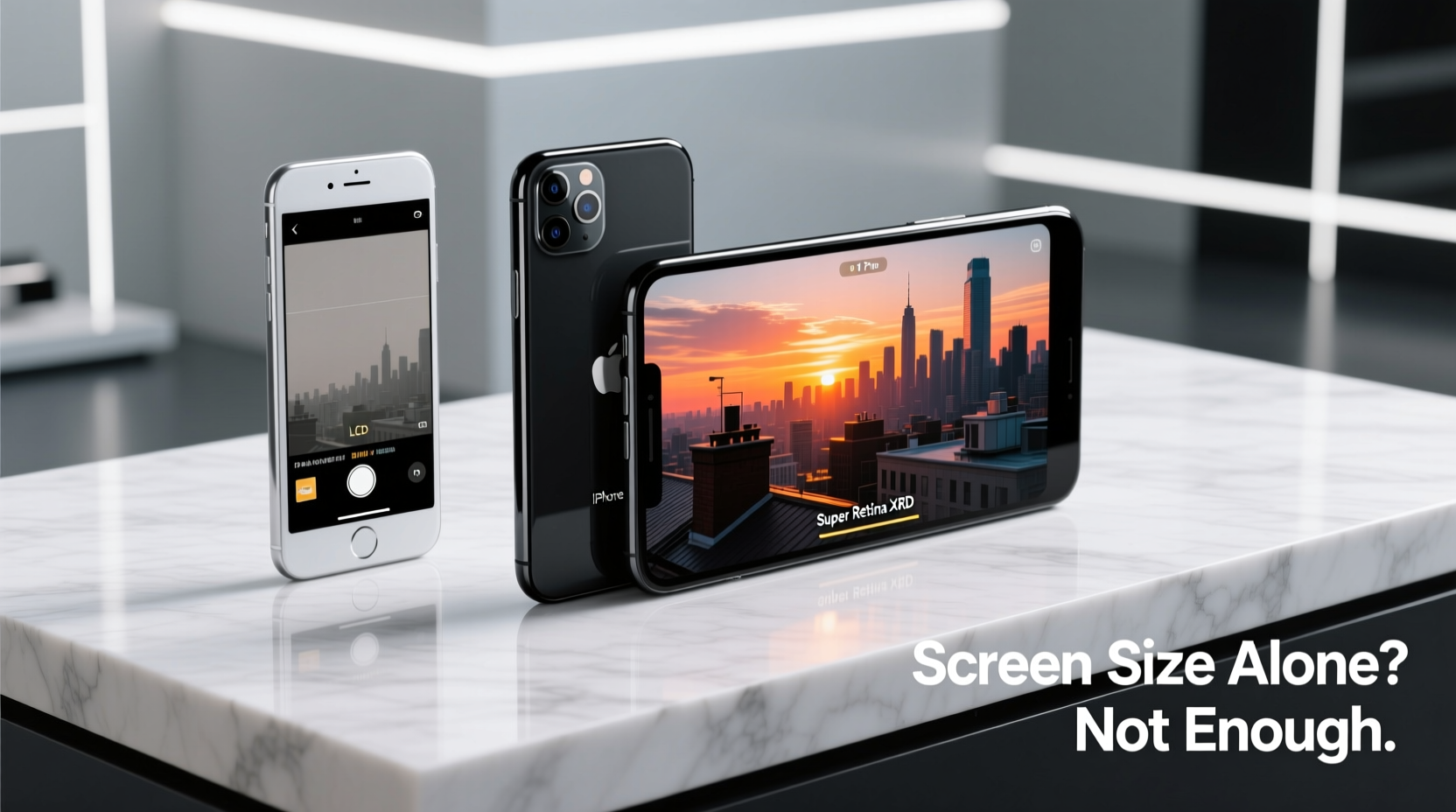
At first glance, the iPhone 11 Pro has a marginally smaller screen (5.8 inches) compared to the 6 Plus (5.5 inches). However, this comparison is misleading without considering resolution, pixel density, contrast, and color accuracy. The 6 Plus uses an LCD panel with a resolution of 1920x1080 (401 ppi), while the 11 Pro features a 2436x1125 OLED display with 458 ppi. More importantly, OLED technology enables true blacks, higher contrast ratios (up to 2,000,000:1), and better brightness levels—peaking at 1200 nits for HDR content.
This means that even though the 11 Pro’s screen is technically larger in usable area due to minimal bezels and no home button, the visual experience is dramatically sharper and more immersive. Text appears crisper, videos have deeper blacks, and photos pop with richer colors. For users who consume a lot of video or read extensively on their phones, the quality leap matters far more than the fractional increase in screen real estate.
Performance and Real-World Speed
The difference in processors between these two devices is nothing short of transformative. The iPhone 6 Plus runs on the Apple A8 chip—a 1.4GHz dual-core processor with 1GB of RAM. By today’s standards, it struggles with multitasking, modern apps, and even basic web browsing when multiple tabs are open. In contrast, the iPhone 11 Pro features the A13 Bionic chip, one of the fastest mobile processors of its time, with a six-core CPU, four-core GPU, and dedicated neural engine.
In practical terms, this means near-instant app launches, smooth scrolling through social media feeds, seamless photo and video editing, and reliable performance in graphics-intensive games. Apps that may crash or lag on the 6 Plus run flawlessly on the 11 Pro. iOS updates also play a role: the 6 Plus topped out at iOS 12, missing out on critical security patches and new features introduced in iOS 13 and later. The 11 Pro supports iOS 17 and will likely receive updates into 2025.
“Hardware longevity isn’t just about how long a phone lasts physically—it’s about how long it remains useful. The A13 Bionic ensures the 11 Pro stays relevant years after release.” — David Kim, Mobile Technology Analyst at TechInsight Group
Camera Capabilities: Night Mode, Zoom, and Computational Photography
If you take photos regularly, the camera upgrade alone justifies moving from the 6 Plus to the 11 Pro. The 6 Plus has a single 8MP rear camera with basic autofocus and LED flash. It lacks optical image stabilization for video, performs poorly in low light, and offers no portrait mode or depth control. The front-facing camera is 1.2MP—barely adequate for video calls by today’s standards.
The iPhone 11 Pro, meanwhile, features a triple-camera system: 12MP wide, ultra-wide, and telephoto lenses. It introduces Night mode for dramatically improved low-light photography, Deep Fusion for enhanced texture and detail, and Smart HDR for balanced exposure. You can shoot 4K video at 60fps, record spatial audio, and edit photos with professional-grade controls. The front camera jumps to 12MP with 4K video and slow-motion capabilities.
For someone used to the limitations of the 6 Plus, the 11 Pro feels like stepping into a new era of mobile photography. Whether capturing family moments, travel memories, or creative projects, the improvement is immediately noticeable.
Comparison Table: Key Differences at a Glance
| Feature | iPhone 6 Plus | iPhone 11 Pro |
|---|---|---|
| Release Year | 2014 | 2019 |
| Screen Size | 5.5 inches (LCD) | 5.8 inches (OLED) |
| Resolution | 1920×1080 | 2436×1125 |
| Processor | A8 | A13 Bionic |
| Rear Cameras | 8MP (Single) | 12MP (Triple: Wide, Ultra-Wide, Telephoto) |
| Front Camera | 1.2MP | 12MP |
| Battery Life | Up to 12 hours talk time | Up to 20 hours video playback |
| iOS Support | Up to iOS 12 | Up to iOS 17 (and beyond) |
| Water Resistance | No official rating | IP68 (up to 4m for 30 mins) |
Real-World Example: Sarah’s Upgrade Journey
Sarah had been using her iPhone 6 Plus since 2015. She loved the large screen for reading news and watching YouTube, but over time, she noticed her phone slowing down. Apps froze, photos took seconds to load, and her battery died by mid-afternoon. She hesitated to upgrade because she feared the 11 Pro would feel too small. When she finally tested it in-store, she was surprised. Despite the similar footprint, the edge-to-edge display made it feel roomier. More importantly, everything responded instantly. She could take sharp night photos of her kids’ soccer games, edit videos on the go, and leave her charger at home without anxiety. Within a week, she realized the upgrade wasn’t about screen size—it was about reclaiming time, confidence, and functionality.
Is the Screen Size Worth the Upgrade?
If your sole reason for upgrading is a bigger screen, the iPhone 11 Pro might disappoint. At 5.8 inches, it's only fractionally larger than the 6 Plus—and with thinner bezels, the overall device is actually more compact. However, if you value screen *quality*, the 11 Pro wins decisively. OLED delivers better contrast, truer blacks, and higher brightness, making it ideal for streaming, photo editing, and outdoor visibility.
Moreover, screen usability isn’t just about size. The 11 Pro’s gesture-based navigation, faster refresh response, and True Tone technology adapt to your environment, reducing eye strain and improving comfort during extended use. In this sense, the upgrade enhances screen *experience* rather than just dimensions.
Upgrade Checklist: Are You Ready for the 11 Pro?
- ✅ Is your iPhone 6 Plus running iOS 12 or earlier?
- ✅ Do apps frequently crash or run slowly?
- ✅ Is your battery life under 50% health?
- ✅ Do you want better low-light photos or 4K video?
- ✅ Do you need modern security updates and app compatibility?
- ✅ Are you frustrated by lack of water resistance or storage limits?
If you answered yes to three or more, the upgrade makes strong practical sense—even if screen size isn’t increasing.
Frequently Asked Questions
Can the iPhone 11 Pro last all day on a single charge?
Yes. Under normal usage—including messaging, browsing, email, and moderate video playback—the iPhone 11 Pro typically lasts a full day. Heavy users may need a top-up, but it significantly outperforms the 6 Plus, which often requires midday charging.
Will my accessories work with the 11 Pro?
Most Lightning cables and wireless chargers are compatible. However, cases designed for the 6 Plus won’t fit due to different dimensions, camera layout, and lack of home button. You’ll need new accessories.
Is the iPhone 11 Pro still supported in 2024?
Yes. The 11 Pro received iOS 17 in 2023 and continues to receive security updates. While future iOS versions may eventually drop support, it remains fully functional and secure as of 2024.
Final Thoughts: Beyond the Inches
Choosing whether to upgrade from the iPhone 6 Plus to the iPhone 11 Pro based solely on screen size overlooks what truly defines a modern smartphone experience. Yes, the physical display is only slightly larger, but the improvements in clarity, responsiveness, durability, and functionality create a device that feels entirely different in daily use. It’s faster, safer, more capable, and built to keep up with your life—not hold you back.
Technology evolves not just in size, but in intelligence, efficiency, and integration. The iPhone 11 Pro represents a quantum leap in nearly every category that affects real-world usability. If you’ve held onto your 6 Plus out of comfort or habit, now may be the time to embrace a device that doesn’t just show more pixels—but does more with them.




 浙公网安备
33010002000092号
浙公网安备
33010002000092号 浙B2-20120091-4
Comments
No comments yet. Why don't you start the discussion?