
When Apple launched the iPhone 11 series in 2019, it introduced a clear tiered lineup: the standard iPhone 11, the iPhone 11 Pro, and the larger iPhone 11 Pro Max. While all three share core features like the A13 Bionic chip and Face ID, the differences in camera systems, display quality, battery life, and build materials create meaningful distinctions. For many buyers, the question isn’t just about specs—it’s about value. Is the jump to the Pro Max worth the extra cost, or does the base iPhone 11 offer enough for most users?
The answer depends on how you use your phone. Casual users who prioritize longevity, simplicity, and value may find the iPhone 11 more than sufficient. Meanwhile, professionals, photographers, and power users might benefit from the Pro Max’s advanced capabilities. Let’s break down the real-world differences to determine whether the Pro Max is overkill—or an essential upgrade.
Design and Build: Glass, Stainless Steel, and Grip
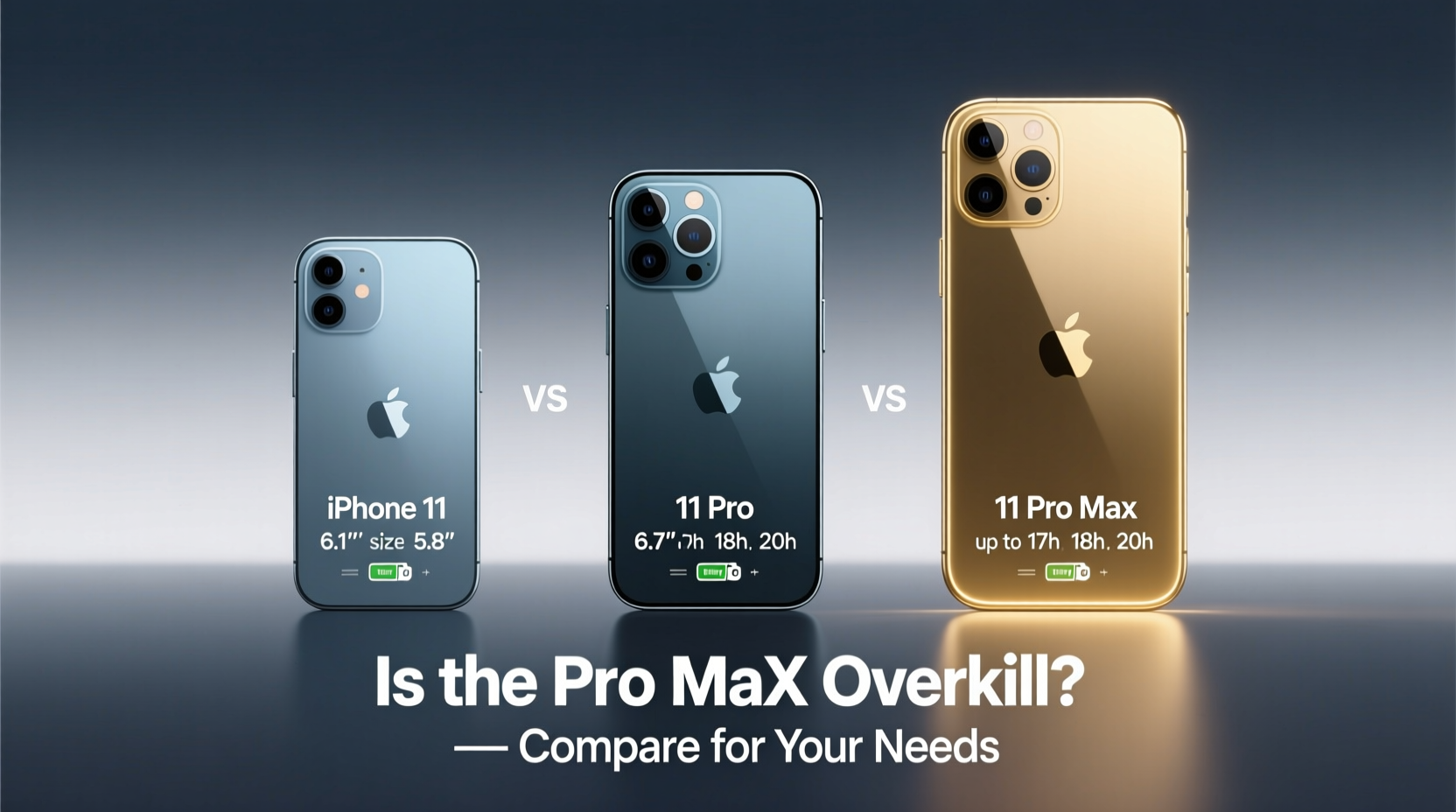
All three models feature glass front and back with aluminum (iPhone 11) or surgical-grade stainless steel (Pro models) frames. The iPhone 11 uses matte-finish glass, while the Pro variants have a textured matte finish that resists fingerprints better. The Pro and Pro Max also feel noticeably heavier due to the metal frame—188g compared to the iPhone 11’s 194g—though the difference is subtle in hand.
The screen size increases progressively: 6.1 inches on the iPhone 11, 5.8 inches on the 11 Pro, and 6.5 inches on the 11 Pro Max. Despite the smaller screen, the 11 Pro feels denser and more compact than the base model. The Pro Max offers the largest canvas, ideal for media consumption and multitasking, but its size can be unwieldy for one-handed use.
Display Quality: OLED vs LCD – A Noticeable Difference
This is where the Pro models pull ahead decisively. The iPhone 11 uses a Liquid Retina HD LCD display, while both Pro models feature Super Retina XDR OLED displays. OLED brings deeper blacks, higher contrast ratios (up to 2,000,000:1), and better color accuracy. HDR content on platforms like Netflix or YouTube looks dramatically sharper and more immersive on the Pro screens.
Brightness is another differentiator. The Pro models peak at 1200 nits for HDR content, compared to 625 nits on the iPhone 11. In direct sunlight, the Pro displays remain far more legible. For anyone who spends significant time outdoors or consumes a lot of video, this is a tangible improvement.
“OLED isn’t just a spec bump—it changes how you experience photos, videos, and even text. Once you go Pro, going back feels like a downgrade.” — David Lin, Mobile Display Analyst at TechPulse Insights
Camera Comparison: Triple Lens vs Dual – Do You Need the Extra Lens?
The iPhone 11 has a dual-camera system: 12MP wide and 12MP ultra-wide. The 11 Pro and 11 Pro Max step up with a triple-camera array: adding a 12MP telephoto lens. This enables 2x optical zoom out and 2x zoom in (4x total), along with improved low-light performance thanks to Night mode on all three lenses.
In practical terms, the telephoto lens adds versatility. Capturing distant subjects without digital zoom degradation matters for travel, events, or wildlife photography. Portrait mode also benefits from more depth control and lighting effects. However, for everyday snapshots, social media posts, and casual photography, the iPhone 11’s camera performs exceptionally well.
Video quality is identical across all models—4K at 60fps, extended dynamic range, and excellent stabilization. If you’re not editing professionally or sharing high-resolution content, the base model holds its own.
Real Example: Travel Photographer’s Dilemma
Sophia, a freelance travel blogger, used the iPhone 11 for six months before upgrading to the 11 Pro Max. On a trip to Iceland, she found herself constantly cropping into landscape shots taken on her 11, losing detail. With the Pro Max, she used the telephoto lens to capture distant waterfalls and wildlife without compromising composition. For her workflow—posting to Instagram, blogs, and client portfolios—the extra lens paid off. But for weekend outings or city walks, she admitted the iPhone 11 would’ve sufficed.
Battery Life: Where the Pro Max Truly Shines
Battery endurance is one of the strongest arguments for the Pro Max. Apple rated it for up to 20 hours of video playback, compared to 17 hours on the 11 and 18 on the 11 Pro. Real-world usage confirms this: heavy users report consistently getting through a full day—even a second half-day—without charging.
The iPhone 11, while respectable, often requires midday charging for power users. The 11 Pro lasts longer than the 11 despite its smaller size, thanks to efficiency gains in the OLED panel and software optimization.
If you’re frequently on the move, rely on navigation, stream music, or use GPS-heavy apps, the Pro Max’s battery advantage becomes a lifestyle upgrade. It reduces dependency on power banks and public chargers.
| Model | Screen Type | Battery (Video Playback) | Weight | Starting Price (Launch) |
|---|---|---|---|---|
| iPhone 11 | Liquid Retina HD (LCD) | 17 hours | 194g | $699 |
| iPhone 11 Pro | Super Retina XDR (OLED) | 18 hours | 188g | $999 |
| iPhone 11 Pro Max | Super Retina XDR (OLED) | 20 hours | 226g | $1,099 |
Performance and Longevity: All Three Are Future-Proof
All models run the same A13 Bionic chip—one of the fastest mobile processors of its generation. This means app launches, multitasking, gaming, and iOS updates perform nearly identically across the board. Even years after release, all three handle iOS 17 smoothly.
Storage options differ: the iPhone 11 starts at 64GB, while Pro models start at 64GB but offer 256GB and 512GB configurations. If you shoot lots of 4K video or download large games and apps, the higher storage tiers on the Pro models become valuable.
For software support, expect all three to receive updates until at least 2024–2025. Given this parity, the decision shouldn’t hinge on performance alone.
Is the Pro Max Overkill? A Practical Checklist
Before deciding, consider your daily habits. Use this checklist to evaluate whether the Pro Max is right for you:
- ✅ Do you watch a lot of videos or stream content on your phone?
- ✅ Do you take photos in low light or need zoom capability?
- ✅ Do you often run out of battery before the day ends?
- ✅ Do you edit photos or videos directly on your device?
- ✅ Do you prefer larger screens for reading, browsing, or productivity?
- ✅ Are you willing to carry a heavier, bulkier phone?
If you answered “yes” to four or more, the Pro Max likely enhances your experience meaningfully. If most answers are “no,” the iPhone 11 delivers excellent value without excess.
Frequently Asked Questions
Can the iPhone 11 still run the latest apps and games?
Yes. The A13 Bionic chip ensures smooth performance for virtually all current apps and games. Only extremely demanding titles or future AR applications might show minor limitations, but for now, the iPhone 11 remains highly capable.
Is the camera difference noticeable in daylight?
In good lighting, all three models produce excellent results. The main advantage of the Pro cameras appears in low light, zoomed shots, and portrait mode depth accuracy. For casual daytime photos, the iPhone 11 is more than adequate.
Does the Pro Max justify its price today?
On the used or refurbished market, the price gap has narrowed. If you can find a Pro Max within $150–$200 of an iPhone 11, the upgrade makes strong sense. But if paying full price new, the iPhone 11 offers better value for average users.
Final Verdict: Match the Phone to Your Lifestyle
The iPhone 11 Pro Max isn’t inherently overkill—it’s a tool optimized for specific needs. Its superior display, extended battery, and versatile camera system benefit users who demand more from their devices. However, for those who primarily make calls, browse social media, take occasional photos, and want a reliable phone without overspending, the iPhone 11 is not just sufficient—it’s smart.
Apple designed this lineup to offer choice, not pressure. There’s no “best” phone universally; only the best fit for your routine. The Pro Max excels when you need endurance, clarity, and creative control. The iPhone 11 wins on affordability, manageability, and performance balance.




 浙公网安备
33010002000092号
浙公网安备
33010002000092号 浙B2-20120091-4
Comments
No comments yet. Why don't you start the discussion?