
When choosing between the iPhone 11 and the iPhone 8 Plus, many users find themselves torn—not just by price or features, but by something more tactile: physical size. While both phones deliver solid Apple experiences, their dimensions, weight, screen layout, and overall ergonomics create very different interactions in daily use. But does a sleeker profile outweigh raw power? Is a larger form factor worth sacrificing pocketability? The answer isn’t just in the numbers—it’s in how those numbers translate to real-life usage.
The iPhone 8 Plus, released in 2017, represents the last generation of iPhones with the classic Home button design and a more traditional rectangular footprint. In contrast, the iPhone 11, launched in 2019, marks Apple’s shift toward modern aesthetics—smaller bezels, Face ID, and improved durability—all packed into a slightly more compact frame despite having a smaller diagonal screen measurement. Let’s dissect how these differences play out beyond the spec sheet.
Physical Dimensions and Design Philosophy
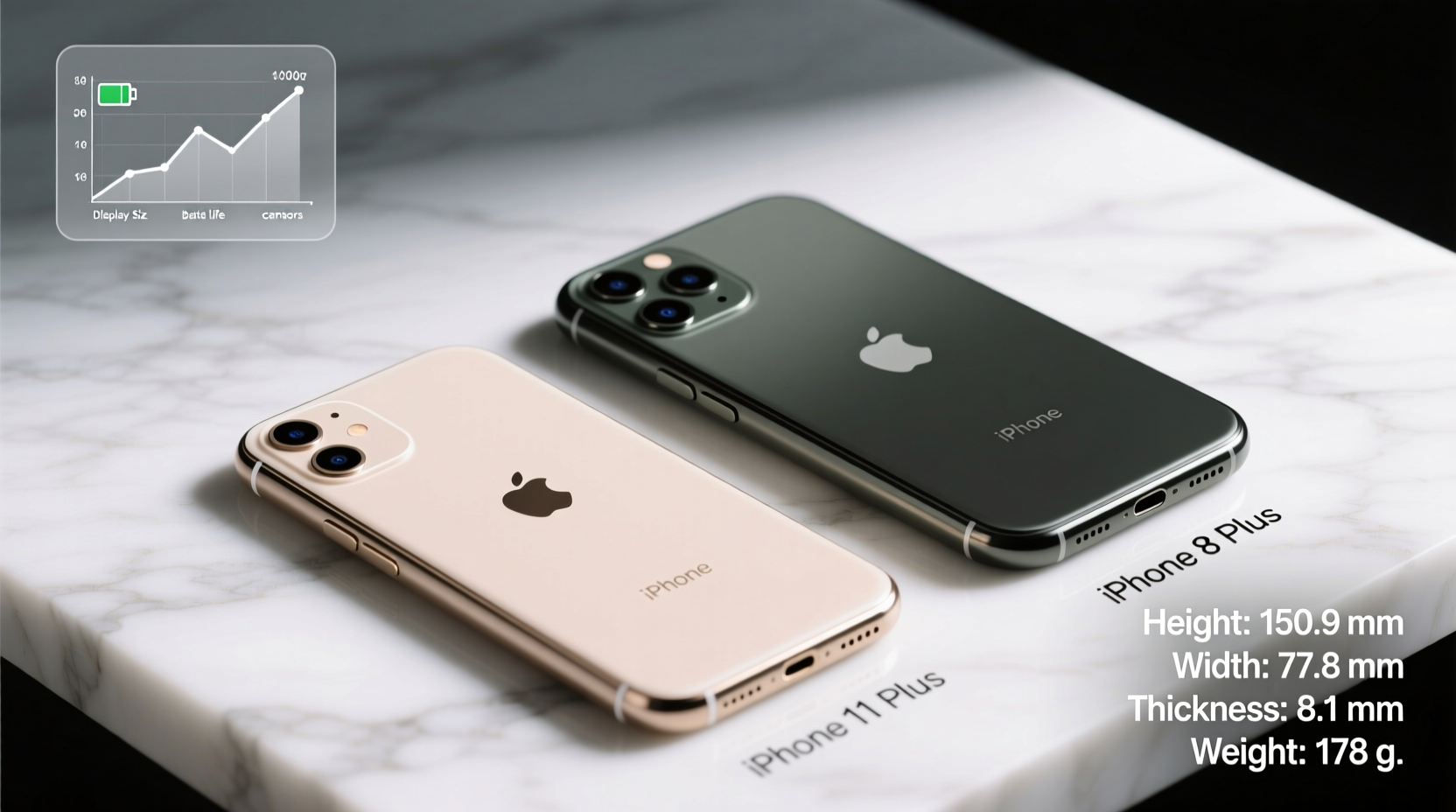
The most immediate difference between the two models lies in their physical presence. The iPhone 8 Plus measures 158.4 x 78.1 x 7.8 mm and weighs 203 grams. It's wide, tall, and noticeably heavier than its successor. Its flat edges and glass back give it a premium feel, but also make it less comfortable during one-handed use, especially for users with smaller hands.
In contrast, the iPhone 11 comes in at 150.9 x 75.7 x 8.3 mm and weighs 194 grams. Though only marginally lighter, it feels significantly more balanced due to its narrower width and refined curvature along the edges. Despite being shorter and narrower, it houses a 6.1-inch LCD display compared to the 8 Plus’s 5.5-inch screen—thanks to reduced bezels and an edge-to-edge front panel.
| Feature | iPhone 11 | iPhone 8 Plus |
|---|---|---|
| Height | 150.9 mm | 158.4 mm |
| Width | 75.7 mm | 78.1 mm |
| Thickness | 8.3 mm | 7.8 mm |
| Weight | 194 g | 203 g |
| Screen Size | 6.1 inches | 5.5 inches |
| Display Type | Liquid Retina HD (LCD) | Retina HD (LCD) |
| Bezel Design | Narrow, notch-enabled | Wide top/bottom bezels |
The dimensional shift reflects Apple’s evolving design language—prioritizing screen real estate while minimizing bulk. This allows the iPhone 11 to offer a larger viewing area in a body that's easier to handle, illustrating how thoughtful engineering can enhance usability without increasing size.
Performance and Hardware: Beyond Physical Form
While size influences comfort, specs determine longevity. Here, the iPhone 11 pulls ahead decisively. Powered by the A13 Bionic chip, it delivers up to 30% faster CPU performance and twice the graphics power of the A11 Bionic in the iPhone 8 Plus. For everyday tasks like browsing, messaging, and streaming, both perform adequately. However, under sustained loads—such as gaming, photo editing, or multitasking—the gap becomes apparent.
Battery life is another critical factor. The iPhone 11 offers approximately 17 hours of video playback, compared to 13 hours on the 8 Plus. That extra endurance stems not just from a larger battery, but from greater energy efficiency across the board—from processor architecture to display management.
“Smartphone satisfaction isn’t just about peak performance—it’s about consistent responsiveness over time. Devices with stronger chips age better.” — David Lin, Mobile Technology Analyst at GadgetInsight
Camera systems further widen the divide. The iPhone 11 introduced a dual-camera setup: wide and ultra-wide lenses. This enables creative flexibility, such as capturing expansive landscapes or fitting more subjects into group shots. The 8 Plus, while pioneering Apple’s dual-lens approach, only includes wide and telephoto lenses—excellent for portraits and optical zoom, but lacking in field-of-view versatility.
Moreover, Night Mode, Deep Fusion, and Smart HDR are exclusive to the iPhone 11. These computational photography features significantly improve low-light clarity and dynamic range, making a tangible difference in image quality.
User Experience: When Size Meets Functionality
A mini case study illustrates this well: Sarah, a freelance photographer, used her iPhone 8 Plus for four years before upgrading to the iPhone 11. She appreciated the large screen for reviewing photos on-site but found the device increasingly sluggish when transferring files or using editing apps. After switching, she noticed immediate improvements—not just in speed, but in handling. “Even though the screen is bigger, the phone fits better in my hand,” she said. “And I can actually shoot usable photos indoors now, thanks to Night Mode.”
This highlights a key insight: user experience emerges from the interplay of size, interface design, and underlying performance. A larger screen may seem advantageous, but if it’s hampered by thick bezels and outdated software support, its utility diminishes. Conversely, a slightly smaller yet smarter layout enhances productivity and enjoyment.
Choosing What Matters: A Practical Checklist
Deciding between these two models depends on individual priorities. Use this checklist to evaluate which aspects align best with your lifestyle:
- Do you value one-handed usability? → iPhone 11 wins due to narrower width.
- Are you still reliant on Touch ID? → iPhone 8 Plus retains fingerprint authentication.
- Do you take lots of photos in dim lighting? → iPhone 11 offers Night Mode; 8 Plus does not.
- Is future-proofing important? → iPhone 11 receives longer iOS support and runs newer apps smoother.
- Do you dislike the notch? → iPhone 8 Plus has a traditional display cutout-free design.
- Need extended battery life? → iPhone 11 lasts longer per charge.
Frequently Asked Questions
Is the iPhone 11 really smaller than the 8 Plus?
It depends on the dimension. The iPhone 11 is shorter and narrower, making it easier to hold and carry, despite having a larger screen. However, it is slightly thicker (8.3 mm vs 7.8 mm). Overall, it feels more compact due to reduced bezels and better weight distribution.
Can the iPhone 8 Plus still run modern apps smoothly?
Yes, for basic functions like email, social media, and light web browsing. However, resource-heavy apps—especially games, AR tools, or video editors—may lag or struggle. Over time, as apps demand more processing power, the A11 chip will become increasingly limiting.
Does the lack of 3D Touch matter on the iPhone 11?
The iPhone 11 replaces 3D Touch with Haptic Touch—a long-press gesture that mimics pressure sensitivity. While not identical, most users adapt quickly. Essential shortcuts (like previewing messages or accessing camera controls) remain accessible, so the functional loss is minimal for average users.
Conclusion: Balancing Form and Function
The debate between iPhone 11 and iPhone 8 Plus ultimately centers on trade-offs. The 8 Plus appeals to those who prefer a familiar design, Touch ID, and a slightly slimmer profile—but it sacrifices modern conveniences and long-term viability. The iPhone 11, though marginally thicker, delivers a superior balance: a roomier display in a more manageable body, cutting-edge performance, advanced cameras, and multi-year software support.
Size matters—but not in isolation. What truly counts is how size interacts with performance, usability, and personal habits. A phone might fit perfectly in your pocket, but if it stutters when opening maps or fails to capture memories clearly, its compactness loses meaning. Conversely, a powerful device that slips from your grasp or strains your fingers won’t be enjoyed fully.
Technology should serve you—not force adaptation. If you're upgrading from an older device or stepping down from a Plus model, consider what kind of experience you want: nostalgic reliability or forward-looking capability. Based on real-world performance, design innovation, and ecosystem longevity, the iPhone 11 makes a compelling case that sometimes, smaller really is smarter.




 浙公网安备
33010002000092号
浙公网安备
33010002000092号 浙B2-20120091-4
Comments
No comments yet. Why don't you start the discussion?