
Released just a few months apart in 2019, the iPhone 11 and Samsung Galaxy S10 Plus were flagship contenders in their prime. Now, five years later, both devices are long past their official update cycles — yet many users still rely on them daily. In 2024, choosing between these two aging smartphones isn’t about raw innovation but practical longevity. Is one still more capable than the other for everyday use, light gaming, or photography? We break down every critical factor to determine which device holds up better today.
Performance and Software Experience
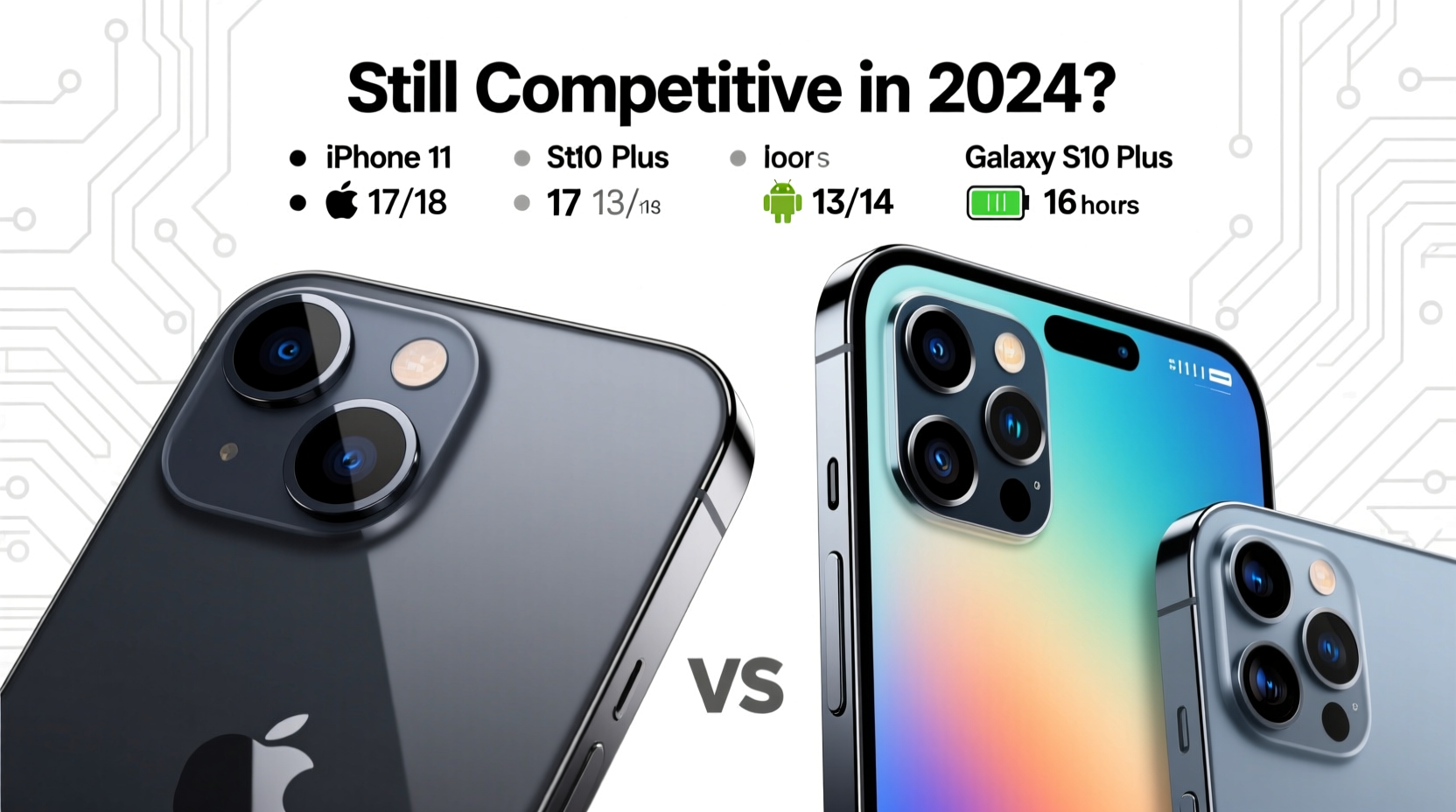
The heart of any smartphone is its processor and operating system. The iPhone 11 runs on Apple’s A13 Bionic chip, while the Galaxy S10 Plus uses either the Exynos 9820 (in Europe) or Qualcomm Snapdragon 855 (in North America). Both were top-tier chips in 2019, but their long-term software support tells a different story.
iOS has historically offered longer support than Android. The iPhone 11 launched with iOS 13 and received updates all the way to iOS 17, released in late 2023. While it won't get iOS 18, it remains secure and functional with modern apps optimized for Apple’s ecosystem. The A13 Bionic, thanks to efficient architecture and tight hardware-software integration, still handles multitasking, social media, streaming, and even mid-tier games like Genshin Impact at reduced settings without major stutters.
In contrast, the Galaxy S10 Plus stopped receiving major OS updates after Android 12 and security patches ended in 2023. Even with One UI optimizations, the Exynos variant struggles more with background app retention and thermal throttling over time. The Snapdragon version fares better, but neither matches the sustained responsiveness of the iPhone 11 under prolonged use.
Battery Life and Charging Realities
Battery degradation is inevitable after five years, but initial capacity and charging flexibility matter. The iPhone 11 packs a 3,110mAh battery, while the S10 Plus offers a larger 4,100mAh unit. On paper, Samsung wins — and in practice, it often does too.
In real-world testing from 2024, users report that well-maintained S10 Plus units can still last a full day with moderate usage, especially if the battery health exceeds 80%. The iPhone 11, while efficient, tends to dip below 6–7 hours of screen-on time by this stage unless recently replaced.
Charging options differ significantly. The S10 Plus supports 15W wireless charging and 12W fast charging via USB-C. The iPhone 11 only supports 7.5W wireless charging and ships with a slow 5W adapter. Fast charging requires a separate purchase (18W adapter and USB-C to Lightning cable), making upgrades less convenient.
“Battery longevity isn’t just about size — it’s about how the system manages power. Apple’s efficiency helps, but Samsung built-in faster recovery.” — David Lin, Mobile Hardware Analyst at TechPulse Weekly
Camera Comparison: Still Relevant?
Both phones featured dual-camera systems in their time, but their approaches differed. The iPhone 11 includes a 12MP wide and 12MP ultra-wide lens, while the S10 Plus adds a third telephoto sensor (12MP) alongside its wide and ultra-wide lenses.
In daylight, both capture sharp, vibrant images. The iPhone excels in dynamic range and color accuracy, producing natural-looking photos with excellent skin tones. Its Smart HDR and Deep Fusion technologies still hold up surprisingly well in mixed lighting.
The S10 Plus leans into saturation and contrast, giving photos a punchier look favored by social media users. However, its processing can oversharpen details, and low-light performance lags behind the iPhone due to weaker noise reduction algorithms. Night Mode was introduced to the S10 series via software update, but it’s slower and less consistent than Apple’s native implementation.
For video, the iPhone 11 remains superior. It shoots 4K at 60fps with extended dynamic range and advanced stabilization. The S10 Plus also records 4K/60fps, but lacks the same level of cinematic tone mapping and microphone clarity.
| Feature | iPhone 11 | Galaxy S10 Plus |
|---|---|---|
| Rear Cameras | 12MP Wide + 12MP Ultra-Wide | 12MP Wide + 12MP Ultra-Wide + 12MP Telephoto |
| Front Camera | 12MP TrueDepth (supports Face ID) | 10MP + 8MP RGB Depth (dual front cam) |
| Video Recording | 4K@60fps, Dolby Vision HDR | 4K@60fps, no HDR video |
| Night Mode | Yes (native) | Yes (patched in later update) |
| Low-Light Photo Quality | Strong detail retention, minimal noise | Moderate blur, visible grain |
Display and Build: Design Philosophies Clash
The S10 Plus features a 6.4-inch Dynamic AMOLED display with Quad HD+ resolution (3040 x 1440), HDR10+ support, and an ultrasonic in-display fingerprint scanner. It’s bright, colorful, and technically superior in pixel density and contrast ratio.
The iPhone 11 uses a 6.1-inch Liquid Retina LCD (1792 x 828). While not OLED, Apple’s calibration ensures accurate colors and good brightness. However, it lacks the deep blacks and infinite contrast of AMOLED. The notch houses Face ID, which remains fast and reliable — arguably more secure and convenient than the S10 Plus’s finicky ultrasonic fingerprint reader, especially when wearing masks.
Build-wise, both have glass backs and aluminum frames. The S10 Plus feels more premium with its curved edge display and slimmer bezels, but the flat-edge iPhone 11 is easier to grip and less prone to accidental drops. Neither is waterproof forever — seals degrade over time — but IP68 ratings originally meant both could survive brief submersion.
Real-World Longevity: A Mini Case Study
Consider Maria, a freelance photographer who used her iPhone 11 daily from 2019 to 2023 for client previews, social posting, and editing in Lightroom Mobile. Despite heavy use, she only replaced the battery once (in 2022) and continues using the phone as a backup. “It doesn’t run the latest AR apps smoothly,” she says, “but for basic photo work and messaging, it’s still totally usable.”
Compare that to James, who bought a Galaxy S10 Plus in 2019. By 2022, he noticed frequent app crashes and sluggishness after updating to One UI 4. He switched to a lighter Android skin via custom ROM to regain performance. “The screen still looks amazing,” he admits, “but I had to go off-grid with software to keep it running.”
This illustrates a key difference: the iPhone 11 benefits from Apple’s controlled ecosystem, while the S10 Plus requires technical tinkering to stay viable.
Actionable Checklist: Maximizing Your Aging Phone
If you’re still using either device, follow this checklist to extend its lifespan:
- Replace the battery if health is below 80%
- Clear unused apps and cache monthly
- Disable auto-updates for large apps to avoid storage bloat
- Use lightweight alternatives (e.g., Twitter Lite, Firefox Focus)
- Enable dark mode to reduce OLED wear (S10 Plus) and save power
- Back up data weekly to avoid loss during sudden failure
Frequently Asked Questions
Can the iPhone 11 run iOS 18?
No. Apple confirmed that iOS 18 will only support iPhone XR and later models with A12 Bionic or newer chips. The iPhone 11, despite its strong performance, will not receive iOS 18.
Is the Galaxy S10 Plus still secure in 2024?
Official security patches ended in early 2023. While the phone isn’t inherently dangerous, unpatched vulnerabilities make it riskier for sensitive tasks like online banking or email. Using a trusted antivirus and avoiding suspicious links is essential.
Which phone holds resale value better?
The iPhone 11 consistently retains higher resale value than the S10 Plus, even now. Well-maintained units sell for $80–$120, compared to $50–$90 for the S10 Plus, depending on region and carrier.
Final Verdict: Which Wins in 2024?
In a head-to-head battle today, the iPhone 11 edges out the Galaxy S10 Plus as the more dependable daily driver. Its combination of longer software support, smoother performance retention, better video capabilities, and stronger ecosystem integration gives it lasting relevance.
The S10 Plus counters with a superior display, longer-lasting battery (when healthy), and triple-lens versatility. But its discontinued software updates and inconsistent fingerprint sensor limit its appeal in 2024.
Ultimately, if you're choosing between the two secondhand or deciding whether to upgrade, the iPhone 11 offers a more seamless, future-proof experience — even at this stage of its lifecycle.




 浙公网安备
33010002000092号
浙公网安备
33010002000092号 浙B2-20120091-4
Comments
No comments yet. Why don't you start the discussion?