
In 2025, flagship smartphones have evolved dramatically—faster processors, AI-powered cameras, foldable designs—but for many buyers on a budget, older premium devices remain appealing. Two such models are the iPhone 11 and the Samsung Galaxy Note 10+. Both were top-tier phones when released in 2019, but now they’re nearly six years old. So, is the iPhone 11 still a smart purchase today? And how does it stack up against the Note 10+? This deep dive compares real-world usability, software support, performance longevity, and overall value to help you decide.
Performance and Hardware: Still Capable or Outdated?
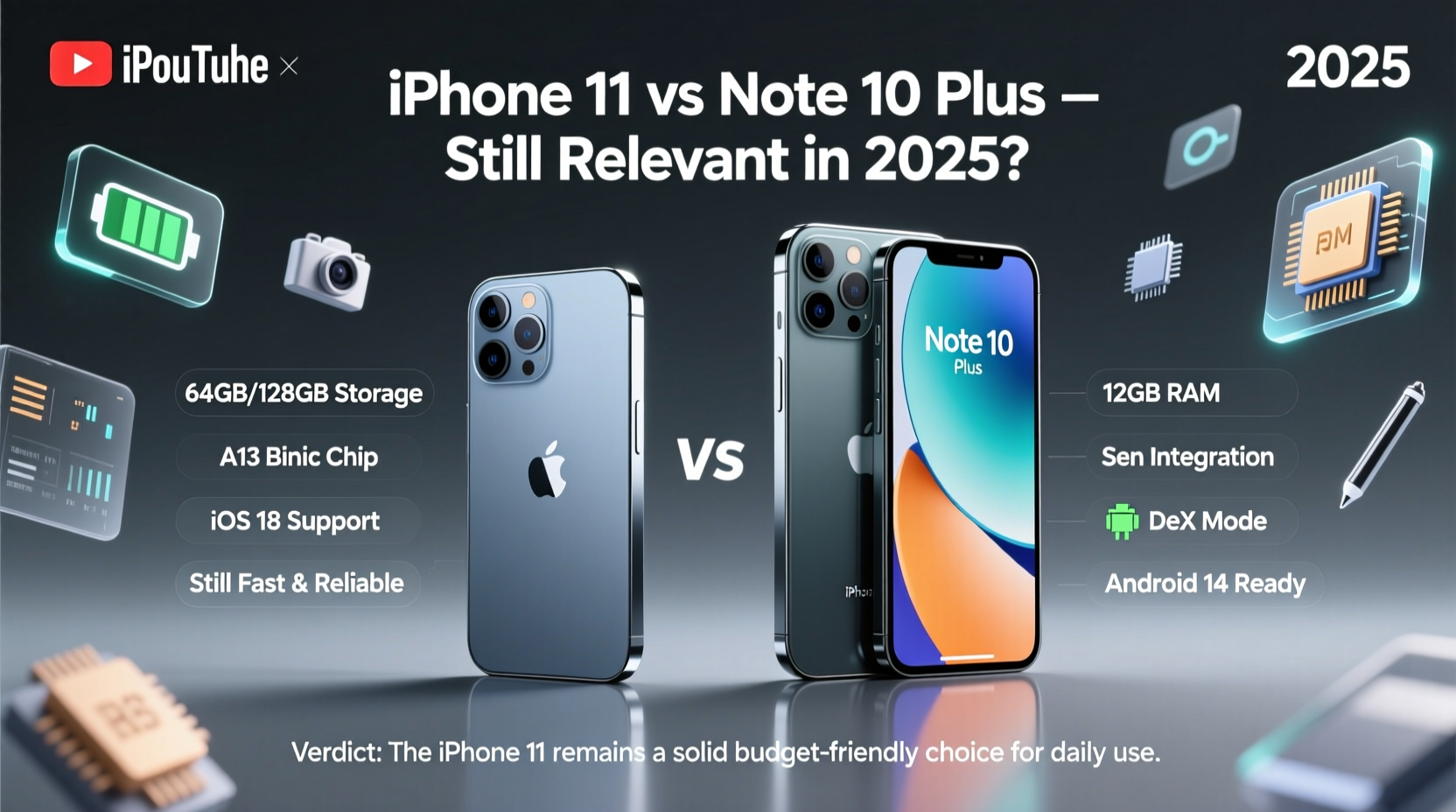
The iPhone 11 runs on Apple’s A13 Bionic chip, a 7nm processor that was class-leading in 2019. Even by 2025 standards, it handles everyday tasks like web browsing, messaging, social media, and HD video playback with ease. Thanks to iOS optimization, the device remains responsive and fluid in core operations. Most apps in the App Store still run smoothly, although heavy games or augmented reality applications may show signs of strain.
In contrast, the Galaxy Note 10+ launched with either the Snapdragon 855 (U.S.) or Exynos 9825 (international), both of which were powerful at the time. However, Android’s less aggressive background process management and hardware fragmentation mean that even with 8GB of RAM, the Note 10+ can feel sluggish in multitasking or after extended use. By 2025, app updates and larger operating system overhead have made the phone noticeably slower, particularly during app switching and camera processing.
Software Support and Longevity
This is where the iPhone 11 shines. As of 2025, it continues to receive full iOS updates, including iOS 18. Apple typically supports iPhones for five to six years after release, and the iPhone 11 is expected to be among the last models compatible with iOS 19, potentially extending its lifespan into 2026. That means access to security patches, privacy features, and new ecosystem integrations long after most Android devices are abandoned.
The Galaxy Note 10+, however, reached its end-of-life much earlier. It received three major Android OS updates (up to Android 12) and four years of security patches, ending in late 2023. In 2025, it no longer receives official updates from Samsung, leaving it vulnerable to emerging security threats and incompatible with newer versions of popular apps that require updated APIs or permissions.
“Apple’s long-term software commitment gives older iPhones a second life that few Android counterparts can match.” — David Lin, Mobile Analyst at TechTrend Insights
Camera Quality: Real-World Photo Performance
The iPhone 11 features a dual-camera system: 12MP wide and ultra-wide lenses. Its strength lies in consistency. Even in 2025, photos taken in daylight are vibrant, well-balanced, and true to color. Low-light performance benefits from Night Mode, which automatically activates in dim environments. Video recording remains excellent—supporting 4K at 60fps and strong stabilization makes it ideal for casual vlogging or family moments.
The Note 10+ has a quad-camera setup: 12MP wide (variable aperture), 12MP telephoto, 16MP ultra-wide, and a depth sensor. While it offers more flexibility with zoom and aperture control, image processing in 2025 feels outdated. Colors tend to oversaturate, dynamic range lags behind modern HDR standards, and low-light shots exhibit noticeable noise. The lack of recent software improvements means camera algorithms haven’t evolved, unlike Apple’s machine learning-enhanced Smart HDR and Photographic Styles.
| Feature | iPhone 11 | Note 10+ |
|---|---|---|
| Primary Camera | 12MP f/1.8 Wide + 12MP f/2.4 Ultra-Wide | 12MP f/1.5–2.4 Wide + 12MP f/2.1 Telephoto + 16MP f/2.2 Ultra-Wide |
| Video Recording | 4K@60fps, Dolby Vision HDR | 4K@60fps, no HDR10+ |
| Night Mode | Yes (all lenses) | No native night mode |
| Software Updates | Ongoing (iOS 18 in 2025) | Ended (last update: 2023) |
| Battery Life (typical use) | ~17 hours video playback | ~14 hours video playback |
User Experience and Ecosystem Integration
One often overlooked factor is ecosystem synergy. The iPhone 11 integrates seamlessly with AirPods, Apple Watch, iCloud, iMessage, and FaceTime. Features like Handoff, Universal Clipboard, and Continuity Camera enhance productivity across devices. For users already invested in Apple’s ecosystem, the iPhone 11 remains a functional hub despite its age.
The Note 10+ once offered strong DeX support and S Pen functionality—features that appealed to professionals and creatives. However, DeX requires external displays and accessories rarely used today, and without ongoing software optimization, the experience feels clunky. The S Pen remains useful for notes and quick actions, but its integration into third-party apps has stagnated since Samsung shifted focus to the Galaxy S23/S24 series and Z Fold line.
Mini Case Study: Maria’s Upgrade Dilemma
Maria, a freelance graphic designer in Lisbon, needed a reliable secondary phone for client calls and portfolio sharing. Her budget was capped at €250. She considered both a refurbished Note 10+ (€220) and an iPhone 11 (€240). After testing both, she chose the iPhone 11. “The Note felt slow opening emails and lagged when I switched between design apps,” she said. “The iPhone opened everything instantly, and my AirPods connected without issue. Plus, knowing it’ll get updates for another year sealed the deal.”
Is the iPhone 11 Still a Good Buy in 2025?
For light to moderate users, yes—the iPhone 11 remains a solid choice. It excels in reliability, battery efficiency, and software longevity. If your usage revolves around communication, social media, photography, and streaming, it delivers a smooth, frustration-free experience. Its build quality (glass front and back with aluminum frame) still holds up well, especially with a protective case.
The Note 10+, while impressive in its prime, shows its age more clearly. Without security updates, slower app performance, and diminishing app compatibility, it's harder to recommend unless purchased at a steep discount (under €180) and used as a secondary device or media player.
Checklist: What to Verify Before Buying an iPhone 11 in 2025
- Confirm iOS version and update eligibility
- Check battery health (via Settings > Battery > Battery Health)
- Inspect for water damage indicators
- Test all buttons, speakers, microphones, and charging port
- Verify iCloud unlock status (Ask seller to remove device from account)
- Ensure original screen and camera modules (avoid replaced parts with poor calibration)
Frequently Asked Questions
Can the iPhone 11 run iOS 18 smoothly?
Yes. Apple optimized iOS 18 for older devices, and the iPhone 11 runs it efficiently. Most features—including enhanced Siri, improved Focus modes, and on-device AI tools—work well. Minor animations may be simplified, but core functionality remains intact.
Is the Galaxy Note 10+ safe to use in 2025?
With no security updates since 2023, using the Note 10+ for sensitive tasks like online banking or email carries risk. Malware targeting outdated Android versions is increasingly common. It’s best suited for offline use, media playback, or as a dedicated e-reader/kitchen tablet.
Which phone holds resale value better?
The iPhone 11 retains value significantly better. Due to Apple’s long software support and global demand for affordable iPhones, a well-maintained iPhone 11 can resell for 60–70% of its current price in 2026. The Note 10+ has minimal resale market left.
Final Verdict: Future-Proofing Matters
In a world where digital security, app compatibility, and software relevance evolve rapidly, choosing a device isn’t just about current performance—it’s about future viability. The iPhone 11, though nearly six years old, continues to deliver a dependable user experience thanks to Apple’s unmatched update policy and ecosystem cohesion. The Galaxy Note 10+, while innovative in its time, has fallen behind due to limited software support and aging hardware inefficiencies.
If you're looking for a capable, secure, and supported smartphone under $300 in 2025, the iPhone 11 is still a compelling option. The Note 10+ may appeal to collectors or tinkerers, but for everyday use, it’s no longer a practical recommendation.




 浙公网安备
33010002000092号
浙公网安备
33010002000092号 浙B2-20120091-4
Comments
No comments yet. Why don't you start the discussion?