
The iPhone 12 mini and iPhone 11 mini represent two generations of Apple’s compact flagship lineup, each appealing to users who prioritize portability without sacrificing premium features. Released just a year apart—2020 for the 11 mini and 2021 for the 12 mini—they share many design cues but differ in critical areas like performance, display, and connectivity. For current iPhone 11 mini owners wondering whether to upgrade, the decision hinges on more than just newness. Real improvements in speed, camera processing, and 5G support must be weighed against cost, battery life, and long-term usability.
Design and Build: Subtle Refinements, Same Compact Feel
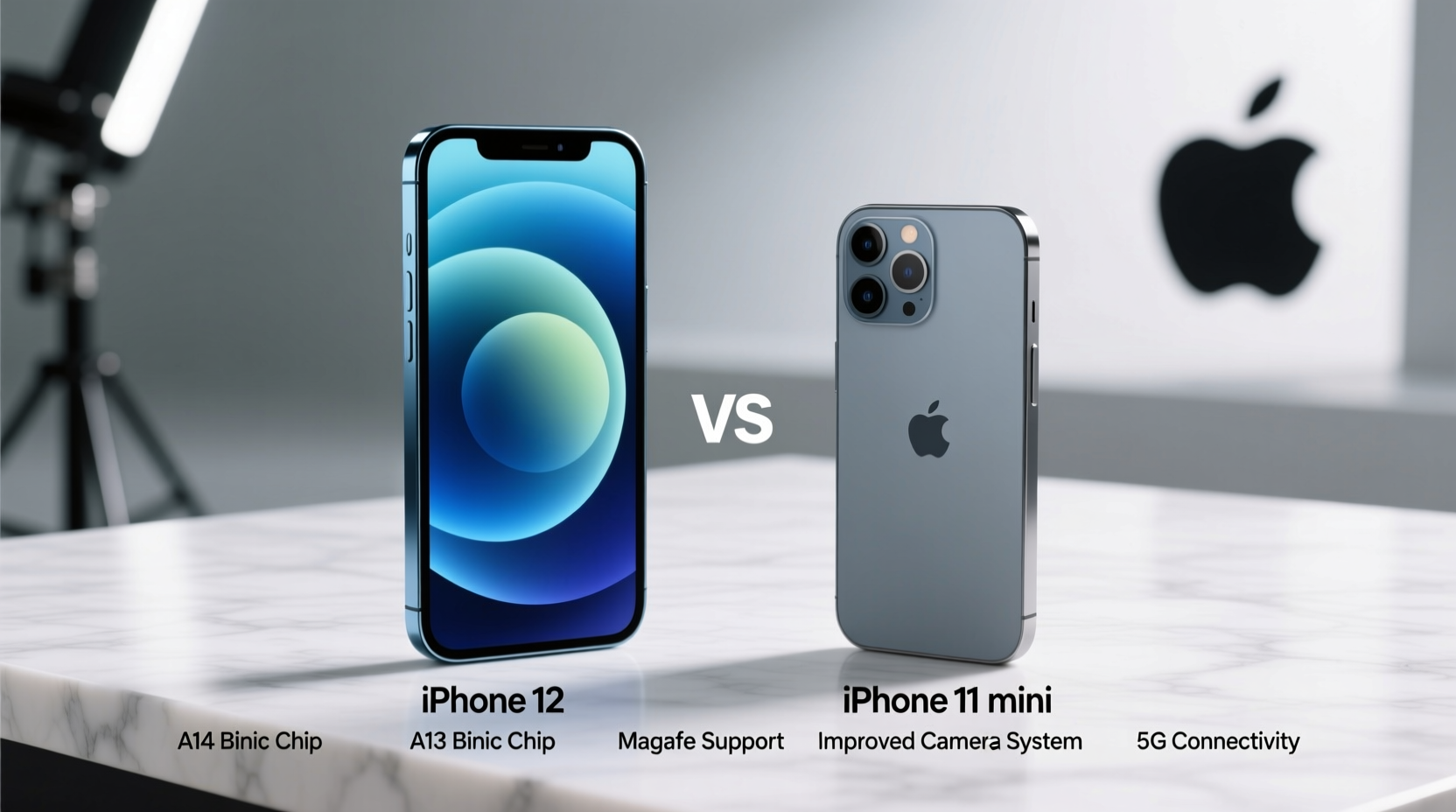
At first glance, the iPhone 12 mini and 11 mini appear nearly identical. Both measure 131.5 x 64.2 x 7.4 mm and weigh around 135–140 grams, making them some of the most pocketable smartphones on the market. The ergonomics are excellent for single-handed use, a rare quality in today’s oversized smartphone landscape.
The key difference lies in materials and construction. The iPhone 12 mini introduced a flat-edge aerospace-grade aluminum frame, replacing the curved edges of the 11 mini. This gives it a more modern, almost retro-inspired look reminiscent of the iPhone 4 and 5 series. It also uses Ceramic Shield front cover glass, which Apple claims offers four times better drop performance. The 11 mini, while still durable with its glass-and-aluminum build, lacks this enhanced protection.
Display and Brightness: A Clear Step Up
The iPhone 12 mini marks a significant leap in display technology. It features a Super Retina XDR OLED screen with a resolution of 2340 x 1080 pixels, compared to the 11 mini’s Liquid Retina HD LCD at 2340 x 1080 as well—but the difference is in quality, not numbers.
OLED panels deliver deeper blacks, higher contrast ratios (up to 2,000,000:1), and superior color accuracy. The 12 mini also reaches peak brightness levels of 1,200 nits (HDR), versus 625 nits on the 11 mini. In practical terms, outdoor visibility is dramatically better on the 12 mini, especially under direct sunlight.
Both devices have a 5.4-inch diagonal size and 476 ppi pixel density, so sharpness is comparable. However, the OLED advantage makes media consumption—especially HDR video on Netflix or Apple TV+—a more immersive experience on the 12 mini.
Performance and Software: Faster Chip, Longer Support
The heart of any smartphone is its processor, and here the 12 mini pulls decisively ahead. It runs on the A14 Bionic chip, built on a 5nm process with 11.8 billion transistors. The 11 mini uses the A13 Bionic, which, while still powerful, was built on a 7nm process.
In real-world usage, both phones handle daily tasks like browsing, messaging, and social media smoothly. But the A14 delivers up to 16% faster CPU performance and 8% faster GPU performance. More importantly, it enables better machine learning capabilities and improved efficiency, which translates to longer software support.
“The A14 Bionic isn’t just faster—it’s more future-proof. Users can expect at least two additional years of iOS updates.” — David Lin, Mobile Hardware Analyst at TechInsight Group
Apple typically supports iPhones with software updates for five to six years. Given that the 11 mini launched with iOS 14 and the 12 mini with iOS 15, the latter is likely to receive updates through iOS 21 or even iOS 22, whereas the 11 mini may stop at iOS 20. For users planning to keep their device beyond three years, this extended support is a major factor.
Camera Comparison: Better Processing, Similar Sensors
On paper, the rear camera systems are nearly identical: both feature a 12MP wide sensor and a 12MP ultra-wide lens. There’s no telephoto lens, consistent with Apple’s strategy for the mini models.
However, the 12 mini benefits from computational photography enhancements powered by the A14 chip. Night mode now works on both cameras (the 11 mini only has Night mode on the wide lens), and Smart HDR 3 improves dynamic range and skin tones in complex lighting. Photographic Styles—a new feature introduced with the 12 series—allows users to apply customizable looks across shots while preserving skin tone integrity.
In low-light conditions, the 12 mini consistently produces cleaner images with less noise and better detail retention. Video recording also sees an upgrade: Dolby Vision HDR recording at 4K/30fps is supported on both, but the 12 mini handles stabilization and exposure transitions more smoothly.
| Feature | iPhone 11 mini | iPhone 12 mini |
|---|---|---|
| Rear Cameras | 12MP Wide + 12MP Ultra-Wide | 12MP Wide + 12MP Ultra-Wide |
| Night Mode (Ultra-Wide) | No | Yes |
| Smart HDR Version | Smart HDR 2 | Smart HDR 3 |
| Dolby Vision Recording | Yes (4K/30fps) | Yes (4K/30fps) |
| Photographic Styles | No | Yes |
Battery Life and Charging: A Trade-Off for New Features
Despite its smaller form factor, the 11 mini actually outperforms the 12 mini in battery endurance. Apple rated the 11 mini for up to 13 hours of video playback, while the 12 mini manages about 10–11 hours under similar conditions. Real-world testing confirms this gap: heavy users often need to charge the 12 mini by late afternoon, while the 11 mini can stretch into evening use.
This reduction is partly due to the more power-hungry OLED display and 5G modem. Speaking of which—the 12 mini supports 5G networks (mmWave and sub-6GHz in certain regions), while the 11 mini is limited to LTE. While 5G offers faster download speeds, it drains the battery quickly unless managed via settings (e.g., Auto 5G mode).
Mini Case Study: Sarah’s Upgrade Decision
Sarah had been using her iPhone 11 mini since December 2020. By mid-2022, she noticed occasional lag when switching between apps and shorter battery life than before. She considered upgrading to the 12 mini after seeing online reviews praising its display and camera.
After testing both devices side-by-side at an Apple Store, she was struck by the 12 mini’s screen clarity and how much crisper photos looked in her gallery. She also appreciated the improved low-light selfies. However, she was disappointed to learn the battery didn’t last as long.
Ultimately, she upgraded—not because she needed 5G, but because the A14 chip meant better app compatibility moving forward, especially for augmented reality apps she used for interior design. She now charges her phone twice a day but finds the trade-off acceptable given the overall snappiness and future-proofing.
Is the Upgrade Worth It? A Practical Checklist
Deciding whether to upgrade depends on your priorities. Use this checklist to evaluate your needs:
- ✅ Do you want better photo quality, especially at night?
- ✅ Are you interested in 5G for faster downloads or future network readiness?
- ✅ Do you plan to keep your phone for more than three years?
- ✅ Do you value a brighter, more vibrant display for streaming or reading?
- ❌ Are you sensitive to reduced battery life?
- ❌ Is budget a primary concern?
If most of your answers are “yes” to the first four and “no” to the last two, the iPhone 12 mini is a worthwhile upgrade. If battery life and cost are top priorities, sticking with the 11 mini—or waiting for a newer compact model—might be smarter.
Frequently Asked Questions
Can the iPhone 12 mini last as long as the 11 mini on a charge?
No. Despite similar usage patterns, the 12 mini typically lasts 1.5 to 2 hours less than the 11 mini due to its OLED display and 5G connectivity. Power-saving modes can help, but not fully compensate.
Does the 12 mini support MagSafe accessories?
Yes. The 12 mini includes built-in magnets for MagSafe charging and compatible accessories like wallets and mounts. The 11 mini does not support true MagSafe alignment or full-speed wireless charging.
Will the iPhone 11 mini stop receiving updates soon?
It’s expected to receive updates through at least 2024 (iOS 17 or 18). However, the 12 mini will likely be supported until 2026 or later, making it more future-proof.
Final Verdict: Upgrade Only If You Value Performance and Longevity
The iPhone 12 mini isn’t a revolutionary upgrade over the 11 mini, but it refines the formula in meaningful ways. The OLED display, 5G support, MagSafe compatibility, and A14 chip collectively make it a more capable, modern device. However, the trade-off in battery life is real and noticeable.
For users deeply invested in the iOS ecosystem, especially those relying on AR apps, high-quality video recording, or long-term software support, the 12 mini justifies the upgrade. Casual users who prioritize battery endurance and already own an 11 mini may find the changes incremental rather than transformative.




 浙公网安备
33010002000092号
浙公网安备
33010002000092号 浙B2-20120091-4
Comments
No comments yet. Why don't you start the discussion?