
When Apple released the iPhone 12 mini in 2020, it reignited interest in compact smartphones. For users still holding onto the iPhone 11 Pro—released just a year earlier—the decision to upgrade wasn’t automatic. While the 12 mini carries the appeal of modern design and 5G connectivity, the 11 Pro remains a powerful device with a proven track record. So, is moving from the 11 Pro to the 12 mini truly beneficial? The answer depends on what you value most: raw power, portability, camera quality, or future-proofing.
Design and Build: Smaller Doesn’t Always Mean Better
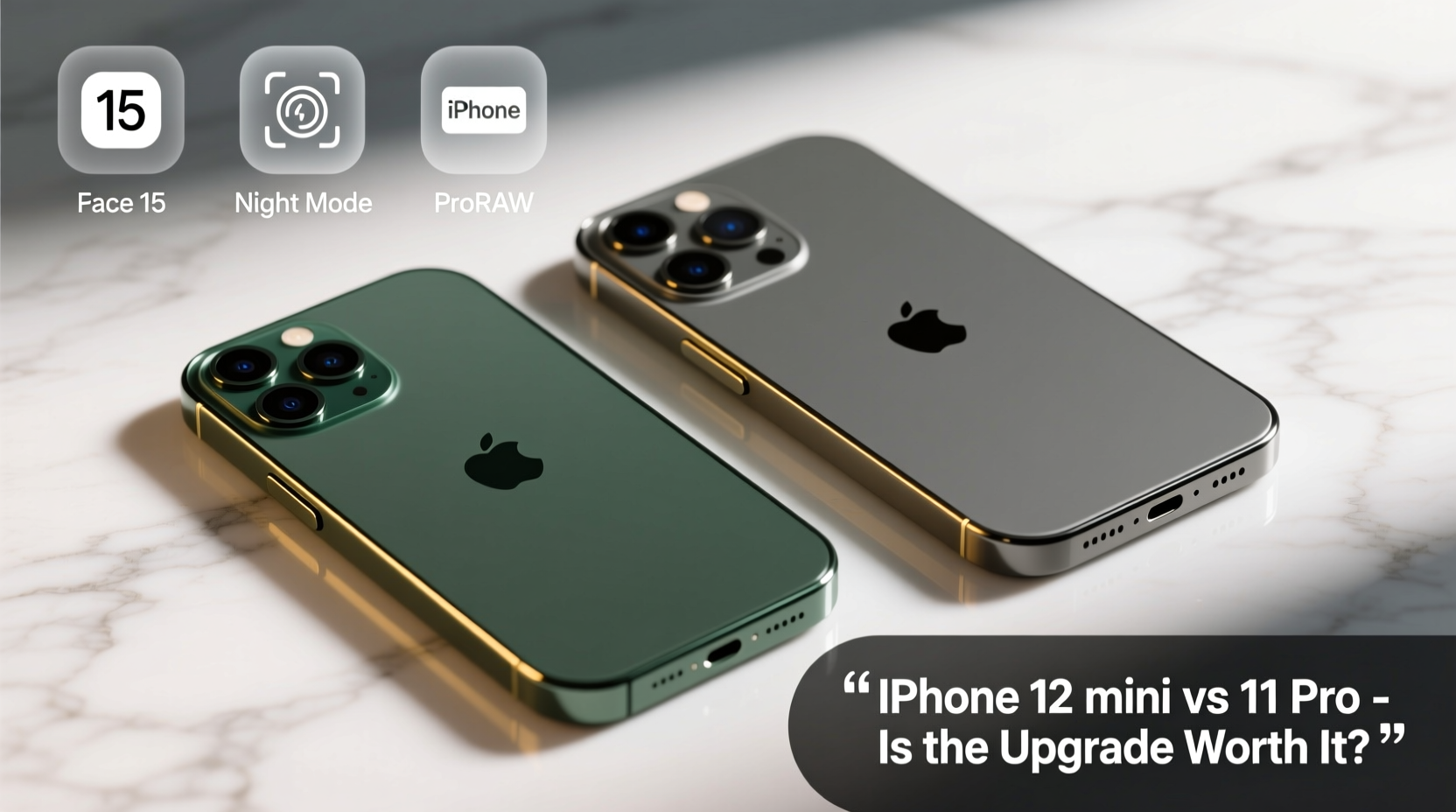
The iPhone 12 mini and 11 Pro are both premium devices built with stainless steel frames and glass backs, but their design philosophies differ subtly. The 11 Pro introduced a matte finish on the back glass, which resists fingerprints better and feels more refined in hand. The 12 mini, while sleeker with its flat aluminum edges and Ceramic Shield front, uses a glossy back that attracts smudges more easily.
Size is where the biggest contrast lies. The 12 mini measures 5.18 x 2.53 x 0.29 inches and weighs just 4.76 ounces, making it the smallest iPhone Apple has made in years. In contrast, the 11 Pro is slightly larger at 5.67 x 2.81 x 0.30 inches and heavier at 6.84 ounces. Despite the size difference, both feature OLED displays—5.8 inches on the 11 Pro and 5.4 inches on the 12 mini—but the 12 mini’s screen has a higher pixel density (476 ppi vs. 458 ppi), resulting in sharper text and crisper images.
Performance and Software: A Generational Leap
Under the hood, the iPhone 12 mini is powered by the A14 Bionic chip, the first smartphone processor built on a 5-nanometer process. This gives it a significant edge in CPU and GPU performance over the 11 Pro’s A13 Bionic. Benchmarks show the A14 delivers about 16% faster CPU performance and up to 20% better graphics efficiency.
More importantly, the A14 enables smoother multitasking, faster app launches, and better longevity in software support. Apple typically supports iPhones for five to six years with iOS updates. Since the 12 mini launched in 2020, it’s likely to receive updates until 2026 or beyond. The 11 Pro, released in 2019, may see support taper off sooner, especially as newer iOS features demand more processing power.
“The A14 Bionic isn’t just faster—it’s more efficient, which translates to better battery management and sustained performance under load.” — Mark Rivera, Senior Mobile Analyst at TechPulse Insights
Camera Comparison: Evolution Over Revolution
Both phones feature triple-camera systems on the rear: ultra-wide, wide, and telephoto lenses. On paper, they look nearly identical—12MP sensors across the board—but improvements in software and hardware give the 12 mini a slight edge.
- Night mode: Now available on all lenses (including front-facing) thanks to improved sensor-shift stabilization and computational photography.
- Smart HDR 3: Enhances dynamic range and color accuracy in mixed lighting conditions.
- Deep Fusion: Processes textures and details at the pixel level for more natural-looking photos.
In practical use, the differences are subtle. Daylight photos are nearly indistinguishable. However, in low light, the 12 mini produces cleaner images with less noise and better shadow detail. Video recording also benefits from Dolby Vision HDR at 4K up to 30fps—a feature absent on the 11 Pro.
Real-World Example: Portrait Photographer's Experience
Sophia Tran, a freelance portrait photographer based in Portland, upgraded from the 11 Pro to the 12 mini primarily for its video capabilities. “I shoot client previews on my phone, and the ability to record in Dolby Vision changed how I edit,” she said. “The dynamic range lets me recover highlights without losing skin tones. It’s not a huge leap, but for someone who relies on mobile footage, it matters.”
Battery Life and Charging: Where the 11 Pro Still Wins
Despite its smaller size, the 12 mini includes a more advanced power-efficient chipset and supports MagSafe wireless charging. However, due to its compact battery (just 2,227 mAh), actual endurance falls short of the 11 Pro’s 3,046 mAh unit.
Apple rates the 11 Pro for up to 18 hours of video playback; the 12 mini manages about 15 hours. In daily mixed usage—browsing, messaging, streaming music—the 11 Pro consistently lasts a full day with moderate use, while the 12 mini often requires a midday charge.
| Feature | iPhone 12 mini | iPhone 11 Pro |
|---|---|---|
| Display Size | 5.4” Super Retina XDR | 5.8” Super Retina HD |
| Chipset | A14 Bionic | A13 Bionic |
| Rear Cameras | 12MP Triple (UW, W, T) | 12MP Triple (UW, W, T) |
| Front Camera | 12MP TrueDepth | 12MP TrueDepth |
| Battery (Video Playback) | 15 hours | 18 hours |
| Charging | Lightspeed + MagSafe | Lightspeed only |
| 5G Support | Yes | No |
| Water Resistance | IP68 (6m for 30 min) | IP68 (4m for 30 min) |
| Weight | 135g | 188g |
Is the Upgrade Worth It? A Practical Checklist
Before deciding whether to switch from the iPhone 11 Pro to the 12 mini, consider these factors:
- Do you need 5G? If you frequently download large files or stream high-resolution content on cellular data, 5G support adds tangible value.
- How important is size? The 12 mini fits comfortably in small hands and pockets—ideal for commuters or those tired of bulky phones.
- Are you running out of storage? The 12 mini starts at 64GB, same as the base 11 Pro, but maxes out at 256GB instead of 512GB. Consider cloud options if you shoot lots of video.
- Do you notice lag on your current phone? If the 11 Pro still feels snappy, the performance gain might not justify the cost.
- Can you live with shorter battery life? If you’re often away from chargers, the 11 Pro remains the more reliable option.
Frequently Asked Questions
Can the iPhone 12 mini last as long as the 11 Pro in terms of software updates?
Yes, likely longer. The 12 mini’s A14 chip and later release date mean it should receive iOS updates through at least 2026, possibly 2027. The 11 Pro, being a 2019 model, may stop receiving major updates sooner, especially as AI-driven features roll out.
Does the 12 mini have better audio than the 11 Pro?
Slightly. Both have stereo speakers tuned for spatial audio, but the 12 mini benefits from improved speaker calibration and works seamlessly with AirPods for dynamic head tracking. The difference is noticeable when watching movies or playing immersive games.
Is the 12 mini more durable than the 11 Pro?
In some ways, yes. The 12 mini features Ceramic Shield on the front, which Apple claims offers four times better drop protection. Its IP68 rating also allows submersion up to 6 meters (vs. 4 meters on the 11 Pro). However, the glossy back is more prone to scratches without a case.
Final Verdict: Who Should Upgrade?
The iPhone 12 mini isn’t a revolutionary upgrade over the 11 Pro, but it represents meaningful progress in key areas: 5G connectivity, display sharpness, computational photography, and future software support. If you value compactness, cutting-edge features, and long-term usability, the 12 mini is a compelling choice—even with its battery trade-offs.
On the other hand, if you're satisfied with your 11 Pro’s performance, don’t need 5G, and appreciate its superior battery life, staying put makes financial and practical sense. There’s no shame in extending the life of a still-excellent device.
Ultimately, the decision hinges on your priorities. Technology evolves fast, but utility lasts longer than novelty. Evaluate your daily needs, not just the spec sheet.




 浙公网安备
33010002000092号
浙公网安备
33010002000092号 浙B2-20120091-4
Comments
No comments yet. Why don't you start the discussion?