
For users clinging to the compact design of Apple’s smaller iPhones, the decision between the iPhone SE (2nd generation) and the iPhone 12 mini often comes down to one critical factor: battery life. While both devices offer excellent build quality and iOS integration, their endurance under daily use varies significantly. If you're upgrading from an older iPhone or considering a switch from the SE 2 to the 12 mini solely for improved battery, it's essential to understand how much real-world difference exists — and whether that difference justifies the cost.
Battery Capacity and Hardware Differences
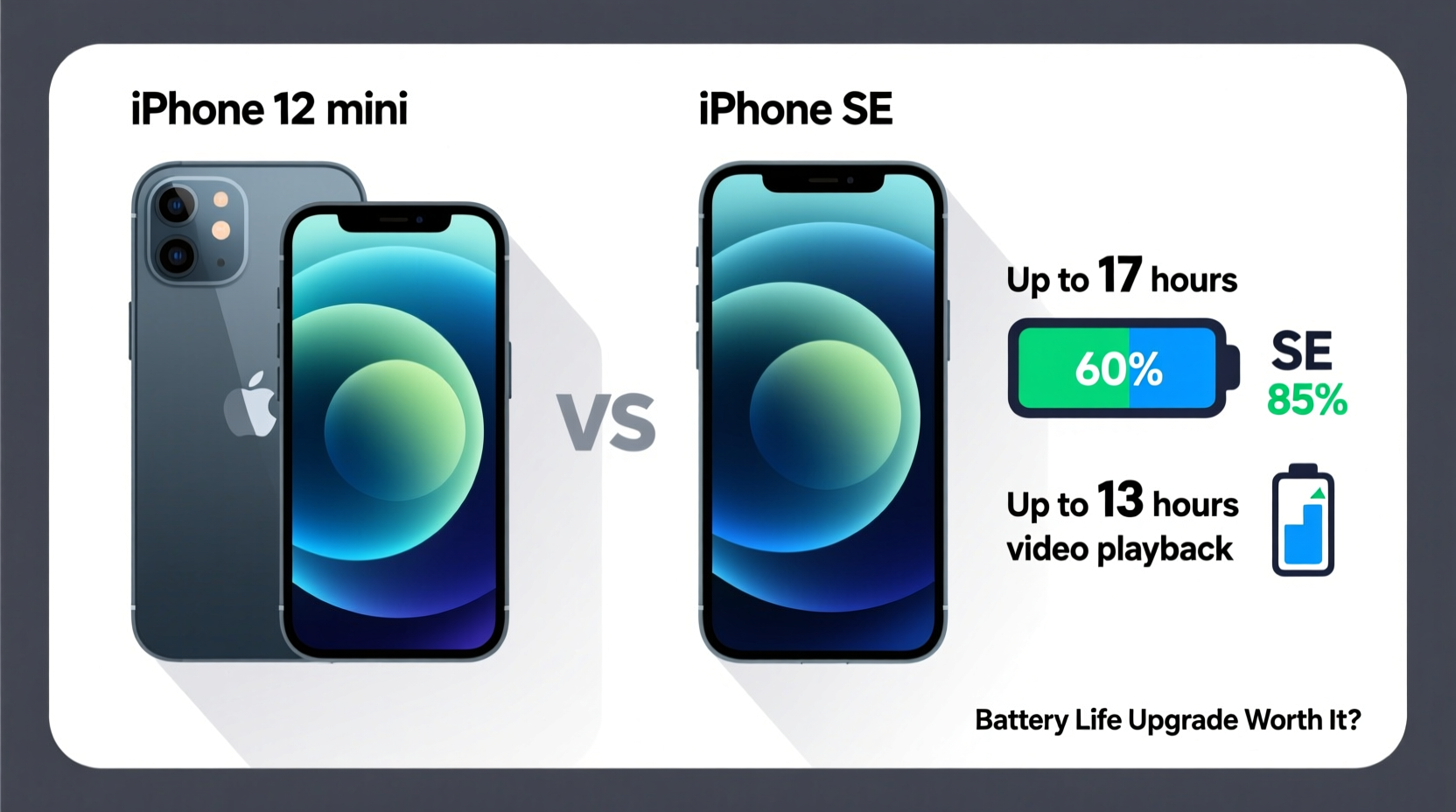
The iPhone SE (2020), despite its modern internals, uses the same chassis as the iPhone 8. This legacy design limits its internal space, resulting in a modest 1,821 mAh battery. In contrast, the iPhone 12 mini, though similarly compact, benefits from newer engineering and a more efficient layout, packing a slightly larger 2,227 mAh cell. That’s about a 22% increase in capacity on paper.
However, capacity isn’t the full story. The 12 mini runs on the A14 Bionic chip — the same as the SE 2 — but features a power-hungry OLED display, 5G connectivity, and a more advanced camera system. These components draw more energy, partially offsetting gains from the larger battery. Meanwhile, the SE 2 uses an older LCD screen and lacks 5G, which helps conserve power despite its smaller cell.
“Battery life isn't just about milliamp-hours — it's about efficiency, software optimization, and user behavior.” — Dr. Linh Nguyen, Mobile Power Systems Researcher at Stanford University
Real-World Battery Performance Comparison
Apple’s official estimates suggest the 12 mini lasts up to 17 hours of video playback, while the SE 2 manages 13 hours. In mixed-use scenarios — including social media, messaging, web browsing, and light photography — the gap becomes clearer:
| Device | Video Playback (max) | Talk Time (LTE) | Standby Time | Typical Daily Use |
|---|---|---|---|---|
| iPhone SE (2nd Gen) | 13 hours | 14 hours | 10 days | 6–9 hours screen time |
| iPhone 12 mini | 17 hours | 15 hours | 10 days | 8–11 hours screen time |
In practical terms, most users report the SE 2 requiring a charge by late afternoon with moderate use, especially if using GPS, streaming audio, or 4G data. The 12 mini, meanwhile, frequently makes it through a full day — even with heavier tasks like podcast listening, navigation, or video calls.
A Closer Look: Who Benefits Most From the Upgrade?
Not every user will notice or need the extra two to three hours of screen time. The value of the upgrade depends heavily on lifestyle and usage habits.
Consider Sarah, a freelance graphic designer who commutes via public transit and relies on her phone for emails, Slack, design inspiration, and occasional video reviews. On her iPhone SE 2, she found herself carrying a portable charger daily. After switching to the 12 mini, she reported going two full workdays on a single charge during lighter weeks — something previously unthinkable.
Conversely, Mark, a retiree who primarily uses his phone for calls, texts, and checking weather, saw little benefit. His SE 2 lasted nearly two days, and he rarely used more than 30% of the battery in a 24-hour period. For him, the upgrade offered minimal return on investment.
If your routine includes frequent travel, outdoor activity, or unpredictable access to charging, the 12 mini’s additional endurance can reduce anxiety and dependency on power banks. But if you’re home-based, charge nightly, and use your phone lightly, the SE 2 remains perfectly capable.
Charging Behavior and Longevity Considerations
Another often-overlooked factor is long-term battery health. Both phones support fast charging (up to 50% in 30 minutes with a 20W adapter) and wireless charging, but the 12 mini’s inclusion of MagSafe enables easier drop-and-charge convenience.
More importantly, consistent partial discharges are less stressful on lithium-ion batteries than deep cycles. Because the 12 mini typically ends the day with more charge remaining, it may experience fewer full-cycle depletions over time. This could translate into better battery retention after 18–24 months of use.
- Users who drain their SE 2 completely nightly may see faster degradation.
- Those who top up frequently (e.g., morning and midday) benefit more from the 12 mini’s buffer.
- Enabling Optimized Battery Charging (Settings > Battery > Battery Health) helps both models.
Step-by-Step: Maximizing Battery Life on Either Device
- Enable Low Power Mode when below 20%, or schedule it to activate automatically at 80%.
- Reduce Motion Effects (Settings > Accessibility > Motion > Reduce Motion) to lower GPU load.
- Turn off 5G on the 12 mini unless needed; use LTE for everyday tasks to save power.
- Limit background app refresh for non-critical apps like Instagram or Spotify.
- Lower screen brightness or enable Auto-Brightness to prevent unnecessary draw.
- Disable Location Services for apps that don’t require constant tracking.
Cost vs. Benefit: Is the Upgrade Justified?
The iPhone 12 mini launched at $699, while the SE 2 started at $399 — a $300 difference. Even today, used or refurbished 12 minis typically command $100–$150 more than equivalent SE 2 units.
Ask yourself: Is an extra 2–3 hours of reliable battery worth that premium? For many professionals, parents, students, or travelers, the answer is yes. The peace of mind from not hunting for outlets during a busy day has tangible value. However, budget-conscious users or those with predictable routines may find the SE 2’s performance sufficient, especially when paired with smart charging habits.
Additionally, consider future-proofing. The 12 mini supports iOS updates until at least 2025, possibly 2026, thanks to its A14 chip and 4GB RAM. The SE 2, also A14-powered, shares similar longevity — so neither has a clear edge here.
Frequently Asked Questions
Does 5G drastically reduce the 12 mini’s battery life?
Yes, when actively in use. Streaming video over 5G can reduce battery life by up to 30% compared to LTE. However, iOS intelligently switches to LTE when 5G isn’t needed, minimizing unnecessary drain.
Can I replace the battery later to extend usability?
Absolutely. Apple offers affordable battery replacements ($69–$89). Replacing the battery after 18–24 months can restore near-original performance on either model, effectively extending their lifespan.
Is the 12 mini too small to justify the battery improvement?
Size is subjective. While both are compact, the 12 mini’s taller 5.4-inch display offers more screen real estate without significantly increasing footprint. Many users find it a better balance of portability and usability.
Final Verdict: When the Upgrade Makes Sense
The iPhone 12 mini does deliver noticeably better battery life than the SE 2 — typically 25–35% more screen-on time under real conditions. That improvement isn’t revolutionary, but it’s meaningful for users whose days are unpredictable or demanding.
If you regularly run out of juice before bedtime, rely on your phone for navigation or remote work, or simply hate carrying chargers, the 12 mini’s battery advantage likely justifies the upgrade. The enhanced display, dual-camera system, and slimmer bezels add further value beyond endurance.
But if you charge nightly, use your phone moderately, and prioritize affordability, the SE 2 remains an outstanding choice. Its battery is adequate for most average users, and the savings can be allocated elsewhere — perhaps toward accessories or future upgrades.




 浙公网安备
33010002000092号
浙公网安备
33010002000092号 浙B2-20120091-4
Comments
No comments yet. Why don't you start the discussion?