
The iPhone 12 mini and iPhone XR represent two distinct philosophies in Apple’s smartphone lineup: one prioritizes compact design without compromising on modern capabilities, while the other delivers excellent value with a larger footprint and older internals. For users torn between portability and progress, the choice isn’t just about screen size—it’s about trade-offs in performance, battery life, longevity, and daily usability. Understanding these differences can help determine whether the smaller form factor justifies stepping back from newer technology.
Design and Portability: The Mini Advantage
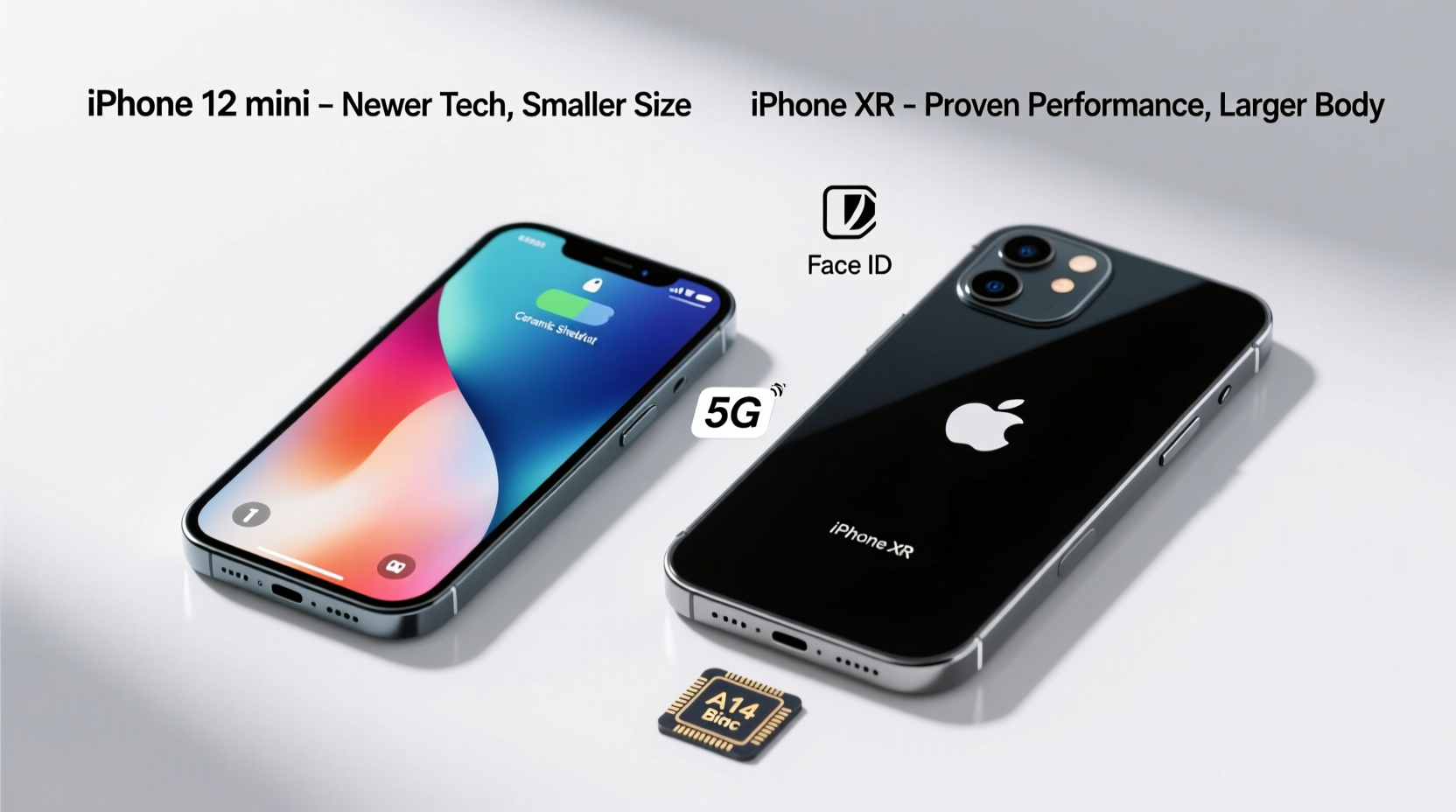
The most immediate distinction between the iPhone 12 mini and the XR is physical size. The 12 mini measures 5.18 x 2.53 x 0.29 inches and weighs just 4.76 ounces, making it one of the few truly pocketable smartphones available today. In contrast, the iPhone XR is noticeably larger at 5.65 x 2.98 x 0.30 inches and 6.84 ounces. While both devices share a glass-and-aluminum build, the 12 mini uses flat-edged aerospace-grade aluminum similar to the iPhone 4, giving it a more refined, tactile feel.
The 12 mini’s 5.4-inch Super Retina XDR OLED display offers deeper blacks, higher brightness (up to 1200 nits HDR), and better contrast than the XR’s 6.1-inch Liquid Retina LCD. However, despite its smaller footprint, the 12 mini manages usable screen real estate thanks to its edge-to-edge design and lack of a home button. Meanwhile, the XR’s LCD panel, while bright and color-accurate, lacks the vibrancy and viewing angles of OLED.
Performance and Future-Proofing
Under the hood, the iPhone 12 mini runs on Apple’s A14 Bionic chip—the first in the industry built on a 5nm process. This gives it a significant lead in CPU and GPU performance over the iPhone XR’s A12 Bionic. Real-world impact includes faster app launches, smoother multitasking, and better handling of graphics-intensive games and AR applications.
Benchmarks show the A14 delivering around 40% faster CPU performance and up to 50% better graphics efficiency than the A12. More importantly, the 12 mini supports iOS updates expected through at least 2027, while the XR, released in 2018, may see support taper off sooner. With Apple typically providing five to six years of OS updates, the 12 mini offers a longer viable lifespan for users who upgrade less frequently.
“Choosing a phone isn’t just about how it performs today—it’s about how long it remains capable. The A14 Bionic ensures the 12 mini stays relevant in an era of increasingly demanding apps.” — David Kim, Mobile Hardware Analyst at TechPulse Insights
Camera Capabilities: Evolution vs. Simplicity
Both phones feature a 12MP main rear camera, but the implementation differs meaningfully. The 12 mini adds a second 12MP ultra-wide lens, enabling greater creative flexibility with 2x optical zoom out, night mode portraits, and improved low-light photography across all lenses. Its sensor also benefits from sensor-shift stabilization (on the main camera), a feature absent even in the XR’s successor lineups until the iPhone 12 Pro.
The iPhone XR, limited to a single rear camera, relies heavily on software to simulate depth effects in Portrait Mode. While results are often impressive for a single-lens system, they fall short in complex lighting or fast-moving scenes. Additionally, the 12 mini introduces Night mode on both front and rear cameras, dramatically improving photo quality in dim environments.
Front-facing cameras tell a similar story. The 12 mini’s TrueDepth system supports Smart HDR 3 and Dolby Vision video recording up to 4K at 30fps—features not available on the XR, which maxes out at 1080p HD.
Camera Feature Comparison
| Feature | iPhone 12 mini | iPhone XR |
|---|---|---|
| Rear Cameras | Dual 12MP (Wide + Ultra-Wide) | Single 12MP (Wide) |
| Front Camera | 12MP, Smart HDR 3 | 7MP, HDR |
| Night Mode | Main & Ultra-Wide + Selfie | Main Only |
| Video Recording | Dolby Vision HDR up to 4K/30fps | HD up to 1080p/60fps |
| Zoom | 2x optical zoom out | Digital zoom only |
Battery Life and Charging: The Hidden Trade-Off
Despite its technological advantages, the 12 mini struggles where many small phones do: battery life. Apple rates it for up to 15 hours of video playback, while the larger XR achieves up to 25 hours. In real-world mixed usage, the 12 mini often requires midday charging for moderate to heavy users. The XR, with its larger 2942mAh battery compared to the 12 mini’s 2227mAh, consistently lasts a full day and sometimes stretches into a second.
Charging capabilities further widen the gap. The 12 mini supports 20W wired fast charging and MagSafe wireless charging, allowing users to regain 50% charge in about 30 minutes. The XR only supports 12W wired and standard Qi wireless charging, lacking true fast-charging hardware without third-party accessories.
Real-World Decision Making: A Case Study
Sophie, a freelance graphic designer based in Portland, used an iPhone XR for three years before upgrading. She loved its durability and screen clarity but found herself frustrated by slow app switching when using Adobe Fresco and Procreate. After testing several models, she chose the 12 mini for its pocketability and modern processor. However, she quickly noticed that her fieldwork—often lasting 10+ hours—required a portable charger. Eventually, she adopted a dual-device strategy: using the 12 mini daily and keeping a refurbished XR as a backup with extended battery cases for travel.
Her experience highlights a growing trend: some users aren’t choosing one phone over another—they’re leveraging both for different needs. The 12 mini excels as a primary daily driver for those prioritizing speed and size, while the XR remains a reliable secondary option for endurance-focused scenarios.
Checklist: Choosing Between iPhone 12 mini and XR
- ✅ Prioritize compact size and modern design → Choose 12 mini
- ✅ Need longer battery life and lower price → Choose XR
- ✅ Use camera features like ultra-wide shots or Dolby Vision → Choose 12 mini
- ✅ Want future-proof performance and iOS support → Choose 12 mini
- ✅ Frequently use phone away from power sources → Consider XR
- ✅ Prefer OLED display with deeper blacks → Choose 12 mini
Frequently Asked Questions
Is the iPhone 12 mini still supported by Apple?
Yes. Released in 2020, the iPhone 12 mini continues to receive iOS updates and security patches. It is expected to be supported through at least 2027, aligning with Apple’s typical 6–7 year software lifecycle.
Can the iPhone XR run the latest apps smoothly?
Most current apps run adequately on the XR, but performance degrades with heavier workloads like augmented reality, video editing, or multitasking across multiple high-demand apps. Users may notice longer load times and occasional stutters compared to A14 and later chips.
Why did Apple discontinue the 12 mini?
Despite critical acclaim, the 12 mini underperformed in sales due to its short battery life and niche appeal. Apple replaced it with the iPhone 14 Plus—a larger, battery-efficient model—indicating a shift toward balancing size and endurance rather than extreme compactness.
Final Verdict: Is the Smaller Size Worth It?
The iPhone 12 mini offers a rare combination of cutting-edge technology in a genuinely small body—a feat few competitors match. Its A14 chip, dual-camera system, OLED display, and modern connectivity make it objectively superior to the XR in nearly every technical aspect. However, the compromise in battery life is real and impactful for many users.
The iPhone XR, while older, remains a compelling device for budget-conscious buyers or those who prioritize screen time over spec sheets. It delivers excellent core functionality at a lower price point and avoids the anxiety of frequent charging.
If you value having the latest technology, a premium build, and a phone that fits comfortably in one hand, the 12 mini is worth the trade-off—even if it means carrying a power bank. But if your priority is simplicity, endurance, and cost-effectiveness, the XR still holds its ground remarkably well in 2024.




 浙公网安备
33010002000092号
浙公网安备
33010002000092号 浙B2-20120091-4
Comments
No comments yet. Why don't you start the discussion?