
Two years after the iPhone 11 Pro’s release, Apple introduced the iPhone 12—a sleeker, faster, 5G-enabled successor. For owners of the 11 Pro wondering whether to upgrade, the decision isn’t just about new features. It’s about real-world value, longevity, and how much those incremental improvements enhance daily use.
The iPhone 11 Pro was a powerhouse in its time, with a triple-camera system, OLED display, and all-day battery life. The iPhone 12 brought design changes, improved processors, and future-proof connectivity. But does that translate into a meaningful upgrade for someone already using a high-end device?
Design and Build: A Shift in Materials
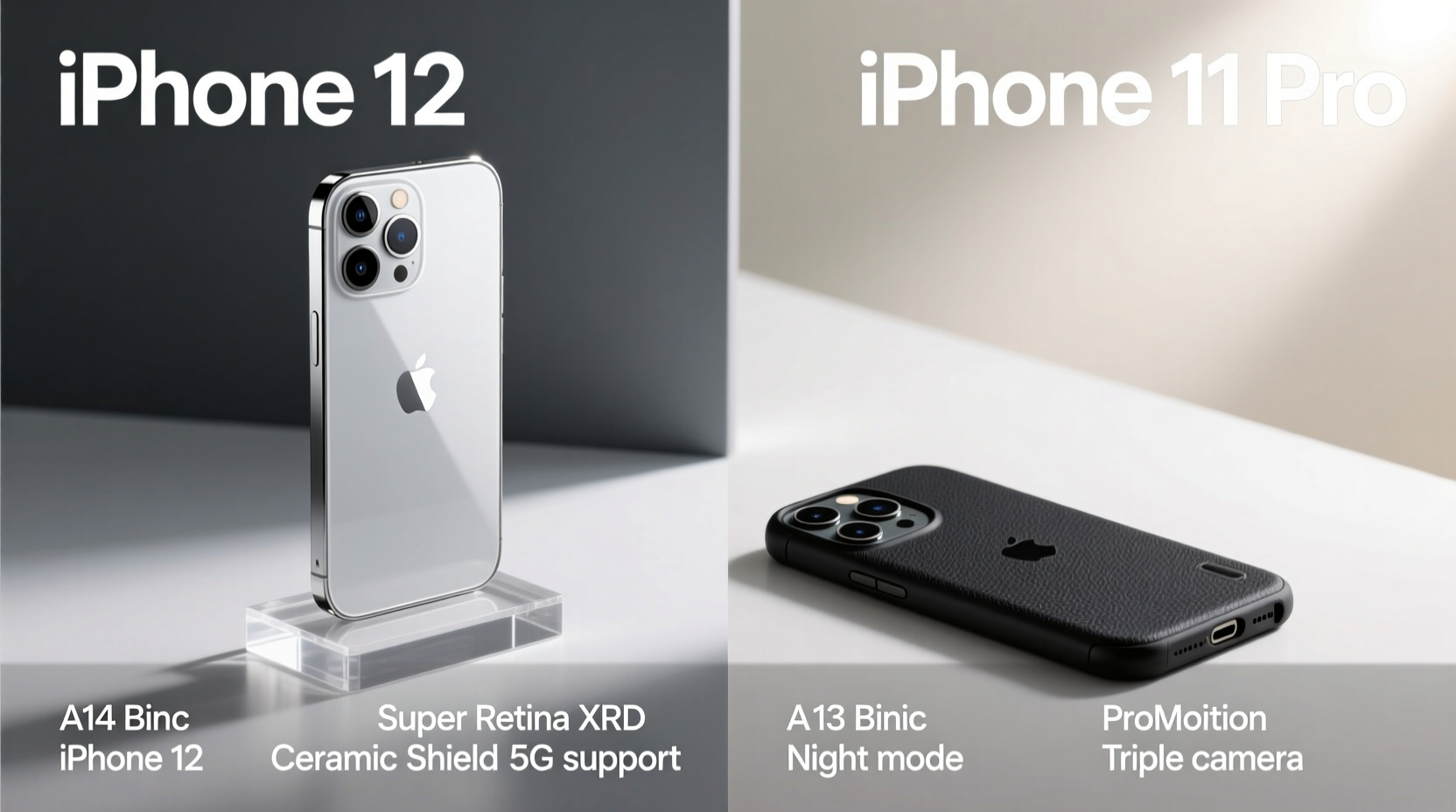
The most immediate difference between the two models is the design language. The iPhone 11 Pro featured curved edges and a glossy back, while the iPhone 12 returned to flat aluminum edges reminiscent of the iPhone 4 era. This change improves grip and gives the phone a more modern, minimalist look.
Apple also introduced Ceramic Shield on the front of the iPhone 12, claiming it offers better drop resistance than any previous iPhone. In independent tests, the iPhone 12 survived drops from shoulder height significantly better than the 11 Pro, which relied on standard glass protection.
Both phones are water-resistant (IP68), but the iPhone 12 maintains this rating at greater depths (up to 6 meters for 30 minutes vs. 4 meters). While most users won’t test these limits, it reflects tighter engineering tolerances.
Performance: Speed vs. Sufficiency
The iPhone 12 runs on the A14 Bionic chip—the first smartphone processor built on a 5-nanometer process. Compared to the 11 Pro’s A13, the A14 delivers roughly 16% faster CPU performance and 8% better GPU efficiency under load.
In practical terms, both devices handle everyday tasks—browsing, messaging, video streaming—with no lag. However, the A14 shows advantages in sustained workloads like video editing, gaming at higher frame rates, and machine learning tasks such as advanced photo processing.
“Even if you don’t feel the speed difference today, the A14 ensures smoother software updates three to four years down the line.” — David Lin, Mobile Hardware Analyst at TechPulse Insights
iOS updates tend to become heavier over time. Devices with newer chips generally stay responsive longer. Given that many users keep phones for 3–4 years, upgrading now could extend total usable life by a year compared to sticking with the 11 Pro.
Camera Comparison: Subtle Gains, Not Leaps
The iPhone 11 Pro set a high bar with its triple-lens system: ultra-wide, wide, and telephoto. The iPhone 12 retains the same configuration but improves sensor quality and computational photography.
Night mode now works across all lenses, not just the main and front cameras. The Night mode portrait feature captures dramatically better low-light portraits. Smart HDR 3 processes images more naturally, preserving highlights and shadows without over-processing.
In direct comparisons, the iPhone 12 produces slightly sharper textures, better dynamic range, and more accurate skin tones. These differences are noticeable when pixel-peeping or printing large photos, but less so on social media thumbnails.
| Feature | iPhone 11 Pro | iPhone 12 |
|---|---|---|
| Chip | A13 Bionic | A14 Bionic |
| Display | 5.8” OLED (Super Retina XDR) | 6.1” OLED (Super Retina XDR) |
| Resolution | 2436 x 1125 | 2532 x 1170 |
| Rear Cameras | Triple 12MP | Triple 12MP (improved sensors) |
| Front Camera | 12MP, f/2.2 | 12MP, f/2.2 + Night Mode |
| Battery Life (Video Playback) | 18 hours | 17 hours |
| Charging | Fast Charging (18W), Wireless | Fast Charging (20W), MagSafe compatible |
| Connectivity | LTE only | 5G (mmWave & sub-6GHz) |
| Weight | 188g | 164g |
| Water Resistance | IP68 (4m) | IP68 (6m) |
Real-World Example: Sarah’s Upgrade Dilemma
Sarah, a freelance photographer based in Portland, used her iPhone 11 Pro daily for client previews, social content, and travel documentation. By late 2022, she noticed iOS 15 felt slightly sluggish during multitasking and her battery dropped below 80% health.
She considered the iPhone 12 primarily for its improved low-light video stabilization and MagSafe compatibility, which allowed her to attach a portable lens kit securely. After testing both devices side-by-side in dimly lit cafes and outdoor dusk shoots, she found the iPhone 12 delivered cleaner footage with less noise.
“It wasn’t a night-and-day difference,” she said, “but the consistency across lighting conditions gave me more confidence shooting straight-to-client videos.” She upgraded and extended her workflow efficiency without investing in a dedicated camera.
Is 5G Worth the Switch?
One of the iPhone 12’s headline features is 5G support—both mmWave (ultra-fast, short-range) and sub-6GHz (wider coverage, moderate speed). In urban centers with dense 5G infrastructure, download speeds can reach 300–600 Mbps, drastically reducing app install times and buffering.
However, outside major cities, 5G availability remains spotty. Many carriers still rely on LTE fallbacks, and mmWave signals struggle indoors. Worse, early 5G implementations drained battery faster due to constant network searching.
If you live in a well-covered area and regularly transfer large files or stream 4K content on the go, 5G adds tangible value. Otherwise, it may remain an underused feature—especially since LTE networks continue improving.
Step-by-Step: Should You Upgrade?
- Evaluate your current phone’s condition. If your 11 Pro still holds a charge past 80%, runs apps smoothly, and has no hardware issues, it likely has 1–2 good years left.
- Assess your usage patterns. Do you edit videos, play graphics-heavy games, or need fast uploads? High-demand tasks benefit more from the A14 and 5G.
- Check carrier coverage. Use your provider’s 5G map to see if your home, office, and commute zones have reliable service.
- Consider accessory ecosystem. MagSafe enables new accessories—wallets, car mounts, battery packs—that snap on magnetically. If you value convenience, this integration enhances usability.
- Calculate cost vs. benefit. Factor in trade-in values. An iPhone 11 Pro in good condition can fetch $200–$275, lowering the net cost of an iPhone 12.
Frequently Asked Questions
Will the iPhone 12 last longer than my 11 Pro?
Yes, likely. The A14 chip will receive iOS updates longer—potentially through 2026 or beyond—compared to the A13, which may stop receiving updates around 2025. Additionally, better thermal management reduces long-term wear.
Can I notice the screen size difference?
The iPhone 12’s 6.1-inch display is slightly larger than the 11 Pro’s 5.8 inches, but the bezels are thinner. Most users adapt within a day. One-handed use remains comfortable, though thumb reach might require slight adjustment.
Does the lighter weight affect durability?
The iPhone 12 is 24 grams lighter than the 11 Pro due to redesigned internal layout and materials. Despite this, third-party stress tests show comparable structural rigidity. The reduced weight improves comfort during prolonged use, such as reading or watching videos.
Final Verdict: Who Should Upgrade?
For casual users, the iPhone 12 is a refinement rather than a revolution. If your 11 Pro still performs well, waiting another year makes financial sense. The improvements are evolutionary—better durability, modest camera gains, and future-ready 5G—not transformative.
But for professionals, frequent travelers in strong 5G zones, or those nearing battery replacement costs ($89 for out-of-warranty units), the upgrade pays off in reliability and long-term usability.
Ultimately, the iPhone 12 isn’t essential—but it is smarter, faster, and built to last. If you value peace of mind and seamless performance for the next three years, stepping up is justified.




 浙公网安备
33010002000092号
浙公网安备
33010002000092号 浙B2-20120091-4
Comments
No comments yet. Why don't you start the discussion?