
The iPhone 12 Pro Max was a landmark release for Apple, not only because of its superior camera system and powerful A14 Bionic chip but also due to one significant feature: dual SIM capability. For the first time in an iPhone, users could run two phone lines simultaneously—one via a physical nano-SIM and the other through an embedded eSIM. This innovation opened new doors for travelers, business professionals, and anyone juggling personal and work numbers. But a pressing question remains: Is using the dual SIM (physical + eSIM) truly better than relying solely on eSIM? The answer depends on usage patterns, carrier support, reliability needs, and long-term convenience.
Understanding Dual SIM and eSIM on iPhone 12 Pro Max
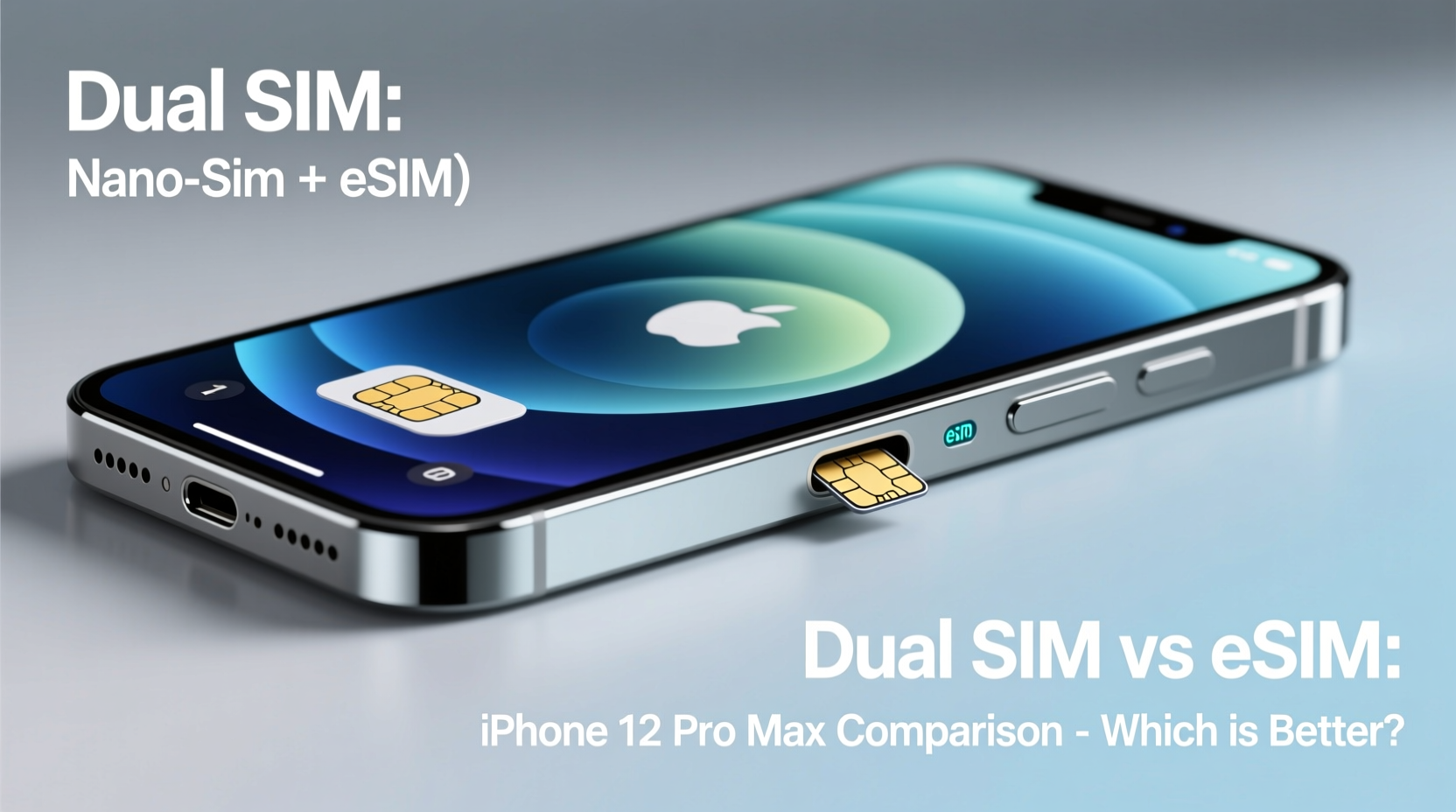
The iPhone 12 Pro Max supports a hybrid dual SIM setup: one physical nano-SIM slot and one digital eSIM. Unlike traditional dual SIM phones that accept two physical cards, Apple’s implementation combines legacy compatibility with modern flexibility. The eSIM is built into the device’s hardware and can be activated remotely by scanning a QR code or through carrier apps—no plastic card required.
This design allows users to maintain separate numbers for different purposes—say, a U.S.-based number for family and a local European number while traveling—without swapping SIMs. However, it's important to note that both lines cannot be active simultaneously for voice calls; when one line is in use, the other goes to voicemail unless Wi-Fi calling is enabled.
Advantages of Dual SIM (Physical + eSIM)
Using both a physical SIM and an eSIM offers tangible benefits, especially for users who value redundancy and flexibility.
- Backup connectivity: If your eSIM fails due to carrier provisioning errors or software glitches, the physical SIM acts as a fallback.
- Global travel ease: Keep your home number active on the physical SIM while adding a temporary local plan via eSIM abroad—no need to carry multiple devices.
- Carrier flexibility: Some carriers still don’t support eSIM activation, particularly smaller regional providers. A physical SIM ensures broader network access.
- No dependency on internet for activation: Physical SIMs work immediately upon insertion, whereas eSIMs require internet access to download the profile.
“Dual SIM functionality on the iPhone 12 Pro Max is a game-changer for international business travelers. It eliminates the hassle of carrying two phones and reduces the risk of missing critical calls.” — David Lin, Mobile Solutions Consultant at TechEdge Global
eSIM-Only Use: Convenience vs. Limitations
While eSIM offers sleek, wire-free simplicity, going all-digital comes with trade-offs. Users who rely exclusively on eSIM for their primary number may face challenges during device transfers, OS updates, or accidental profile deletions.
One major concern is portability. Transferring an eSIM to a new iPhone requires reactivation through the carrier, which can take hours—or even days—if customer service queues are long. In contrast, a physical SIM can be removed and inserted into another compatible phone instantly.
Additionally, some countries and carriers still lack full eSIM support. In regions like parts of Southeast Asia, Africa, or rural areas of Latin America, local networks may not offer eSIM plans at all, forcing travelers to revert to physical SIMs anyway.
When eSIM Shines
eSIM excels in controlled environments where infrastructure is reliable. For example:
- Frequent short trips within eSIM-supported countries
- Users with strong carrier relationships (e.g., AT&T, Verizon, T-Mobile in the U.S.)
- Those who prioritize minimalism and avoid managing plastic SIM cards
Real-World Example: Business Traveler in Asia
Consider Mark, a sales executive based in San Francisco who travels monthly to Japan, Singapore, and India. He uses his iPhone 12 Pro Max with a physical SIM from his U.S. carrier (T-Mobile) and activates a local eSIM in each country via the Apple Store’s partnership with local providers.
In Tokyo, he scans a QR code at the airport to activate a 30-day SoftBank eSIM. Calls to clients appear under a Japanese number, improving local trust. When flying to Mumbai, however, he discovers that his preferred Indian carrier doesn’t support eSIM provisioning for foreign visitors. Without a spare physical SIM, he would have been disconnected. Instead, he uses a backup nano-SIM preloaded with a Reliance Jio plan, maintaining connectivity until he returns to eSIM-friendly zones.
This scenario illustrates why having a physical SIM as part of the dual SIM setup provides crucial insurance against inconsistent global eSIM adoption.
Comparison Table: Dual SIM vs. eSIM-Only on iPhone 12 Pro Max
| Feature | Dual SIM (Physical + eSIM) | eSIM Only |
|---|---|---|
| Setup Speed | Instant (physical), minutes (eSIM) | Requires internet and carrier approval |
| Travel Flexibility | High – works globally with local SIMs | Limited to eSIM-supported regions |
| Device Transfer | Easy – move physical SIM to new phone | Depends on carrier reactivation speed |
| Durability | Physical SIM can degrade over time | No wear, but vulnerable to software bugs |
| Security | Physical theft risk if SIM swapped fraudulently | More secure, tied to Apple ID and device |
| Redundancy | Yes – one line backs up the other | No – single point of failure |
Actionable Checklist: Optimizing Your iPhone 12 Pro Max SIM Setup
To get the most out of your iPhone 12 Pro Max’s dual SIM capability, follow this checklist:
- ✅ Assign clear roles to each line (e.g., Line 1 = personal, Line 2 = business)
- ✅ Enable Wi-Fi calling and data roaming on both numbers
- ✅ Label your lines in Settings > Cellular > Cellular Plans for easy identification
- ✅ Test incoming calls on both numbers before traveling
- ✅ Keep a spare physical SIM with a basic plan for emergencies
- ✅ Regularly back up your iPhone to preserve eSIM profiles during resets
- ✅ Confirm eSIM compatibility with your carrier before deactivating a physical SIM
Expert Insight: Long-Term Viability of eSIM
Despite growing adoption, eSIM technology is still maturing. Carriers vary widely in how they manage provisioning, customer support, and cross-border compatibility.
\"While eSIM represents the future of mobile connectivity, we're still in a transition phase. Until every carrier worldwide supports seamless activation and transfer, dual SIM setups with a physical fallback remain the smarter choice for power users.\" — Dr. Lena Patel, Telecommunications Analyst at ConnectInsight Group
Apple continues to push toward an eSIM-only future—starting with U.S. models of the iPhone 14 and later—but the absence of a physical SIM has drawn criticism from consumers who value control and accessibility.
FAQ
Can I use two eSIMs on the iPhone 12 Pro Max?
No. The iPhone 12 Pro Max supports only one eSIM and one physical SIM at a time. You cannot have two active eSIMs simultaneously.
What happens if I lose my eSIM activation QR code?
You can request a new QR code from your carrier or reactivate the eSIM through their app or website, provided your number is still associated with your account.
Does using dual SIM drain the battery faster?
Not significantly. While both lines remain registered on their networks, the impact on battery life is minimal under normal usage. However, frequent network switching in weak signal areas may increase power consumption slightly.
Conclusion: Choose Based on Need, Not Trend
The iPhone 12 Pro Max’s dual SIM capability isn’t just a technical novelty—it’s a practical tool for managing modern communication demands. While eSIM offers undeniable elegance and convenience, relying on it exclusively introduces risks related to availability, recovery, and interoperability.
For most users, especially those who travel internationally or depend on uninterrupted connectivity, combining a physical SIM with an eSIM delivers the best balance of reliability and flexibility. The physical SIM serves as a fail-safe; the eSIM enables seamless switching between networks. Together, they form a resilient system that adapts to real-world unpredictability.




 浙公网安备
33010002000092号
浙公网安备
33010002000092号 浙B2-20120091-4
Comments
No comments yet. Why don't you start the discussion?