
For years, Samsung has dominated the high-end Android market with its Galaxy Note series, offering powerful hardware, a stylus, and expansive displays that catered to professionals and creatives alike. Apple’s iPhone 12 Pro Max, released in late 2020, marked a turning point — not just as another incremental upgrade, but as a device that challenged the long-standing loyalty many users had to Samsung’s flagship line. The question now isn’t just about specs; it’s whether the iPhone 12 Pro Max offers enough compelling advantages to justify switching from the Galaxy Note 20 Ultra.
This isn’t merely a battle of megapixels or processor speed. It’s about ecosystem integration, long-term software support, real-world usability, and personal workflow alignment. For users entrenched in Samsung’s ecosystem — with Galaxy Buds, SmartThings, DeX, and S Pen functionality — switching feels like more than changing phones. It’s shifting digital lifestyles.
Design and Build: Premium Materials, Different Philosophies
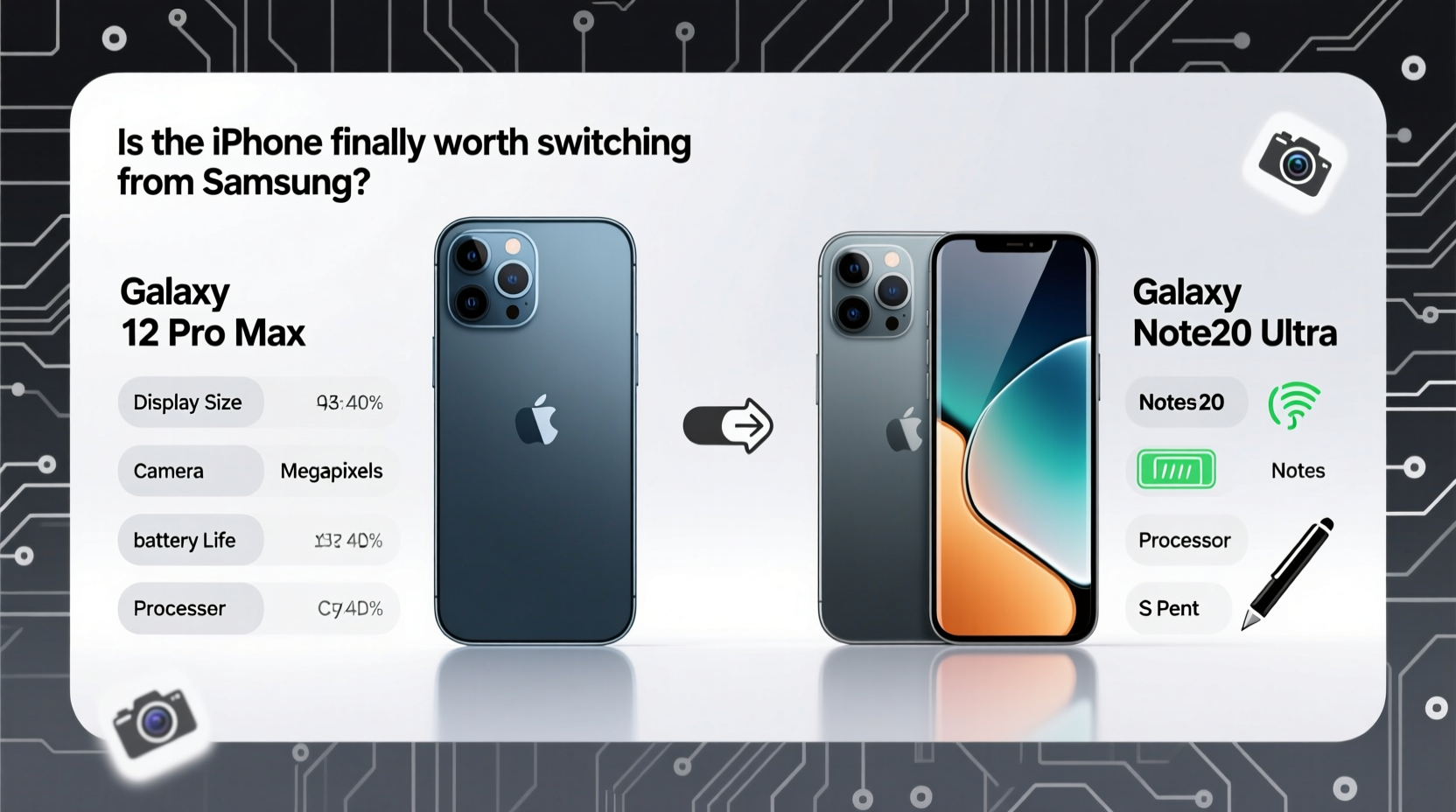
The iPhone 12 Pro Max introduced Apple’s flat-edge stainless steel design, reminiscent of the iPhone 4 era but refined for modern use. Its Ceramic Shield front cover and precision-machined aluminum frame deliver durability and a distinct tactile experience. At 226 grams, it’s heavy but balanced, with a compact footprint relative to its 6.7-inch display.
In contrast, the Galaxy Note 20 Ultra features a sleek matte glass back with a metal frame and a subtle curved edge on its Dynamic AMOLED 2X panel. It weighs slightly more at 208 grams and includes an integrated S Pen silo — a signature feature absent on any iPhone. While both devices feel premium, their philosophies diverge: Apple emphasizes minimalism and longevity; Samsung leans into versatility and tool integration.
Display and Usability: Brightness vs. Consistency
The Note 20 Ultra’s 6.9-inch QHD+ display runs at 120Hz with adaptive refresh rate technology, delivering buttery-smooth scrolling and responsiveness. Its peak brightness exceeds 1500 nits, making it one of the most visible screens under direct sunlight. The curved edges, while elegant, can cause glare and accidental touches.
Apple opted for a 6.7-inch Super Retina XDR OLED at a fixed 60Hz refresh rate. While technically behind Samsung in refresh speed, the iPhone’s color accuracy, contrast ratio (1,000,000:1), and HDR performance are industry-leading. iOS animations are optimized for fluidity even without high Hz, and the flat screen eliminates parallax issues common on curved panels.
For media consumption and outdoor visibility, Samsung wins on paper. But for color-critical work like photo editing or video grading, the iPhone’s calibrated consistency across devices often proves more reliable.
Performance and Software Longevity
Beneath the surface, these devices couldn’t be more different. The iPhone 12 Pro Max runs on Apple’s A14 Bionic chip — the first 5nm mobile processor at launch. Benchmarks showed it outperforming every Android counterpart, including the Snapdragon 865+ in the Note 20 Ultra, by up to 40% in CPU tasks and nearly double in GPU efficiency.
But raw power isn’t the full story. iOS offers tighter hardware-software integration, resulting in smoother multitasking, faster app launches, and longer-term software support. iPhones typically receive 5–6 years of OS updates; Samsung guarantees only 4 years of major Android upgrades for the Note 20 Ultra.
“Switching from Android to iOS used to mean sacrificing features. Now, it’s about gaining stability and long-term reliability.” — David Kim, Mobile Systems Analyst at TechInsider Group
If you plan to keep your phone beyond three years, the iPhone’s update policy becomes a decisive advantage. Apps remain compatible longer, security patches are consistent, and resale value stays higher.
Camera Comparison: Versatility vs. Simplicity
The Galaxy Note 20 Ultra packs a triple rear system: 108MP main, 12MP ultrawide, and a 12MP periscope telephoto with 5x optical zoom. It supports 8K video recording and advanced AI scene optimization. However, the high-resolution mode is rarely used due to processing bloat, and low-light photos can appear oversharpened.
The iPhone 12 Pro Max features a 12MP main sensor with sensor-shift stabilization — a first for smartphones — along with a 12MP ultrawide and 65mm telephoto (2.5x optical zoom). While lower in megapixel count, its larger sensor captures 87% more light, producing superior dynamic range and noise control in dim environments. Night mode is automatic and consistently excellent.
| Feature | iPhone 12 Pro Max | Galaxy Note 20 Ultra |
|---|---|---|
| Main Sensor | 12MP, sensor-shift OIS | 108MP, standard OIS |
| Telephoto Zoom | 2.5x optical, 10x digital | 5x optical, 50x digital |
| Low-Light Performance | Excellent (Night mode) | Good (occasional noise) |
| Video Recording | 4K Dolby Vision HDR | 8K@24fps |
| Front Camera | 12MP, 4K | 10MP, 4K |
Dolby Vision HDR video recording on the iPhone sets a new benchmark for mobile filmmaking. While Samsung records higher-resolution 8K footage, it lacks the end-to-end color grading pipeline Apple offers. For creators who edit on Macs or use Final Cut Pro, this integration streamlines workflows significantly.
Battery Life and Charging: Real-World Endurance
Both phones offer all-day battery life, but usage patterns reveal key differences. The Note 20 Ultra’s 4,500mAh battery supports 25W fast charging, 15W wireless charging, and reverse wireless charging. With moderate use, it lasts around 10–11 hours of screen-on time.
The iPhone 12 Pro Max, despite a smaller 3,687mAh battery, achieves comparable endurance thanks to the A14’s efficiency and iOS power management. It supports 20W wired and 15W MagSafe wireless charging — slightly slower than Samsung, but MagSafe enables new accessories like wallets and chargers that snap into place magnetically.
Neither includes a charger in the box, following eco-conscious trends. But Apple’s move predates Samsung’s, suggesting a longer-term strategy toward accessory ecosystems rather than just power delivery.
Mini Case Study: From Note Power User to iPhone Convert
Jessica Lin, a freelance architect based in Chicago, used Galaxy Notes since the Note 5. She relied on the S Pen for sketching floor plans and took hundreds of reference photos weekly. In 2021, she switched to the iPhone 12 Pro Max after her Note 20 Ultra developed charging port issues and stopped receiving updates sooner than expected.
“I missed the S Pen at first,” she said. “But I started using an iPad with Apple Pencil for sketches, and my iPhone seamlessly synced everything via iCloud. The camera quality improved my site documentation, and Face ID works better in cold weather than fingerprint sensors.”
Her transition highlights a broader trend: users aren’t replacing one device — they’re upgrading entire ecosystems. Once inside Apple’s world, the synergy between iPhone, iPad, Mac, and AirPods reduces friction enough to outweigh losing the S Pen.
Checklist: Should You Switch?
- ✅ Do you prioritize long-term software updates and resale value?
- ✅ Are you already using other Apple devices (Mac, iPad, Watch)?
- ✅ Is camera consistency and video quality more important than zoom range?
- ✅ Do you prefer intuitive, stable software over customizable interfaces?
- ❌ Do you heavily depend on the S Pen for daily tasks?
- ❌ Are you invested in Samsung DeX or Knox security for enterprise use?
If most of your answers align with the first four, the switch makes strategic sense. If the last two are critical, staying with Samsung remains justified.
Frequently Asked Questions
Can I transfer data easily from Galaxy Note 20 Ultra to iPhone 12 Pro Max?
Yes. Apple’s “Move to iOS” app, available on the Google Play Store, securely transfers contacts, messages, photos, calendars, and free apps over a private Wi-Fi connection. Paid apps must be re-downloaded, but purchases tied to Google accounts may not carry over.
Is the lack of a headphone jack a dealbreaker?
Not necessarily. Both phones omit the 3.5mm jack. Users adapt quickly to Bluetooth earbuds or USB-C/Lightning adapters. AirPods offer tighter integration with iPhone, while Galaxy Buds work best with Samsung.
Which phone holds value better over time?
The iPhone 12 Pro Max retains value significantly better. After 18 months, it typically resells for 60–70% of original price; the Note 20 Ultra drops to 40–50%. This reflects stronger demand, longer support, and brand perception in the secondhand market.
Conclusion: The Switch Makes Sense — But Only If You're Ready
The iPhone 12 Pro Max isn’t just competitive with the Galaxy Note 20 Ultra — in several key areas, it surpasses it. Superior processors, longer software support, better video capabilities, and seamless ecosystem integration make it the most compelling iPhone yet for former Samsung loyalists.
However, switching means letting go of beloved features: the S Pen, ultra-high zoom, DeX desktop mode, and deep Android customization. The decision isn’t about which phone has more specs, but which aligns with how you live and work.




 浙公网安备
33010002000092号
浙公网安备
33010002000092号 浙B2-20120091-4
Comments
No comments yet. Why don't you start the discussion?