
In the premium smartphone arena of 2020, two flagships stood tall: Apple’s iPhone 12 Pro Max and Huawei’s P40 Pro Plus. Both devices represented the peak of their respective brands’ engineering—Apple with its tightly integrated ecosystem and Huawei with its groundbreaking camera technology. But when placed side by side, did Apple truly come out on top? Or was Huawei’s innovation enough to dethrone the industry leader?
This isn’t just about specs or marketing claims. It’s about real-world usability, longevity, software support, and what each device offers in terms of value for power users, creatives, and tech enthusiasts.
Design and Build Quality: Premium Materials, Different Philosophies
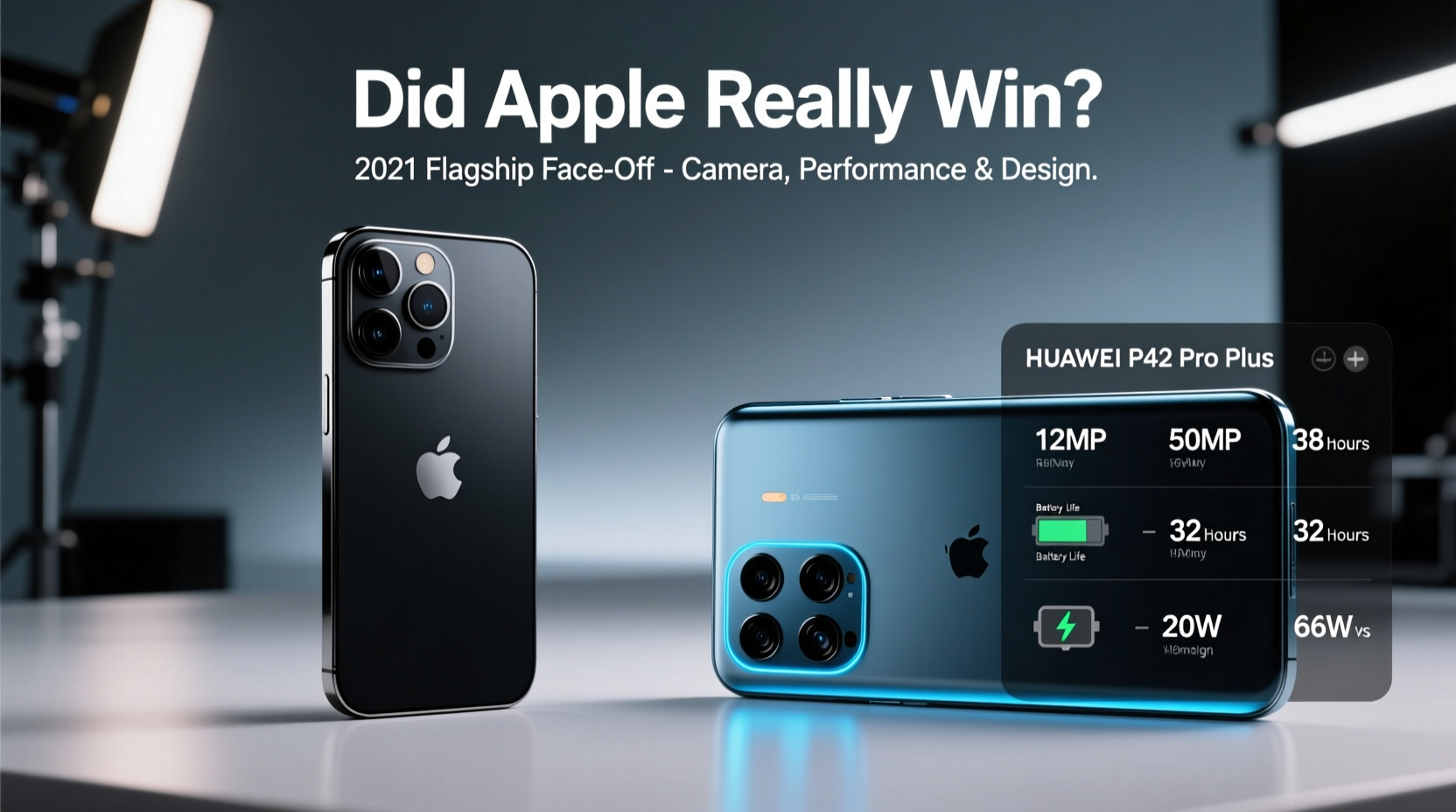
The iPhone 12 Pro Max introduced a flat-edge stainless steel frame with Ceramic Shield front cover, giving it a retro-inspired look reminiscent of the iPhone 4 era. Its squared-off edges provide a more tactile grip but can feel sharp over time. At 226 grams, it's heavy, yet the build exudes durability and sophistication.
Huawei’s P40 Pro Plus, meanwhile, adopted a curved OLED display with an \"Infinity Edge\" design and used nano-crystalline ceramic materials for the back panel. This gave it a smoother, cooler-to-the-touch feel compared to glass, along with superior scratch resistance. At 226 grams as well, it matches the weight but distributes it differently due to its curved form factor.
Material Comparison at a Glance
| Feature | iPhone 12 Pro Max | Huawei P40 Pro Plus |
|---|---|---|
| Frame Material | Stainless Steel | Aluminum Alloy |
| Back Material | Glass (Ceramic Shield) | Nano-Crystalline Ceramic |
| Water Resistance | IP68 (6m for 30 min) | IP68 (2m for 30 min) |
| Weight | 226g | 226g |
While both phones are built to last, Apple leans toward industrial precision, whereas Huawei embraces elegance and material innovation. Neither clearly “wins,” but preferences may depend on whether you value rigidity (Apple) or refinement (Huawei).
Camera Systems: Innovation vs Consistency
If there’s one area where Huawei challenged Apple most aggressively, it was photography. The P40 Pro Plus featured a dual-telephoto system: one periscope lens offering 10x optical zoom and another supporting 3x, enabling lossless hybrid zoom up to 10x and digital zoom up to 100x. Paired with a 50MP main sensor using RYYB technology for improved low-light capture, it set new standards for mobile zoom.
Apple, in contrast, equipped the iPhone 12 Pro Max with a 12MP main sensor featuring sensor-shift stabilization—a first for iPhones—and 2.4x optical zoom range via its telephoto lens. While it lacks extreme zoom capabilities, Apple focused on consistency across lenses and computational photography enhancements like Deep Fusion and Smart HDR 3.
“Huawei pushed hardware boundaries, but Apple mastered post-processing. One captures more light; the other tells a better story.” — David Lin, Mobile Imaging Analyst at TechScope Asia
In daylight, both deliver excellent dynamic range and color accuracy. In low light, the P40 Pro Plus often captures brighter scenes due to its larger effective pixel size, though sometimes at the cost of natural tone. The iPhone produces more balanced, filmic images—even if slightly darker.
Real Example: Wildlife Photographer’s Experience
A nature photographer based in Norway tested both devices during a trip to Svalbard. Attempting to photograph distant polar bears, the P40 Pro Plus allowed clear framing at 10x zoom without significant blur. The iPhone required moving closer, which wasn’t always safe or possible. However, when editing RAW files later, the iPhone’s ProRAW format offered greater flexibility in recovering shadows and highlights. For field versatility, Huawei won. For post-production control, Apple had the edge.
Performance and Software: Ecosystem Lock-In vs Raw Flexibility
The iPhone 12 Pro Max runs iOS 14 (upgradable to latest versions), powered by Apple’s A14 Bionic chip—the first 5nm processor in a smartphone. Benchmarks consistently showed it outperforming rivals in CPU and GPU tasks, maintaining smooth operation even under sustained load.
Huawei’s P40 Pro Plus uses the Kirin 990 5G, also built on 7nm+ process. While powerful, it trails the A14 in raw speed and efficiency. Real-world usage remains fluid, especially with EMUI 10.1, but multitasking with heavy apps shows slight stutters over time.
However, the bigger issue lies beyond hardware: Google services. Due to U.S. trade restrictions, the P40 Pro Plus ships without access to Google Play Services, affecting everything from app availability (e.g., Instagram, WhatsApp updates) to seamless cloud sync and location accuracy. Users must rely on Huawei Mobile Services (HMS) and third-party workarounds—an inconvenience many Western consumers aren’t willing to accept.
Software Longevity Outlook
- iPhone 12 Pro Max: Expected iOS support until 2025–2026, with annual major updates.
- P40 Pro Plus: Security patches continue, but no guaranteed future OS upgrades beyond EMUI 12.
For long-term ownership, Apple’s track record of five years of OS updates gives it a decisive advantage over Huawei’s uncertain roadmap post-sanctions.
Battery Life and Charging: Efficiency vs Speed
The iPhone 12 Pro Max packs a 3,687mAh battery, delivering up to 20 hours of video playback. In mixed use, it comfortably lasts a full day. However, charging options are limited: 20W wired fast charging (charger not included) and 15W MagSafe wireless. No USB-C port remains a point of criticism.
Huawei counters with a 4,200mAh cell and 40W wired super-fast charging—reaching 70% in 30 minutes. Even more impressive is its 40W wireless charging capability, doubling Apple’s maximum. Reverse wireless charging is available on both.
Despite the smaller battery, the iPhone often matches or exceeds Huawei in screen-on time due to iOS optimization and lower background activity. Yet, when urgency matters, Huawei’s charging speed cannot be ignored.
Charging Comparison Summary
| Aspect | iPhone 12 Pro Max | P40 Pro Plus |
|---|---|---|
| Battery Capacity | 3,687 mAh | 4,200 mAh |
| Wired Charging | 20W | 40W |
| Wireless Charging | 15W (MagSafe) | 40W |
| Reverse Charging | Yes (7.5W) | Yes (2.5W) |
Final Verdict: Did Apple Really Win?
On paper, Huawei delivered bolder innovations—especially in camera zoom and charging. The P40 Pro Plus wasn't just competitive; in specific technical areas, it surpassed Apple. However, winning isn’t solely about specs.
Apple triumphs in ecosystem cohesion, long-term software support, app reliability, and global usability. The absence of Google services severely limits the P40 Pro Plus outside China and regions with strong HMS adoption. Additionally, resale value, developer support, and integration with Macs, iPads, and wearables make the iPhone a safer investment.
As noted by industry analyst Mia Zhao:
“Huawei built a masterpiece engineers admire. Apple built a product people trust every day.” — Mia Zhao, Senior Tech Correspondent, Digital Horizon Weekly
Frequently Asked Questions
Can I install Google apps on the Huawei P40 Pro Plus?
Yes, through manual installation using tools like GSpace or LZPlay, but these methods are unstable, pose security risks, and don’t guarantee full functionality (e.g., push notifications may fail).
Is the iPhone 12 Pro Max still worth buying in 2024?
Yes, particularly if you’re invested in the Apple ecosystem. It receives current iOS updates, performs well in daily tasks, and holds value better than most Android flagships.
Which phone has better video recording?
The iPhone 12 Pro Max leads significantly. With Dolby Vision HDR recording at 4K/60fps, advanced stabilization, and superior audio capture, it remains the go-to choice for vloggers and content creators.
Conclusion: Choose Based on Your Priorities
Declaring a single winner depends on what you value most. If cutting-edge camera hardware, ultra-fast charging, and unique design excite you—and you can live without Google apps—then the Huawei P40 Pro Plus deserves serious consideration.
But for most users seeking reliability, seamless updates, broad app compatibility, and multi-device synergy, the iPhone 12 Pro Max delivers a more complete, future-proof experience. Apple didn’t necessarily “win” on innovation alone, but it secured victory in sustainability, trust, and everyday usability.




 浙公网安备
33010002000092号
浙公网安备
33010002000092号 浙B2-20120091-4
Comments
No comments yet. Why don't you start the discussion?