
When Apple released the iPhone 12 lineup in 2020, it introduced a clear hierarchy: the base iPhone 12 for everyday users, and the iPhone 12 Pro Max for professionals and enthusiasts. At first glance, both devices share the same design language, A14 Bionic chip, and 5G connectivity. But beneath the surface, key differences in camera systems, display size, battery life, and materials raise an important question — is upgrading from the iPhone 12 to the Pro Max actually worth the extra cost?
This isn’t just about specs on paper. It’s about how those differences translate into daily use, long-term satisfaction, and value for money. Whether you’re considering an upgrade or choosing between models secondhand, understanding where the Pro Max excels — and where it doesn’t matter as much — can save you hundreds without sacrificing what truly matters.
Design and Build Quality: More Than Just Weight
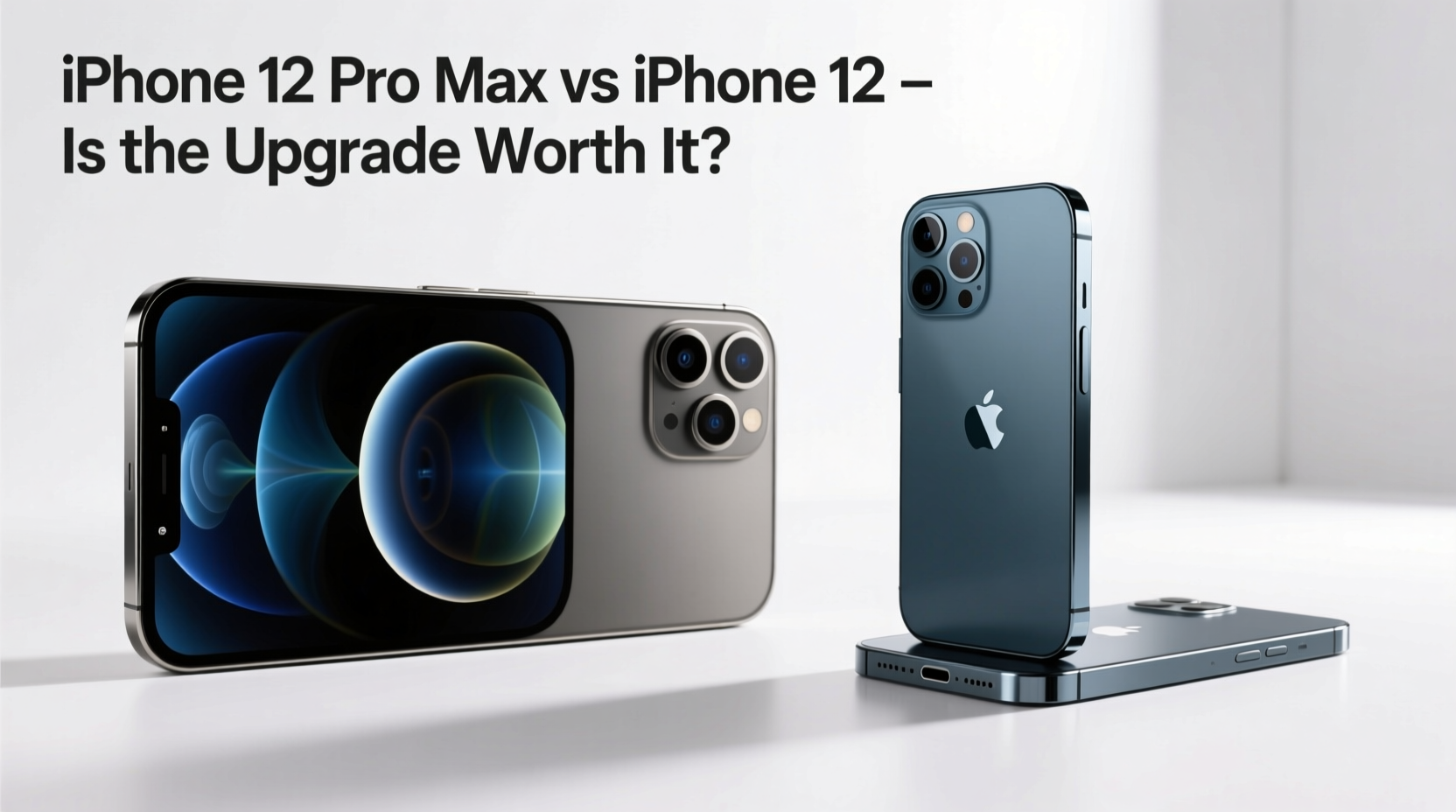
The most immediate difference between the iPhone 12 and iPhone 12 Pro Max lies in their build. Both feature flat aluminum edges and Ceramic Shield front covers, but the Pro Max uses stainless steel instead of aluminum for its frame. This gives it a noticeably heavier, more premium feel — 226 grams compared to the iPhone 12’s 164 grams.
The larger dimensions of the Pro Max (160.8 x 78.1 x 7.4 mm) make it harder to operate with one hand, especially for users accustomed to compact phones. However, that extra size accommodates a bigger battery and supports better heat dissipation during intensive tasks.
Display Differences: Size vs. Resolution
Both phones use Super Retina XDR OLED displays with the same pixel density (460 ppi), meaning image sharpness is nearly identical. The main distinction is screen size: 6.1 inches on the iPhone 12 versus 6.7 inches on the Pro Max.
That extra screen real estate benefits media consumption, multitasking, and gaming. Watching videos or editing documents feels more immersive on the Pro Max. However, since both screens have the same resolution (2532 x 1170), there’s no improvement in clarity — only in viewing area.
Neither model includes a high refresh rate (like 120Hz), which was still reserved for the Pro lineup starting with the iPhone 13 series. So while the Pro Max offers a larger canvas, it doesn’t deliver a smoother visual experience.
Camera System: Where the Pro Max Truly Shines
If there’s one area where the iPhone 12 Pro Max pulls significantly ahead, it’s photography. While both devices have triple-lens setups (wide, ultra-wide, telephoto), the Pro Max introduces critical hardware upgrades that impact real-world results.
- Larger sensor: The main wide camera on the Pro Max has a 47% larger sensor, capturing more light and improving low-light performance.
- Sensor-shift stabilization: Unlike the iPhone 12’s optical image stabilization (which moves only the lens), the Pro Max shifts the entire sensor. This provides superior shake correction, especially when shooting video or in dim conditions.
- LiDAR scanner: Enables faster autofocus in low light and enhances AR applications and Night mode portraits.
“Sensor-shift stabilization changed mobile photography. It allows users to capture usable shots at slower shutter speeds, even handheld.” — David Kim, Mobile Imaging Specialist, DPReview
In practical terms, this means the Pro Max takes visibly better photos in challenging lighting. Shadows retain detail, night shots are cleaner, and portrait depth detection is more accurate thanks to LiDAR. For casual photographers who mostly shoot in daylight, the iPhone 12 performs admirably. But for anyone serious about mobile photography, the Pro Max delivers tangible improvements.
Battery Life and Performance: Real-World Gains
Despite sharing the same A14 Bionic chip, the two models differ dramatically in battery endurance. Apple rated the iPhone 12 for up to 17 hours of video playback, while the Pro Max reaches up to 20 hours — a meaningful increase in heavy-use scenarios.
Real-world testing confirms this gap. Users report consistently getting through a full day of heavy usage (including streaming, GPS navigation, and social media) on the Pro Max, whereas the iPhone 12 often requires a midday charge under similar conditions.
| Feature | iPhone 12 | iPhone 12 Pro Max |
|---|---|---|
| Battery Life (Video Playback) | Up to 17 hours | Up to 20 hours |
| Weight | 164 g | 226 g |
| Screen Size | 6.1 inches | 6.7 inches |
| Main Camera Sensor | Standard size | 47% larger |
| Stabilization | Lens-based OIS | Sensor-shift OIS |
| Frame Material | Aluminum | Stainless Steel |
| LiDAR Scanner | No | Yes |
Mini Case Study: Travel Photographer's Experience
Sophie Tran, a freelance travel photographer based in Vancouver, upgraded from an iPhone 12 to a used iPhone 12 Pro Max before a month-long trip through Southeast Asia. Her goal was to rely solely on her phone for content creation across Instagram, blogs, and client previews.
She found that the larger sensor made a noticeable difference during early morning shoots in misty rice fields and evening street photography in Bangkok. “I could shoot at dusk without pulling out my DSLR,” she said. “The dynamic range and reduced noise gave me publishable images straight out of the camera.”
The extended battery life also eliminated anxiety during full-day excursions without access to charging. Meanwhile, the LiDAR scanner improved focus accuracy when photographing local artisans in poorly lit workshops.
For Sophie, the upgrade justified its cost — not because of brand prestige, but because it directly enhanced her ability to produce professional-grade work on the go.
Is the Upgrade Worth It? A Practical Checklist
Before deciding whether to upgrade, consider your actual needs. Use this checklist to evaluate if the Pro Max aligns with your lifestyle:
- Do you regularly take photos in low light or at night? → Pro Max advantage
- Do you watch videos, play games, or edit documents on your phone? → Larger screen helps
- Do you often run out of battery before bedtime? → Pro Max lasts longer
- Are you sensitive to phone weight or prefer one-handed use? → iPhone 12 is lighter and more compact
- Do you use AR apps or advanced photo editing tools? → LiDAR adds value
- Is budget a primary concern? → iPhone 12 offers excellent core performance at lower price
Frequently Asked Questions
Can the iPhone 12 handle professional photography?
Yes, for basic to intermediate needs. The iPhone 12 captures excellent color accuracy and dynamic range in good lighting. However, it lacks the low-light capabilities and sensor stabilization of the Pro Max, making it less ideal for demanding environments.
Does the Pro Max feel too big for daily use?
It depends on your hand size and habits. Many users adapt quickly, especially if they prioritize screen space. However, single-handed operation is difficult, and fitting it into small pockets can be awkward. Try holding one in-store before committing.
Is the price difference justified?
At launch, the Pro Max started $300 higher than the iPhone 12. Today, on the resale market, the gap is narrower — often $100–$150. For power users, creatives, or frequent travelers, that delta may be worthwhile. For general consumers, the standard model remains a strong choice.
Final Verdict: Who Should Upgrade?
The iPhone 12 Pro Max isn’t a revolutionary leap over the iPhone 12 — but it is a focused evolution for specific users. Its strengths lie in three areas: camera performance (especially in low light), battery endurance, and screen size.
If you value photographic quality, shoot in varied lighting conditions, or spend long days away from chargers, the Pro Max delivers measurable improvements. The stainless steel build and LiDAR also add subtle but meaningful refinements for tech enthusiasts.
However, if you primarily use your phone for calls, messaging, browsing, and occasional daytime photos, the iPhone 12 already meets — and often exceeds — expectations. The A14 chip ensures snappy performance, iOS updates are identical, and the smaller form factor remains more accessible for many.
Ultimately, the upgrade is worth it only if your usage aligns with the Pro Max’s strengths. Otherwise, you’re paying for capabilities you won’t fully utilize.




 浙公网安备
33010002000092号
浙公网安备
33010002000092号 浙B2-20120091-4
Comments
No comments yet. Why don't you start the discussion?