
For millions of iPhone users, the decision to upgrade isn’t just about wanting the latest device—it’s about whether the improvements justify the cost. If you’re still using an iPhone 12 Pro Max, a flagship powerhouse from 2020, the jump to the iPhone 14 (released in 2022) may seem tempting but questionable. After all, Apple markets every new release as revolutionary, but real-world gains often tell a different story. This deep dive compares both models across key areas—design, display, performance, camera, battery life, and software support—to help you determine if the iPhone 14 truly offers enough to warrant leaving your 12 Pro Max behind.
Design and Physical Dimensions: Bigger Isn’t Always Better
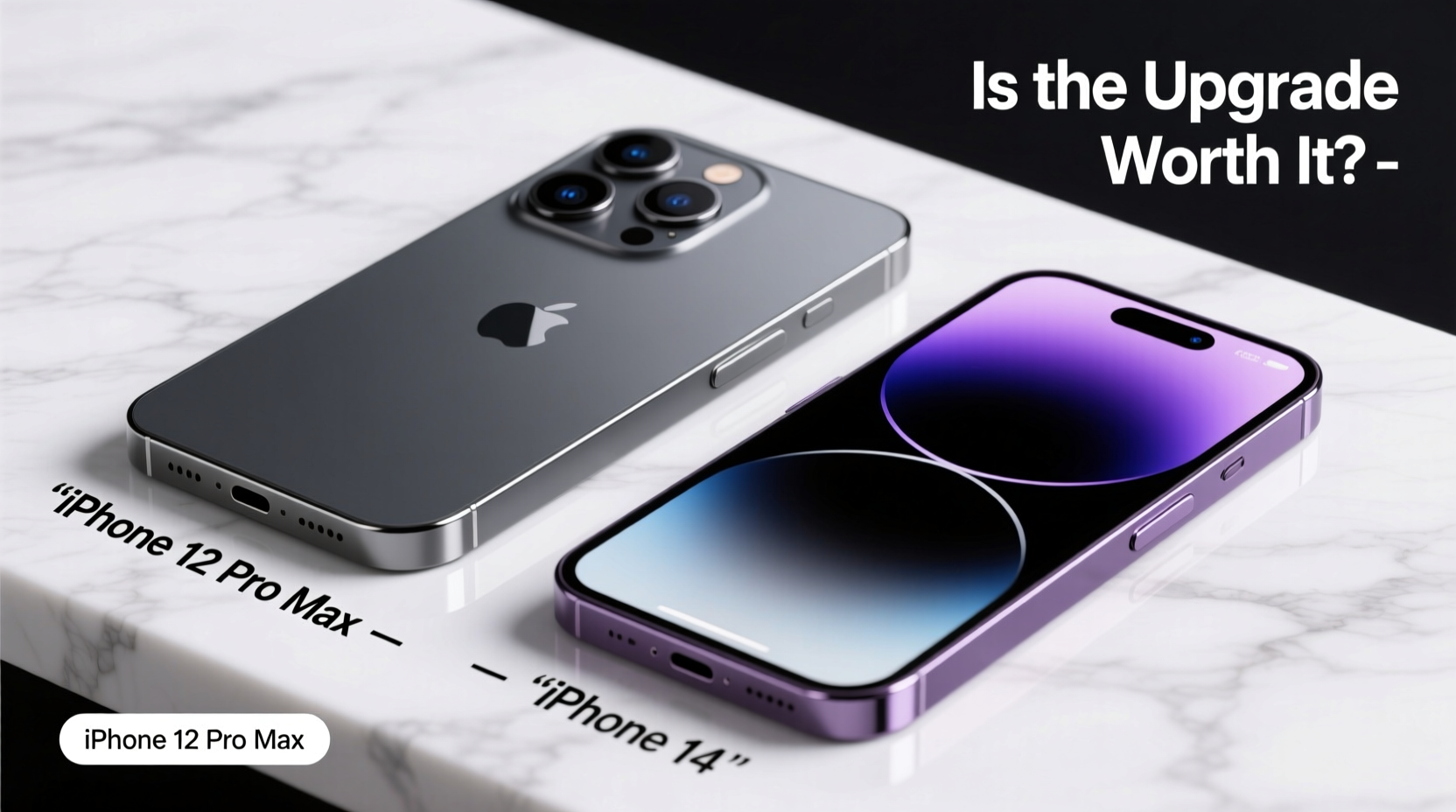
The iPhone 12 Pro Max and iPhone 14 differ significantly in size and weight, reflecting Apple’s shift toward more compact flagship designs with the standard iPhone 14 line.
| Feature | iPhone 12 Pro Max | iPhone 14 |
|---|---|---|
| Height | 160.8 mm | 146.7 mm |
| Width | 78.1 mm | 71.5 mm |
| Thickness | 7.4 mm | 7.8 mm |
| Weight | 228 g | 172 g |
| Build | Stainless steel frame, Ceramic Shield front | Aluminum frame, Ceramic Shield front |
The iPhone 12 Pro Max is noticeably larger and heavier, which some users appreciate for media consumption and productivity. However, the iPhone 14’s smaller footprint makes it easier to handle with one hand and more pocket-friendly. While the 12 Pro Max uses a premium stainless steel band, the iPhone 14 steps down to aerospace-grade aluminum—less luxurious but still durable.
Display and Brightness: Clarity vs. Practicality
The 12 Pro Max features a 6.7-inch Super Retina XDR OLED display with HDR support and a peak brightness of 1,200 nits. In contrast, the iPhone 14 has a 6.1-inch Super Retina XDR display with a slightly improved peak outdoor brightness of up to 1,200 nits (HDR content) and 1,000 nits sustained.
While both screens are excellent, the 12 Pro Max delivers a more immersive experience for movies and multitasking. However, the iPhone 14 introduces **True Tone** and **Haptic Touch** enhancements that refine user interaction. Notably, neither phone includes a high-refresh-rate ProMotion display—that feature remains exclusive to the Pro models.
In everyday use, the difference in brightness is marginal unless you’re frequently outdoors. The smaller screen on the iPhone 14 also means higher pixel density per square inch, resulting in marginally sharper text and icons.
Performance and Longevity: Chipset Showdown
This is where the iPhone 14 pulls ahead decisively. The 12 Pro Max runs on the A14 Bionic chip (5nm), while the iPhone 14 is powered by the A15 Bionic chip—with a 5-core GPU variant (one core disabled compared to the Pro models).
- A14 Bionic (12 Pro Max): Still powerful, handles iOS 17 smoothly, excels in multitasking and gaming.
- A15 Bionic (iPhone 14): Up to 15% faster CPU, 30–50% better graphics performance, and improved machine learning efficiency.
Real-world usage shows the A15 manages intensive apps—like video editing tools and AR games—more efficiently. It also contributes to better battery optimization and future-proofing. Apple typically supports iPhones for five to six years of iOS updates. Given that the iPhone 12 Pro Max launched with iOS 14, it will likely receive updates through iOS 20 or 21. The iPhone 14, starting with iOS 16, could see support into iOS 22 or beyond—making it a safer long-term investment.
“Even incremental chip upgrades in iPhones translate to tangible benefits in responsiveness, app launch speed, and thermal management.” — David Lin, Mobile Hardware Analyst at TechPulse Insights
Camera System: Evolution Over Revolution
The iPhone 12 Pro Max set a high bar in 2020 with its triple-lens system: 12MP wide, ultra-wide, and telephoto (2.5x optical zoom). It introduced sensor-shift stabilization and Night mode on all lenses.
The iPhone 14 retains a dual-camera setup (12MP main + 12MP ultra-wide) but enhances the primary sensor with a larger aperture (ƒ/1.5 vs. ƒ/1.6) and improved photonic engine for better low-light photos. It also adds **Photographic Styles** and advanced computational photography features like Smart HDR 4.
In side-by-side tests, the iPhone 14 produces more natural skin tones, better shadow detail, and faster processing in mixed lighting. However, it lacks the dedicated telephoto lens—limiting optical zoom to 2x (digital beyond that), whereas the 12 Pro Max offers superior 2.5x optical zoom and better lossless cropping.
For casual photographers, the iPhone 14’s improvements are noticeable and welcome. For enthusiasts who rely on zoom and depth versatility, the 12 Pro Max still holds an edge.
Mini Case Study: Travel Photographer’s Dilemma
Sophia, a freelance travel photographer, used her iPhone 12 Pro Max extensively for client work across Southeast Asia. When considering an upgrade to the iPhone 14, she tested both in low-light cityscapes and daylight landscapes. She found the iPhone 14 captured cleaner night shots with less noise and more accurate colors. However, when photographing distant temples or wildlife, she missed the 12 Pro Max’s telephoto reach. Ultimately, she kept her 12 Pro Max as her primary device and uses the iPhone 14 as a backup—proving that “better” doesn’t always mean “replaces.”
Battery Life and Charging: Real-World Endurance
Battery performance is critical for daily usability. Apple rates the 12 Pro Max for up to 20 hours of video playback—the longest of any iPhone at its launch. The iPhone 14, despite a smaller battery, achieves up to 20 hours as well, thanks to the more efficient A15 chip and optimized power management.
In practical terms:
- iPhone 12 Pro Max: Lasts a full day with heavy use; ideal for travelers or professionals needing extended uptime.
- iPhone 14: Matches it closely under moderate use but may require charging sooner during intensive tasks like GPS navigation or 4K recording.
Both support 20W fast charging and MagSafe, but neither includes a charger in the box. The 12 Pro Max’s larger physical battery (3,687 mAh vs. 3,279 mAh) gives it a slight edge in longevity over multiple charge cycles.
Should You Upgrade? A Practical Checklist
Before making the switch, consider these factors:
- Are you prioritizing portability over screen size?
- Do you want longer software support (iPhone 14 likely gets 1–2 extra update years)?
- Is improved low-light photography important to your daily use?
- Can you benefit from faster performance in games or creative apps?
- Are you sensitive to phone weight and one-handed handling?
If most answers are “yes,” the iPhone 14 is a worthwhile upgrade. But if you value zoom capability, a larger display, and don’t mind the heft, sticking with the 12 Pro Max remains a strong choice—especially if you bought it recently or refurbished.
Frequently Asked Questions
Is the iPhone 14 waterproof like the 12 Pro Max?
Yes. Both phones have an IP68 rating, meaning they can survive submersion in up to 6 meters of water for 30 minutes. No practical difference in water resistance.
Does the iPhone 14 support 5G?
Yes, just like the 12 Pro Max. Both support sub-6GHz 5G networks. Neither supports mmWave outside of specific U.S. models, so connectivity performance is nearly identical.
Can I expect better battery life on the iPhone 14?
Not significantly. While the A15 is more efficient, the smaller battery limits gains. Real-world battery life is comparable, with the 12 Pro Max edging ahead in sustained heavy use.
Final Verdict: Upgrade Only If Your Needs Have Changed
The iPhone 14 is not a radical leap over the iPhone 12 Pro Max—it’s a refinement. It trades bulk for agility, swaps a telephoto lens for smarter photo processing, and delivers a more future-ready chipset in a lighter body. If you’re attached to the Pro Max experience, there’s no urgent reason to leave it. But if you’ve found the older model too large, too heavy, or due for replacement after three years of use, the iPhone 14 offers meaningful quality-of-life improvements.
Rather than chasing newness, focus on what matters: how the phone fits your lifestyle. The best upgrade isn’t the newest model—it’s the one that works seamlessly in your hands, day after day.




 浙公网安备
33010002000092号
浙公网安备
33010002000092号 浙B2-20120091-4
Comments
No comments yet. Why don't you start the discussion?