
When Apple launched the iPhone 12 lineup, it introduced a new tiered approach to its Pro models: the iPhone 12 Pro and the iPhone 12 Pro Max. Both devices share nearly identical internal hardware, but the Pro Max commands a higher price tag. For many consumers, the question isn’t just about specs—it’s about value. Is the larger, pricier Pro Max actually worth the extra investment over the already impressive 12 Pro?
This article breaks down the key differences between the two models, evaluates real-world performance, and helps you decide whether the upgrade delivers meaningful benefits or simply inflates the cost without substance.
Design and Display: Bigger Isn’t Always Better
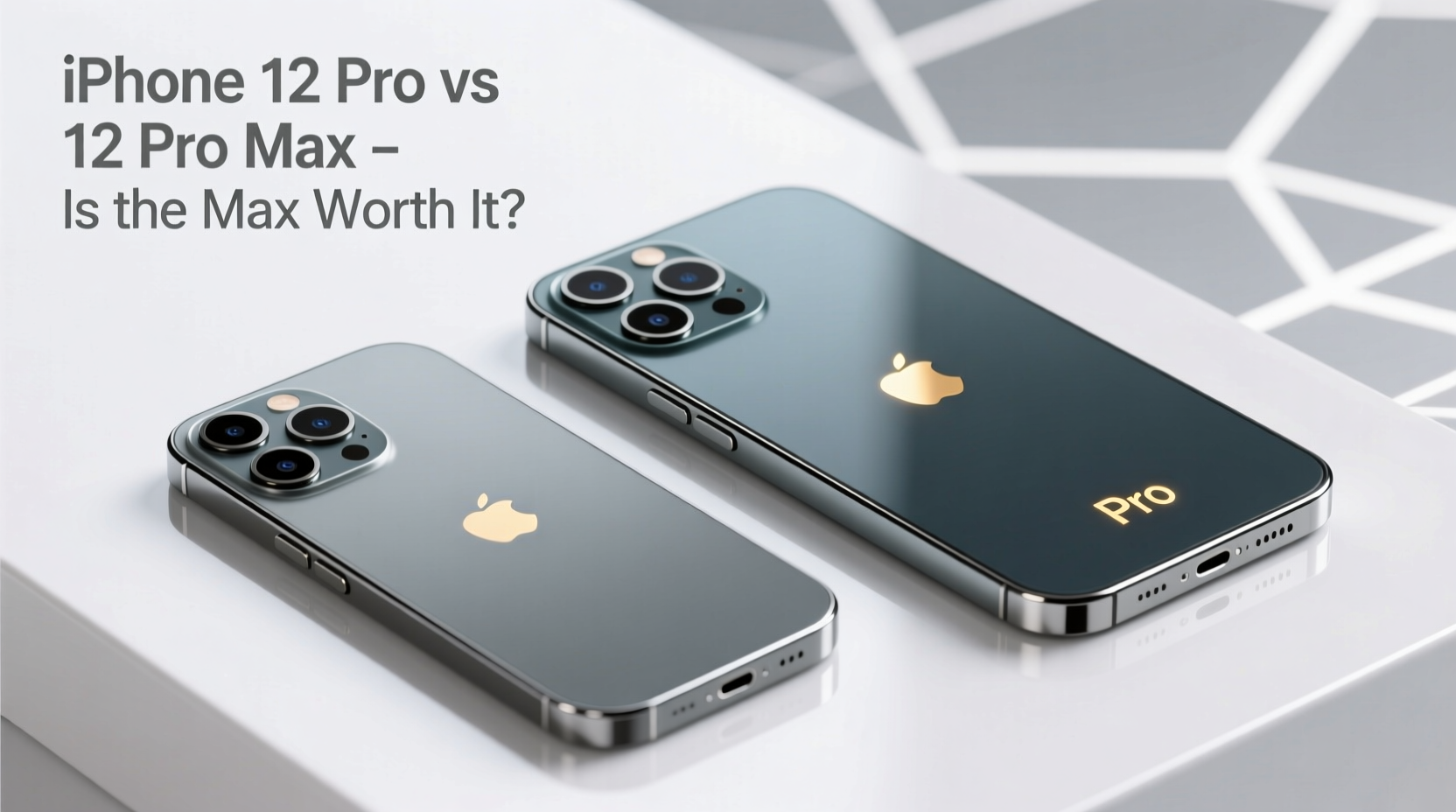
The most noticeable difference between the iPhone 12 Pro and 12 Pro Max lies in their physical dimensions. The Pro Max features a 6.7-inch Super Retina XDR display, compared to the 6.1-inch screen on the 12 Pro. That may not sound like a dramatic leap, but in hand, the difference is significant.
The Pro Max measures 160.8 x 78.1 x 7.4 mm and weighs 228 grams, while the 12 Pro comes in at 146.7 x 71.5 x 7.65 mm and 189 grams. That’s a 39-gram difference—equivalent to carrying an extra AA battery in your pocket. For users with smaller hands or those who prioritize one-handed use, the 12 Pro remains the more ergonomic choice.
Both phones use Ceramic Shield front cover, stainless steel frames, and matte glass backs, so build quality and durability are identical. The display technology is also the same: OLED panels with HDR, 2,000,000:1 contrast ratio, and 1200 nits peak brightness. There’s no difference in resolution density (460 ppi), meaning both deliver sharp, vibrant visuals.
Camera System: Where the Pro Max Gains an Edge
While both phones feature triple-camera systems—12MP wide, ultra-wide, and telephoto—the Pro Max introduces a critical hardware upgrade: sensor-shift optical image stabilization (OIS) on the main wide lens. This technology, previously reserved for DSLRs, moves the sensor itself rather than the lens elements, resulting in superior stabilization, especially in low light.
Apple claims this leads to up to 5x better stabilization performance. In practical terms, that means sharper night shots, smoother video, and improved photo consistency when shooting handheld. For photography enthusiasts or anyone who regularly captures moments in dim environments, this is a tangible benefit.
The Pro Max also has a slightly larger main sensor, allowing it to gather more light. While the difference in daylight photos is negligible, the advantage becomes apparent in challenging lighting conditions. Additionally, the LiDAR scanner is present on both models, enhancing AR performance and low-light autofocus.
“Sensor-shift OIS is a game-changer for mobile photography. It doesn’t just reduce blur—it improves dynamic range and focus accuracy in real time.” — David Kim, Mobile Imaging Specialist at DXOMARK
Battery Life: The Clear Winner Emerges
If there’s one area where the Pro Max clearly outperforms the 12 Pro, it’s battery life. Apple rates the Pro Max for up to 20 hours of video playback, compared to 17 hours on the 12 Pro. Real-world usage confirms this gap.
Users consistently report an extra 2–3 hours of screen-on time with the Pro Max. Whether you’re streaming video, navigating with GPS, or working through a long day without access to charging, that additional endurance can be decisive.
Both phones support 20W fast charging, 15W MagSafe wireless charging, and 7.5W Qi charging. However, due to its larger battery capacity (3,687 mAh vs. 2,815 mAh), the Pro Max takes slightly longer to charge fully. Still, the trade-off in longevity usually outweighs the minor inconvenience.
Performance and Software: Identical Under the Hood
Underneath the surface, both devices are powered by the same A14 Bionic chip—the first smartphone processor built on a 5nm process. This means identical CPU, GPU, and Neural Engine performance. Apps launch at the same speed, multitasking feels equally smooth, and gaming experiences are indistinguishable.
iOS updates, security patches, and feature support will be identical across both models for the foreseeable future. There is no software-based advantage to choosing one over the other. Any performance gains from the Pro Max stem from its larger thermal mass, which may allow for slightly better sustained performance during extended workloads—but this is marginal and rarely noticeable.
Value Comparison: Is the Upgrade Worth $100+?
The iPhone 12 Pro started at $999 (128GB), while the 12 Pro Max began at $1,099—a $100 premium. At higher storage tiers, the gap widens further. So, what do you get for that extra cost?
| Feature | iPhone 12 Pro | iPhone 12 Pro Max |
|---|---|---|
| Screen Size | 6.1 inches | 6.7 inches |
| Weight | 189 g | 228 g |
| Battery Life (Video Playback) | 17 hours | 20 hours |
| Main Camera Stabilization | Lens-shift OIS | Sensor-shift OIS |
| Starting Price (128GB) | $999 | $1,099 |
| Storage Options | 128GB, 256GB, 512GB | 128GB, 256GB, 512GB |
The decision ultimately hinges on personal priorities. If you value longer battery life and superior low-light photography, the Pro Max justifies its cost. But if portability, ease of handling, and budget efficiency matter more, the 12 Pro delivers 90% of the experience at a lower price.
Real-World Example: A Photographer’s Dilemma
Consider Sarah, a travel photographer who upgraded from an iPhone 11 Pro to the 12 Pro Max. She initially hesitated due to the size but chose the Max for its improved camera stability. On a recent trip to Iceland, she shot extensively in near-darkness around glaciers and waterfalls. The sensor-shift OIS allowed her to capture sharp images at shutter speeds as slow as 1/4 second without a tripod—something her previous phone struggled with. For her, the extra cost was justified by the creative flexibility it provided.
In contrast, her colleague Mark, a business consultant who uses his phone mainly for emails, calls, and occasional social media, found the 12 Pro more than sufficient. He appreciated the lighter weight and easier pocket fit. After six months, he saw no compelling reason to switch.
Checklist: Should You Choose the Pro Max?
- ✅ Do you shoot photos or videos often, especially in low light?
- ✅ Do you need all-day battery life without midday charging?
- ✅ Are you comfortable with a larger, heavier device?
- ✅ Is budget less of a concern than performance and longevity?
- ✅ Do you plan to keep your phone for 3+ years, maximizing ROI?
If you answered “yes” to three or more, the Pro Max is likely worth the investment.
Frequently Asked Questions
Can the iPhone 12 Pro Max fit in standard phone cases designed for the 12 Pro?
No. Due to its larger frame and different button placement, the 12 Pro Max requires its own case. Using a 12 Pro case will leave parts of the phone exposed and compromise protection.
Does the Pro Max support the same accessories as the 12 Pro?
Yes. Both models support MagSafe chargers, wallets, and third-party accessories. Magnetic alignment works identically, though the magnets are positioned slightly differently to match each phone’s size.
Is the camera zoom different between the two models?
No. Both have a 2x optical zoom (52mm equivalent) and up to 10x digital zoom. The improved stabilization on the Pro Max enhances zoomed photo quality, but the optical capabilities are the same.
Final Verdict: Who Should Upgrade?
The iPhone 12 Pro Max isn’t a revolutionary leap over the 12 Pro—it’s a refinement. It takes the excellent foundation of the 12 Pro and enhances it with better battery life, superior camera stabilization, and a more immersive display. But these improvements come at the cost of size, weight, and price.
For power users, photographers, travelers, and anyone who relies on their phone throughout the day, the Pro Max offers meaningful advantages that accumulate over time. For casual users, commuters, or those sensitive to bulk, the 12 Pro remains the smarter, more balanced choice.
Ultimately, the “worth” of the extra money depends not on specs alone, but on how you use your phone. Evaluate your daily habits, not just the marketing claims.




 浙公网安备
33010002000092号
浙公网安备
33010002000092号 浙B2-20120091-4
Comments
No comments yet. Why don't you start the discussion?