
If you're holding onto an iPhone 12 Pro and wondering whether it's time to make the leap to the iPhone 13 Pro, the decision likely hinges on one key feature: the camera. Apple markets each new Pro model as a significant step forward in mobile photography, but how much has actually changed between these two generations? For users who prioritize photo quality—whether for travel, social media, or everyday memories—the answer isn't always obvious. This breakdown dives into the technical upgrades, real-world performance differences, and practical considerations to help you decide if the iPhone 13 Pro’s camera improvements justify leaving your 12 Pro behind.
Sensor Upgrades and Hardware Evolution
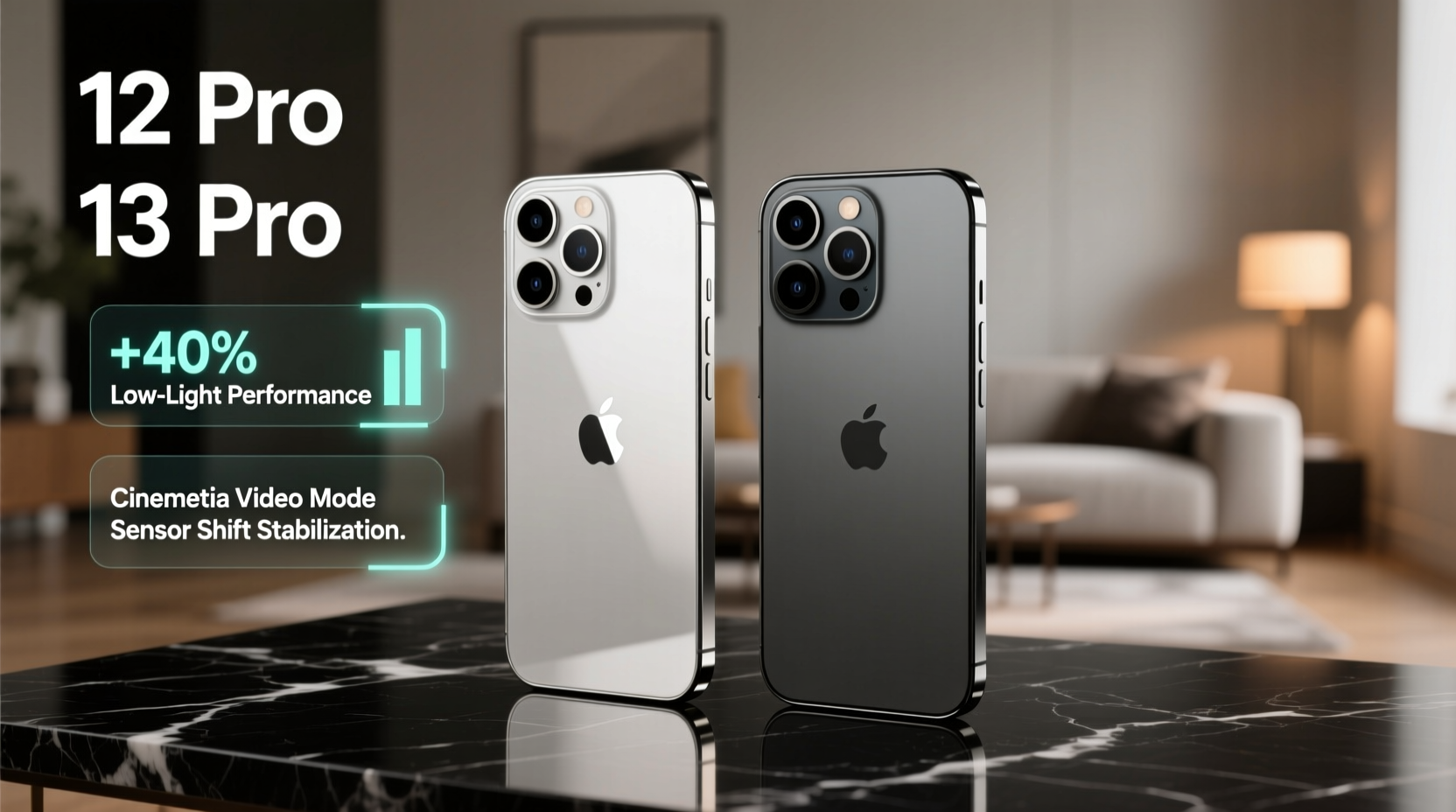
The most substantial change from the iPhone 12 Pro to the 13 Pro lies beneath the surface: sensor size and light capture capability. Apple introduced a larger main (wide) camera sensor in the 13 Pro—approximately 47% larger than its predecessor. This increase directly impacts dynamic range and low-light performance. More surface area means more photons captured per shot, resulting in cleaner shadows, reduced noise, and better detail retention in dim environments.
The ultra-wide lens remained unchanged in hardware, maintaining the same ƒ/2.4 aperture and 12MP resolution. However, software enhancements in the 13 Pro now allow Night mode to function across all lenses—including ultra-wide and telephoto—whereas the 12 Pro only supported Night mode on the wide and front cameras. This expansion gives the 13 Pro a tangible edge when shooting in dark conditions using any lens.
Computational Photography: Photographic Styles and Smart HDR 4
While hardware sets the foundation, Apple’s computational photography does the heavy lifting. The iPhone 13 Pro runs on the A15 Bionic chip, which delivers improved image signal processing and machine learning capabilities over the A14 in the 12 Pro. One standout feature exclusive to the 13 Pro is Photographic Styles, allowing users to set custom preferences for tone and color (e.g., Rich Contrast, Vibrant, Warm) that apply intelligently across shots without compromising HDR data.
This differs from traditional filters because it adapts to lighting and subject matter dynamically. For example, skin tones remain natural even under strong backlighting, while still preserving the user-selected contrast profile. In contrast, the 12 Pro relies solely on Smart HDR 3, which, while excellent, lacks this level of personalization.
Smart HDR 4 on the 13 Pro also improves subject recognition in complex scenes—such as backlit group photos or fast-moving children—by analyzing depth, texture, and motion more precisely. This leads to more balanced exposures and accurate color reproduction, particularly in mixed-light environments.
Low-Light and Night Mode Performance Comparison
To understand the real-world impact of the larger sensor and improved processing, consider a common scenario: capturing a candlelit dinner or a cityscape after sunset. On the 12 Pro, Night mode produces respectable results, but shadows often show grain, and fine details like fabric textures or facial features may blur slightly during longer exposures.
The 13 Pro handles these situations with greater confidence. Its sensor captures more light faster, reducing exposure times and minimizing motion blur. Combined with deeper noise reduction algorithms, images appear sharper and more natural—even at ISO levels where the 12 Pro begins to struggle.
“Apple’s shift toward larger sensors marks a turning point in smartphone photography. The 13 Pro doesn’t just process images better—it captures them better.” — David Kim, Mobile Imaging Analyst at TechVision Labs
Detailed Feature Comparison Table
| Feature | iPhone 12 Pro | iPhone 13 Pro |
|---|---|---|
| Main Sensor Size | 1/1.7\" | 1/1.65\" (47% larger) |
| Night Mode (All Lenses) | No – Ultra-wide not supported | Yes – All three rear cameras |
| Photographic Styles | No | Yes (Customizable tone/color presets) |
| Sensor-Shift Stabilization | Yes (Main camera only) | Yes (Main camera only) |
| Smart HDR Version | Smart HDR 3 | Smart HDR 4 |
| Cinematic Mode (Video) | No | Yes – 1080p at 30fps (depth-mapped focus shifts) |
| ProRes Video Recording | No | Yes (on select storage models) |
Real-World Example: Travel Photographer’s Experience
Jessica Tran, a freelance travel photographer based in Vancouver, upgraded from the iPhone 12 Pro to the 13 Pro ahead of a trip through Iceland. Her goal was to rely more on her phone for quick landscape and street shots without carrying extra gear.
She noted that during early morning shoots near glaciers, the 13 Pro consistently produced cleaner shadows and preserved highlight details in snow-covered peaks better than her 12 Pro had. “In golden hour, the difference wasn’t huge,” she said, “but once the sun dipped below the horizon, the 13 Pro kept delivering usable shots long after my old phone started pushing too much digital gain.”
She also praised Cinematic Mode for vlogging, calling it “a game-changer” for solo creators. While not essential for still photography, the ability to record shallow-depth video with automatic focus transitions added creative flexibility she hadn’t anticipated.
Is the Upgrade Worth It? A Practical Checklist
Before making the switch, ask yourself the following questions. Check off each item that applies to your usage pattern:
- ✅ Do you regularly shoot in low-light environments (restaurants, concerts, night walks)?
- ✅ Are you frustrated by noise or loss of detail in shadows on your current device?
- ✅ Do you value creative control over color and tone beyond standard filters?
- ✅ Are you interested in advanced video features like Cinematic Mode or ProRes?
- ✅ Do you use your phone as a primary camera, rather than a backup to a DSLR or mirrorless system?
If you checked three or more items, the iPhone 13 Pro’s camera upgrades are likely meaningful enough to justify the transition. However, if you mostly shoot in daylight, share casual snapshots, or already edit photos extensively in post-processing apps, the gains may feel incremental rather than transformative.
When to Hold Off on Upgrading
It’s important to recognize that the iPhone 12 Pro remains a powerful photographic tool. Its triple-lens system, LiDAR scanner, and sensor-shift stabilization ensure it still outperforms most smartphones on the market. Unless you’re pushing the limits of mobile photography—shooting in extreme lighting, relying on video storytelling, or demanding maximum consistency—the jump may not deliver a dramatic return on investment.
Additionally, consider cost. Even two years after release, the price gap between used 12 Pro and 13 Pro models can exceed $200. That amount could instead be invested in accessories—like a portable LED light, tripod, or premium editing app subscription—that enhance your existing setup without requiring a full device replacement.
Frequently Asked Questions
Can the iPhone 13 Pro take noticeably better photos in daylight?
In well-lit conditions, both phones produce excellent results with minimal visible difference. The 13 Pro may offer slightly better dynamic range and color accuracy due to Smart HDR 4, but for most users, the distinction is subtle and only apparent upon close inspection.
Does the telephoto lens improve from 12 Pro to 13 Pro?
No. Both models feature a 12MP telephoto lens with 2x optical zoom and the same aperture (ƒ/2.0). Zoom performance and detail retention are nearly identical. Any perceived improvement comes from backend processing, not optical changes.
Is Cinematic Mode useful for non-professionals?
Yes. Even casual users appreciate how Cinematic Mode automatically shifts focus between subjects in videos, creating a film-like effect. It works best with people or pets and requires no manual input, making it accessible to beginners.
Final Verdict: Should You Upgrade?
The camera upgrade from iPhone 12 Pro to 13 Pro is technically significant but contextually selective. For photography enthusiasts, content creators, or anyone who frequently pushes their phone’s limits in challenging lighting, the 13 Pro offers measurable improvements in image fidelity, low-light clarity, and creative functionality. Features like Photographic Styles and expanded Night mode add layers of control previously unavailable.
However, for average users who primarily capture moments in good lighting and share them socially, the benefits are marginal. The 12 Pro continues to deliver professional-grade results in most scenarios. Upgrading purely for the camera may not be justified unless you’ve reached the boundaries of what your current device can do.




 浙公网安备
33010002000092号
浙公网安备
33010002000092号 浙B2-20120091-4
Comments
No comments yet. Why don't you start the discussion?