
For photographers who rely on their smartphones daily, the decision to upgrade isn’t just about speed or battery life—it often hinges on one critical factor: image quality. The iPhone 12 Pro launched in 2020 as Apple’s flagship photography device, packing a triple-lens system and LiDAR for depth sensing. Fast forward to 2022, and the iPhone 14 Plus arrived with larger sensors, improved computational photography, and new hardware enhancements. But if you’re still using an iPhone 12 Pro, is upgrading to the 14 Plus justified purely by camera performance?
The short answer: yes—but with nuance. While both phones deliver excellent photos under ideal conditions, the 14 Plus brings meaningful improvements in low light, dynamic range, and consistency thanks to its newer imaging pipeline and larger sensor. For casual users, the difference may be subtle. For those who frequently shoot in challenging lighting or value long-term future-proofing, the upgrade holds tangible benefits.
Sensor Size and Light Capture: The Foundation of Better Photos
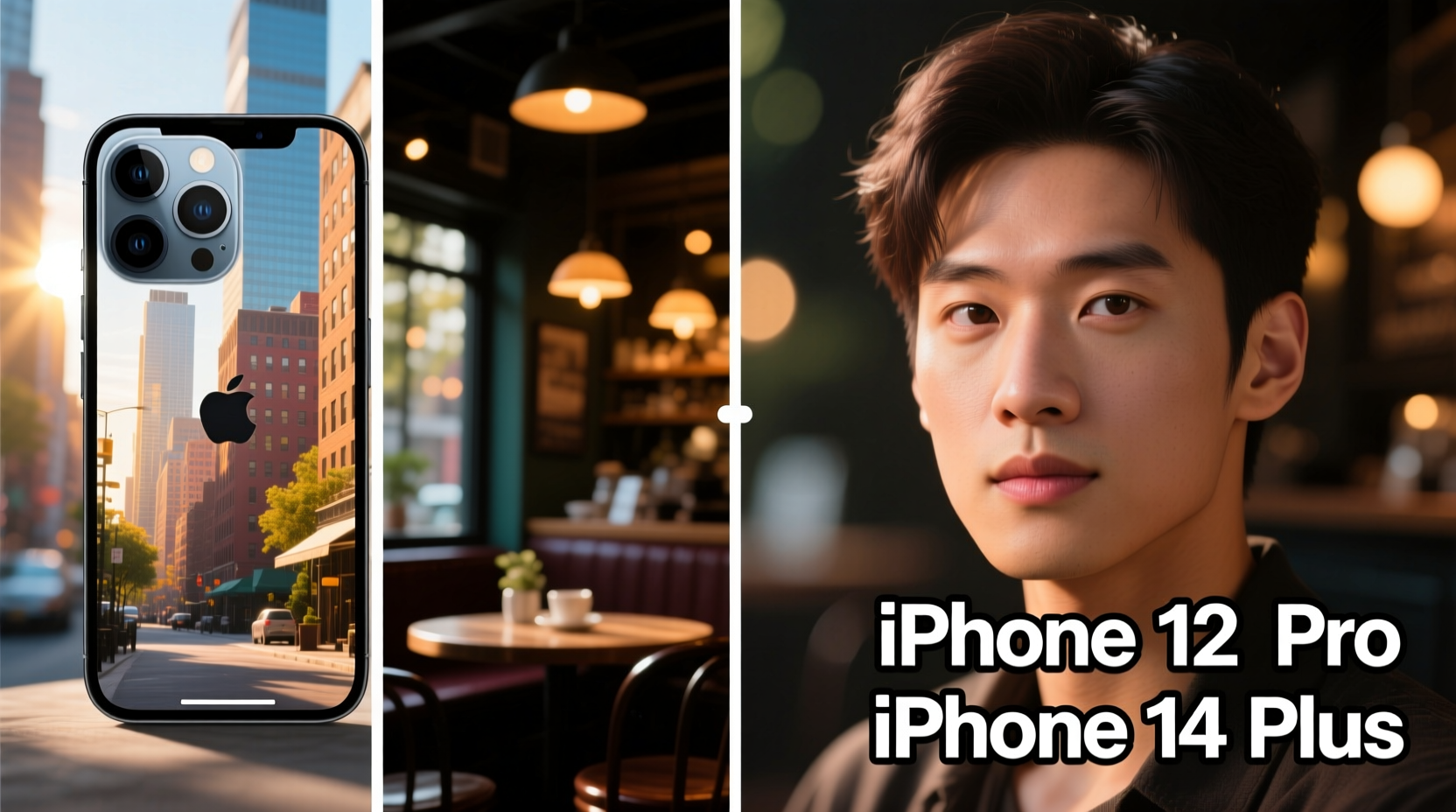
The most significant hardware change between these two models lies in the main camera sensor. The iPhone 12 Pro uses a 12MP f/1.6 wide lens with a relatively small sensor by modern standards. In contrast, the iPhone 14 Plus features a larger 12MP f/1.5 main sensor with a 49% increase in total light collection. This might sound like a modest spec bump, but in practice, it translates to noticeably better performance in dim environments.
Greater light capture means less noise, more accurate color reproduction, and finer detail retention in shadows. When shooting indoors without flash or capturing golden hour scenes at dusk, the 14 Plus preserves textures that the 12 Pro tends to blur or lose entirely. Apple also introduced sensor-shift optical image stabilization (OIS) in the 14 series, which offers superior motion correction compared to the 12 Pro’s traditional OIS—especially when walking while filming or using slower shutter speeds.
Computational Photography: How Software Shapes Image Quality
Beyond hardware, Apple has significantly refined its image signal processing over three generations. The iPhone 14 Plus runs on the A15 Bionic chip (same as the iPhone 13 Pro), but with enhanced neural engine capabilities and updated Photographic Styles integration. More importantly, it supports Smart HDR 4 and Deep Fusion across all lenses, applied earlier and more intelligently in the image pipeline.
In side-by-side tests, the 14 Plus consistently produces more balanced exposures. Where the 12 Pro sometimes struggles with backlit subjects—either blowing out skies or darkening faces—the 14 Plus retains highlight detail while lifting facial tones naturally. Skin tones appear more lifelike, and color gradients (like sunsets or painted walls) show fewer banding artifacts.
One area where software makes a dramatic impact is Night mode. On the 12 Pro, Night mode activates only on the wide lens and requires near-stillness for optimal results. The 14 Plus enables Night mode across all cameras, uses faster frame alignment, and reduces exposure time from up to 3 seconds down to around 1–2 seconds in many cases—making handheld shots sharper and more practical.
“Sensor size matters, but what separates today’s best smartphone cameras is how well they blend hardware with machine learning.” — David Guttenfelder, National Geographic Photographer & Mobile Imaging Advocate
Camera System Comparison: Lenses, Zoom, and Versatility
Both phones feature three rear cameras, but their roles and effectiveness differ slightly:
| Feature | iPhone 12 Pro | iPhone 14 Plus |
|---|---|---|
| Main Sensor | 12MP, f/1.6, standard OIS | 12MP, f/1.5, sensor-shift OIS |
| Ultra-Wide | 12MP, f/2.4, 120° FoV | 12MP, f/2.4, 120° FoV |
| Telephoto | 12MP, f/2.0, 2x optical zoom | 12MP, f/2.8, 3x optical zoom |
| Night Mode Support | Wide only | All lenses |
| Photographic Styles | No | Yes (Customizable tone preferences) |
| LiDAR Scanner | Yes | No |
Note the absence of LiDAR on the 14 Plus—a trade-off Apple made despite including it on higher-end models. While this doesn’t affect daylight photography, it does reduce autofocus speed in very dark scenes and limits some augmented reality applications. However, for general photo-taking, the improved sensor and processing compensate well.
The 14 Plus also gains macro video recording capability via software tuning, allowing closer focusing on small subjects during video shoots—an edge the 12 Pro lacks entirely.
Real-World Example: Portrait Shooting in Mixed Lighting
Consider a common scenario: photographing a person standing near a window during late afternoon. The 12 Pro often defaults to exposing for the bright background, leaving the subject underexposed unless you manually tap and adjust. Even then, noise creeps into shadow areas when boosting brightness later.
In the same setting, the 14 Plus applies Smart HDR 4 to segment the face, hair, and background independently. It pulls detail from both highlights and shadows, delivering a final image where the sky isn’t washed out, and skin texture remains visible. There’s less need for manual intervention, and edits in apps like Lightroom require fewer adjustments to achieve a polished look.
This kind of consistency adds up over time, especially for users who share content directly from their phones without post-processing.
Is the Upgrade Worth It for Photo Quality Alone?
If your primary goal is better photo quality, the upgrade path depends on your current usage patterns:
- You shoot mostly in daylight: The differences are minimal. Both phones take excellent outdoor photos.
- You often take indoor, night, or backlit photos: The 14 Plus offers clear advantages in clarity, color accuracy, and reduced noise.
- You value ease of use: The 14 Plus requires less manual tweaking thanks to smarter auto-exposure and focus decisions.
- You rely on telephoto shots: The jump from 2x to 3x optical zoom on the 14 Plus provides greater framing flexibility without digital cropping.
Checklist: Should You Upgrade Based on Camera Needs?
- Do you frequently shoot in low light? → Yes = Strong reason to upgrade
- Are you frustrated by inconsistent exposures? → Yes = 14 Plus improves reliability
- Do you want more zoom reach without quality loss? → Yes = 3x telephoto helps
- Are you satisfied with current photo output? → Yes = Wait or consider other factors (battery, screen)
- Do you edit photos professionally or semi-professionally? → Yes = 14 Plus offers better RAW data and processing headroom
Frequently Asked Questions
Does the iPhone 14 Plus have a better front camera?
Yes. The 14 Plus features a 12MP TrueDepth front camera with autofocus and Night mode support—upgrades over the 12 Pro’s 7MP fixed-focus selfie cam. This results in sharper close-ups, better low-light selfies, and more natural portrait effects.
Can the iPhone 12 Pro still take great photos?
Absolutely. Under good lighting, the 12 Pro produces images that rival many mid-tier DSLRs. Its color science and white balance remain highly accurate. However, it shows its age in high-contrast or dark scenes where modern iPhones preserve more detail.
Is the lack of LiDAR on the 14 Plus a major drawback?
Only in niche cases. For photography, the impact is minor. Autofocus in darkness may be slightly slower, and AR apps lose precision, but everyday shooting performance isn’t hindered.
Final Thoughts: Making the Right Choice for Your Photography Goals
Upgrading from the iPhone 12 Pro to the 14 Plus solely for camera improvements won’t feel revolutionary, but it is evolutionary in the best way. The gains aren’t flashy—they’re quiet refinements that add up: cleaner night shots, more consistent HDR, better zoom, and enhanced video stabilization. These improvements matter most when conditions aren’t perfect, which, realistically, is most of the time.
If you’ve held onto your 12 Pro because it still “takes good pictures,” ask yourself: Are you spending extra time editing? Do you miss shots due to slow focus or poor low-light performance? If so, the 14 Plus removes friction and elevates consistency.




 浙公网安备
33010002000092号
浙公网安备
33010002000092号 浙B2-20120091-4
Comments
No comments yet. Why don't you start the discussion?