
If you're still using an iPhone XR, iPhone 11, or even an older model like the iPhone 8 or 7, you might be wondering whether it's time to upgrade to the iPhone 12—or if staying put is the smarter financial and practical move. Apple’s recent lineup has brought meaningful improvements in design, performance, and connectivity, but not every update justifies the cost for every user.
This comparison cuts through marketing hype to deliver a clear, real-world assessment of what changes between the iPhone XR, iPhone 11, and iPhone 12—and whether those changes matter enough to warrant an upgrade.
Design and Build: A Shift in Materials and Form
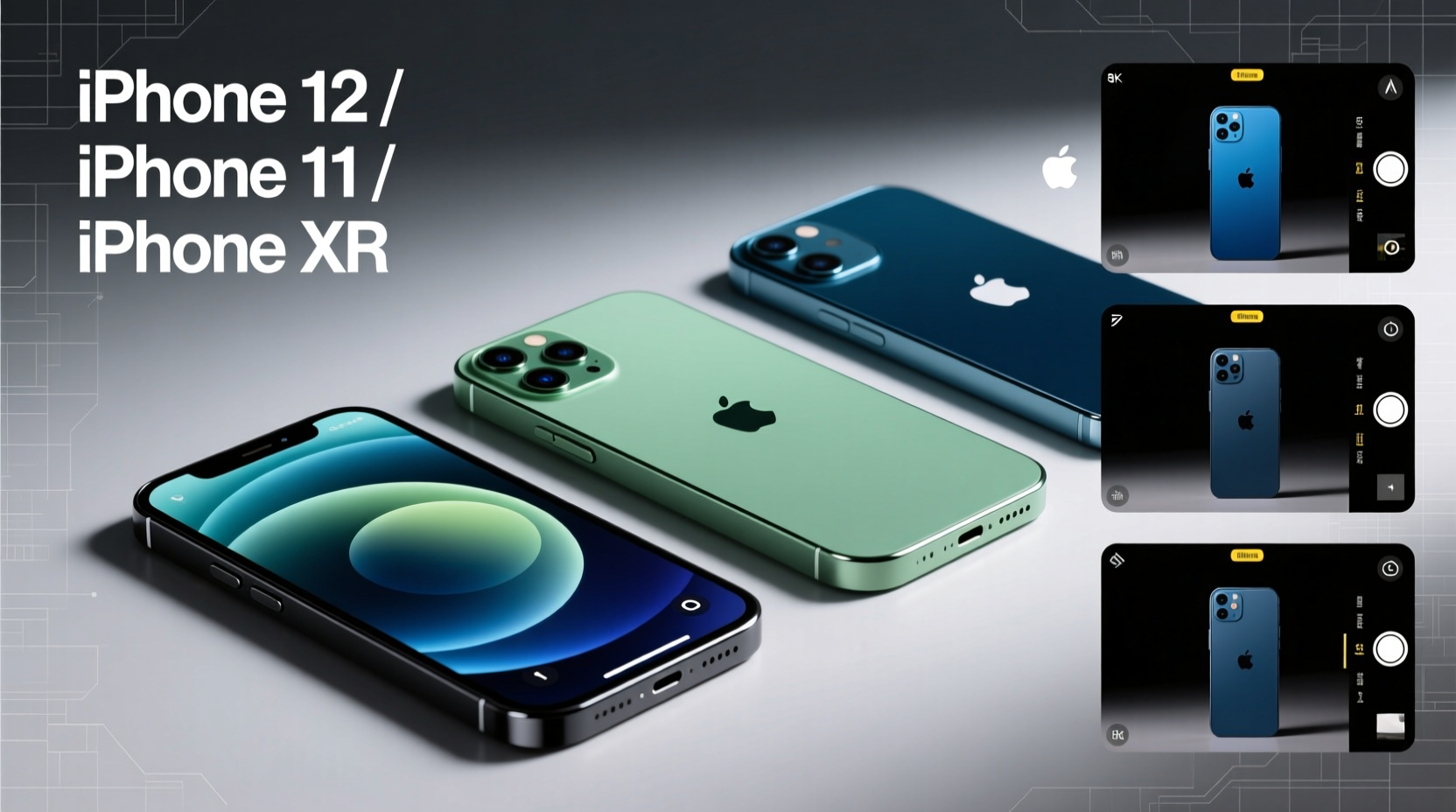
The most noticeable difference between these models lies in their physical design. The iPhone XR and 11 both feature rounded aluminum edges and a single glass panel on the back, giving them a softer, more casual look. In contrast, the iPhone 12 reintroduced flat-edged stainless steel sides, echoing the design language of the iPhone 5 and bringing a more premium, modern feel.
While aesthetics are subjective, the build materials matter. The iPhone 12 uses Ceramic Shield front cover glass, which Apple claims offers four times better drop protection than previous models. It also supports MagSafe accessories—a magnetic ecosystem that enables seamless attachment of chargers, wallets, and cases.
The iPhone XR and 11 lack MagSafe, limiting accessory compatibility. However, they remain durable and water-resistant (IP67 rating), surviving brief submersion in up to 1 meter of water for 30 minutes—on par with the iPhone 12.
Performance: Speed That Matters—But Only When It Does
All three phones use Apple’s A-series chips: the XR has the A12 Bionic, the 11 uses the A13, and the 12 runs on the A14 Bionic—the first smartphone chip built on a 5-nanometer process. This progression means each generation is faster and more power-efficient than the last.
In practice, the A14 delivers about 16% higher CPU performance and 8% better GPU performance than the A13, while the A13 is roughly 20% faster than the A12. For everyday tasks—browsing, messaging, social media, and even most gaming—the differences are barely perceptible.
However, if you edit videos, use AR apps, or rely on processor-heavy tools like Procreate or Adobe Premiere Rush, the A14 in the iPhone 12 will offer smoother multitasking and faster export times. Long-term software support also favors newer chips; Apple typically supports devices for 5–6 years, so an iPhone 12 is likely to receive updates until 2026 or beyond.
“Even modest performance gains can extend a device’s useful lifespan by a year or more, especially as apps grow more demanding.” — David Lin, Mobile Hardware Analyst at TechPulse Insights
Camera Comparison: Incremental Gains Add Up
The camera systems across these models reflect Apple’s strategy of steady refinement rather than revolutionary change.
- iPhone XR: Single 12MP wide camera, f/1.8 aperture. Lacks Night mode and ultra-wide lens.
- iPhone 11: Dual-camera system: 12MP wide + 12MP ultra-wide. Adds Night mode, improved Smart HDR, and better low-light performance.
- iPhone 12: Same dual setup but with larger apertures (f/1.6 on main sensor), improving low-light capture by 27%. Also introduces Deep Fusion and Smart HDR 3.
The jump from XR to 11 is far more significant than from 11 to 12. Adding an ultra-wide lens unlocks creative framing options and better landscape shots. Night mode, introduced on the 11, makes a dramatic difference in dim lighting—something the XR simply can’t match.
The iPhone 12 improves upon this with slightly sharper details and better dynamic range, particularly in mixed lighting. But unless you're a photography enthusiast or regularly share photos professionally, the visual improvement may not justify the upgrade cost.
Detailed Feature Comparison
| Feature | iPhone XR | iPhone 11 | iPhone 12 |
|---|---|---|---|
| Release Year | 2018 | 2019 | 2020 |
| Chipset | A12 Bionic | A13 Bionic | A14 Bionic |
| Rear Cameras | 12MP Wide | 12MP Wide + Ultra-Wide | 12MP Wide + Ultra-Wide |
| Night Mode | No | Yes | Yes (Improved) |
| Display Type | Liquid Retina (LCD) | Liquid Retina (LCD) | Super Retina XDR (OLED) |
| 5G Support | No | No | Yes (Sub-6GHz) |
| MagSafe | No | No | Yes |
| Battery Life (Video Playback) | Up to 16 hours | Up to 17 hours | Up to 17 hours |
| Starting Storage | 64GB | 64GB | 64GB |
Note the display upgrade: iPhone 12 uses an OLED panel, delivering deeper blacks, higher contrast, and better brightness compared to the LCD screens on the XR and 11. This makes a noticeable difference when watching HDR video or using dark mode.
Is 5G Worth the Upgrade?
The iPhone 12 was Apple’s first 5G-capable phone. While 5G promises faster download speeds and lower latency, real-world benefits today are limited. Most users won’t consistently experience speeds much beyond advanced LTE, and 5G coverage remains spotty outside major urban areas.
Additionally, 5G drains battery faster. Apple includes smart data mode to switch between 5G and LTE automatically, but power-conscious users may prefer disabling 5G entirely.
Unless you work with large cloud files, stream 4K content on cellular data, or live in a well-covered 5G zone, this feature alone isn’t a compelling reason to upgrade.
Real-World Decision Guide: Who Should Upgrade?
Not every upgrade path makes sense. Here’s a step-by-step checklist to determine if moving to the iPhone 12 is right for you.
- Evaluate your current phone’s condition. Is it slow, cracked, or suffering from poor battery life? If yes, an upgrade may improve daily usability.
- Assess your usage needs. Do you take lots of photos, edit videos, or play graphics-intensive games? The iPhone 12’s A14 and better camera may enhance your experience.
- Consider long-term ownership. If you plan to keep your phone for 3+ years, the iPhone 12’s newer chip and iOS support window make it a safer investment.
- Check resale or trade-in value. iPhones retain value well. An iPhone XR or 11 can often fetch $150–$300, reducing the effective cost of a new device.
- Weigh the cost-benefit ratio. If the iPhone 12 costs $600 used and your current phone works fine, ask: Will the improvements save me time, stress, or money?
Mini Case Study: Sarah’s Upgrade Dilemma
Sarah has used her iPhone XR since 2019. Her battery lasts about half a day, and she notices lag when switching between apps. She takes frequent photos of her kids and shares them on Instagram. After researching, she realized the iPhone 11 would give her better battery, Night mode, and smoother performance—at a lower price than the iPhone 12. She traded in her XR for $180 and bought a used iPhone 11 for $350, achieving 90% of the benefit at 60% of the cost.
Frequently Asked Questions
Should I upgrade from iPhone XR to iPhone 12?
Possibly. You’ll gain a dramatically better camera (especially at night), a faster processor, OLED display, and 5G. If your XR is showing age, this upgrade brings tangible improvements in speed, photo quality, and future-proofing.
Is upgrading from iPhone 11 to 12 worth it?
Less so. The differences are subtle: slightly better camera, OLED screen, MagSafe, and 5G. Unless you value the flatter design, MagSafe accessories, or want the longest possible software support, the iPhone 11 remains excellent for most users.
Can my older iPhone still run the latest iOS?
Yes. All three models support iOS 17, and likely iOS 18. Performance may degrade slightly on the A12 (XR), but core functions remain smooth. Apple optimizes updates for older hardware, though app developers may eventually require newer chips.
Final Verdict: Make the Right Move for Your Life
Upgrading from iPhone XR to iPhone 12 is a meaningful leap—better camera, faster chip, superior display, and modern features like MagSafe and 5G. For users whose phones are struggling or who value photography and longevity, it’s a worthwhile investment.
But if you’re on an iPhone 11, the gains are marginal. You’ll get a nicer screen and slightly better low-light photos, but nothing transformative. In many cases, holding onto your 11 and saving for an iPhone 15 or 16 makes more financial sense.
Technology should serve your life—not dictate it. Upgrade when the benefits align with your needs, not because a new model exists. With thoughtful evaluation, you can avoid unnecessary spending and keep enjoying a device that works well, looks great, and fits your lifestyle.




 浙公网安备
33010002000092号
浙公网安备
33010002000092号 浙B2-20120091-4
Comments
No comments yet. Why don't you start the discussion?