
When it comes to capturing fast-paced moments, travel adventures, or daily vlogs, two devices often rise to the top: the iPhone 12 and the GoPro Hero 9. Both are capable of producing high-quality video, but they serve different needs and environments. The iPhone 12 is a full-featured smartphone with a powerful camera system; the GoPro Hero 9 is purpose-built for rugged, hands-free, dynamic shooting. So, is the iPhone 12 truly enough for action shots and vlogging, or does the GoPro still hold an edge?
Video Quality: Resolution, Dynamic Range, and Low-Light Performance
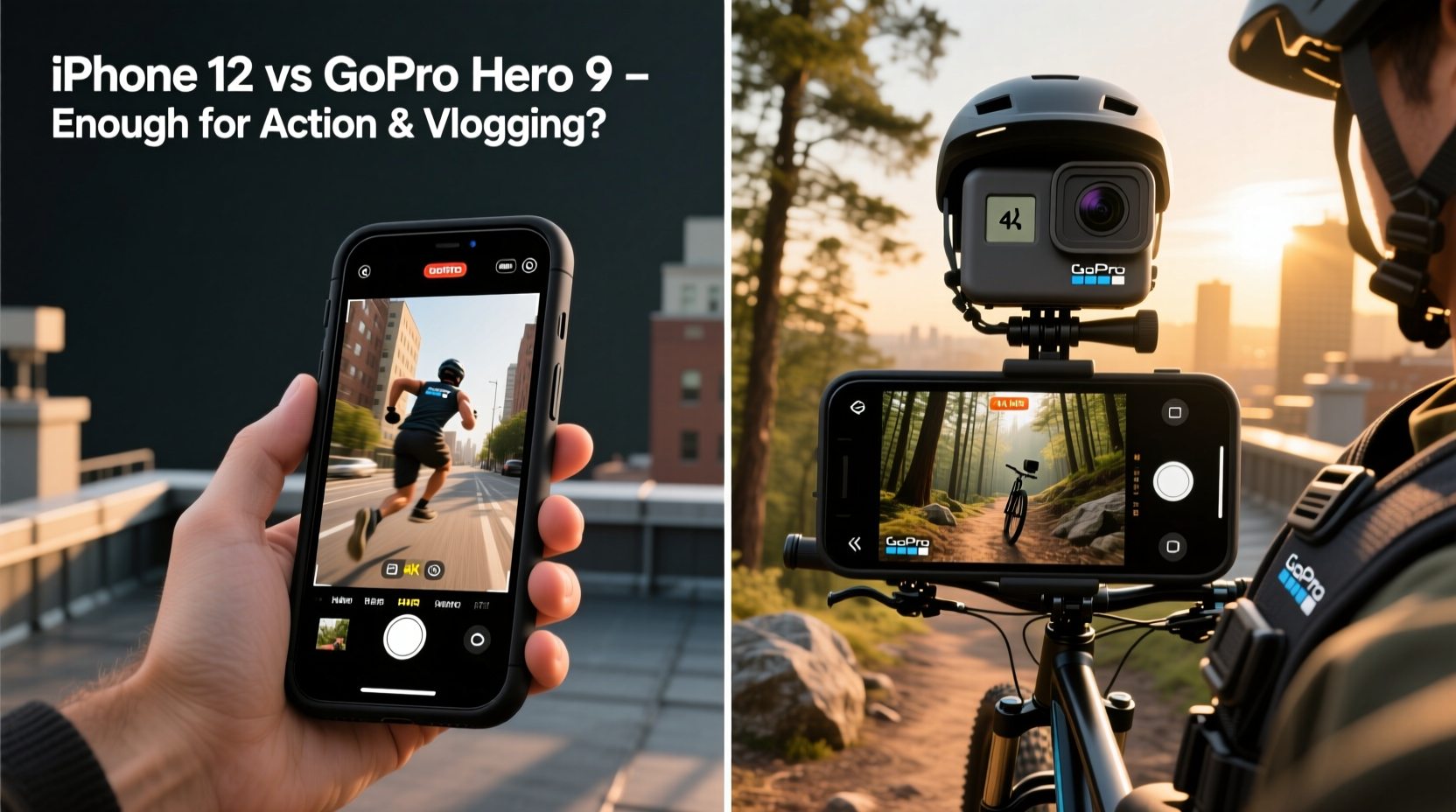
The iPhone 12 records 4K video at up to 60fps using its dual-camera system, with advanced computational photography that enhances color accuracy, contrast, and detail. Its larger sensor and optical image stabilization (OIS) contribute to impressive low-light performance—especially when using Night mode in photos and newer cinematic modes in video.
In contrast, the GoPro Hero 9 also shoots 5K30 and 4K60 video, offering slightly higher resolution than the iPhone 12. While GoPro’s image processing prioritizes wide dynamic range and color neutrality (ideal for post-production), it struggles more in low-light scenarios due to its smaller sensor. However, its HyperSmooth 3.0 stabilization and horizon-leveling technology often make footage look smoother and more stable, even during intense motion.
For most casual vloggers, the iPhone 12 delivers richer colors and better shadow recovery. But if you're filming mountain biking, surfing, or skydiving, the GoPro’s consistent exposure and distortion control across extreme conditions may be more reliable.
Stabilization and Motion Handling
This is where the GoPro Hero 9 pulls ahead decisively. Its HyperSmooth 3.0 stabilization uses advanced gyroscopic data and AI-based frame analysis to keep footage steady—even without a gimbal. It includes Horizon Leveling, which keeps your horizon flat even if the camera rotates 100% sideways. This is invaluable for action sports or handheld walking shots.
The iPhone 12 has excellent OIS and digital stabilization, especially in standard photo and video modes. However, during aggressive movement—like running through trails or filming from a moving vehicle—the iPhone can exhibit micro-jitters and occasional warping from electronic image stabilization (EIS). While usable, the result isn’t as consistently smooth as the GoPro’s output.
“GoPro’s stabilization algorithms are tuned specifically for erratic motion. No smartphone, no matter how advanced, can match that level of consistency in true action environments.” — Daniel Park, Adventure Filmmaker & Gear Reviewer
Durability and Portability: Built for the Elements
The GoPro Hero 9 is waterproof up to 33 feet (10 meters) without a case and built to withstand dust, drops, and temperature extremes. It’s designed to be mounted on helmets, handlebars, chest harnesses, or drones—freeing your hands completely. Its compact size makes it ideal for packing light on hikes, dives, or bike tours.
The iPhone 12, while rated IP68 for water and dust resistance, is not meant for prolonged submersion or rough handling. Using it in wet or dusty conditions risks damage unless protected by bulky cases, which add weight and reduce accessibility. Mounting an iPhone requires additional accessories and compromises balance and portability.
If your vlogging involves beach trips, skiing, or underwater snorkeling, the GoPro offers peace of mind the iPhone simply can’t match.
Audio Capture and Accessories Ecosystem
Both devices have stereo recording capabilities, but their microphone placement affects real-world performance. The iPhone 12’s mics are optimized for voice calls and front-facing vlogs, delivering clear audio when speaking directly into the lens. However, wind noise becomes a major issue outdoors unless using an external mic or deadcat.
The GoPro Hero 9 features three microphones, enabling directional audio capture and improved wind reduction. With firmware updates, it supports WAV audio recording (via SD card) for higher fidelity. More importantly, it accepts external mics via USB-C, opening doors to pro-grade audio solutions like lavaliers or shotgun mics.
Additionally, GoPro’s ecosystem includes hundreds of mounts, mods (like the Media Mod or Display Mod), and integrations with drones and smart remotes. The iPhone lacks this plug-and-play versatility for action setups.
Comparison Table: iPhone 12 vs GoPro Hero 9
| Feature | iPhone 12 | GoPro Hero 9 |
|---|---|---|
| Max Video Resolution | 4K at 60fps | 5K at 30fps, 4K at 60fps |
| Image Stabilization | OIS + EIS (good) | HyperSmooth 3.0 + Horizon Leveling (excellent) |
| Water Resistance | IP68 (up to 6m for 30 min) | 10m without case |
| Low-Light Performance | Strong (larger sensor, Night mode) | Moderate (smaller sensor) |
| Battery Life (video) | ~2.5–3 hours | ~1.5–2 hours (replaceable battery) |
| External Mic Support | Limited (Lightning/USB-C with adapters) | Yes (USB-C, direct input) |
| Mounting Flexibility | Requires cases and adapters | Native support for all GoPro mounts |
| Front Screen for Self-Framing | Yes (main display) | Yes (2-inch rear + 1.4-inch front screen) |
Real-World Example: A Travel Vlogger’s Dilemma
Sophie, a solo travel vlogger touring Southeast Asia, used only her iPhone 12 for the first six months of her journey. She captured beautiful cityscapes and food reviews with crisp audio and vibrant colors. But when she went scuba diving in Thailand and tried kayaking in Vietnam, her phone either stayed behind for fear of damage—or returned with fogged lenses and corrupted files after accidental splashes.
She invested in a GoPro Hero 9 and immediately noticed the difference. She could film herself paddling down rivers, attach the camera to her backpack for point-of-view shots, and even record time-lapses overnight—all without worrying about moisture or bumps. The front-facing screen helped her frame herself accurately without guesswork. Though the color grading required slight tweaking in editing, the reliability and freedom outweighed the extra post-production work.
Checklist: Choosing Between iPhone 12 and GoPro Hero 9
- ✅ Do you primarily film static or urban vlogs with good lighting? → iPhone 12 may suffice.
- ✅ Will you shoot in wet, dusty, or high-motion environments? → GoPro Hero 9 is safer.
- ✅ Do you already carry a phone everywhere and want minimal gear? → Lean toward iPhone.
- ✅ Need hands-free mounting and rugged build? → GoPro wins.
- ✅ Editing workflow matters: Does your computer handle 5K files efficiently? → Consider file sizes.
- ✅ Budget-conscious? → iPhone doubles as communication device; GoPro is single-purpose.
Frequently Asked Questions
Can I use my iPhone 12 as a primary vlogging camera?
Absolutely—for casual, everyday vlogging in controlled conditions. The iPhone 12 produces studio-quality video with natural skin tones and excellent autofocus. Just protect it well and consider using a clip-on mic and small stabilizer for best results.
Does the GoPro Hero 9 have worse audio than the iPhone?
Out of the box, GoPro audio is acceptable but not exceptional. Wind noise can be intrusive. However, with an external microphone connected via USB-C, the Hero 9 surpasses the iPhone in customizable audio quality, especially in noisy outdoor settings.
Is the iPhone 12’s camera better than GoPro overall?
Better depends on context. For cinematic visuals, low-light scenes, and portrait-style vlogs, yes—the iPhone excels. But for durability, stabilization during motion, and ease of mounting, the GoPro is superior. They’re tools for different jobs.
Final Verdict: Is the iPhone Enough?
The iPhone 12 is remarkably capable. For many vloggers—especially those just starting out or focusing on lifestyle content—it eliminates the need for extra gear. You already own it, it edits seamlessly into iCloud and desktop workflows, and its camera performs brilliantly under normal conditions.
But when adventure calls, when you're biking down rocky trails, diving into oceans, or filming in rainforests, the GoPro Hero 9 remains unmatched in resilience, stabilization, and creative flexibility. It's not just a camera—it's an extension of your body in motion.
You don’t necessarily need both—but understanding your environment and shooting style will determine whether the iPhone is truly \"enough.\"




 浙公网安备
33010002000092号
浙公网安备
33010002000092号 浙B2-20120091-4
Comments
No comments yet. Why don't you start the discussion?