
The iPhone 11 remains a capable device years after its release, but Apple’s iPhone 12 introduced several meaningful upgrades that may sway loyal users to make the switch. For those still using an iPhone 11, deciding whether to upgrade isn’t just about new features—it’s about real-world benefits, longevity, and personal usage patterns. This guide breaks down the most important considerations to help you determine if stepping up to the iPhone 12 is truly worth it.
Performance: A Noticeable Leap in Speed
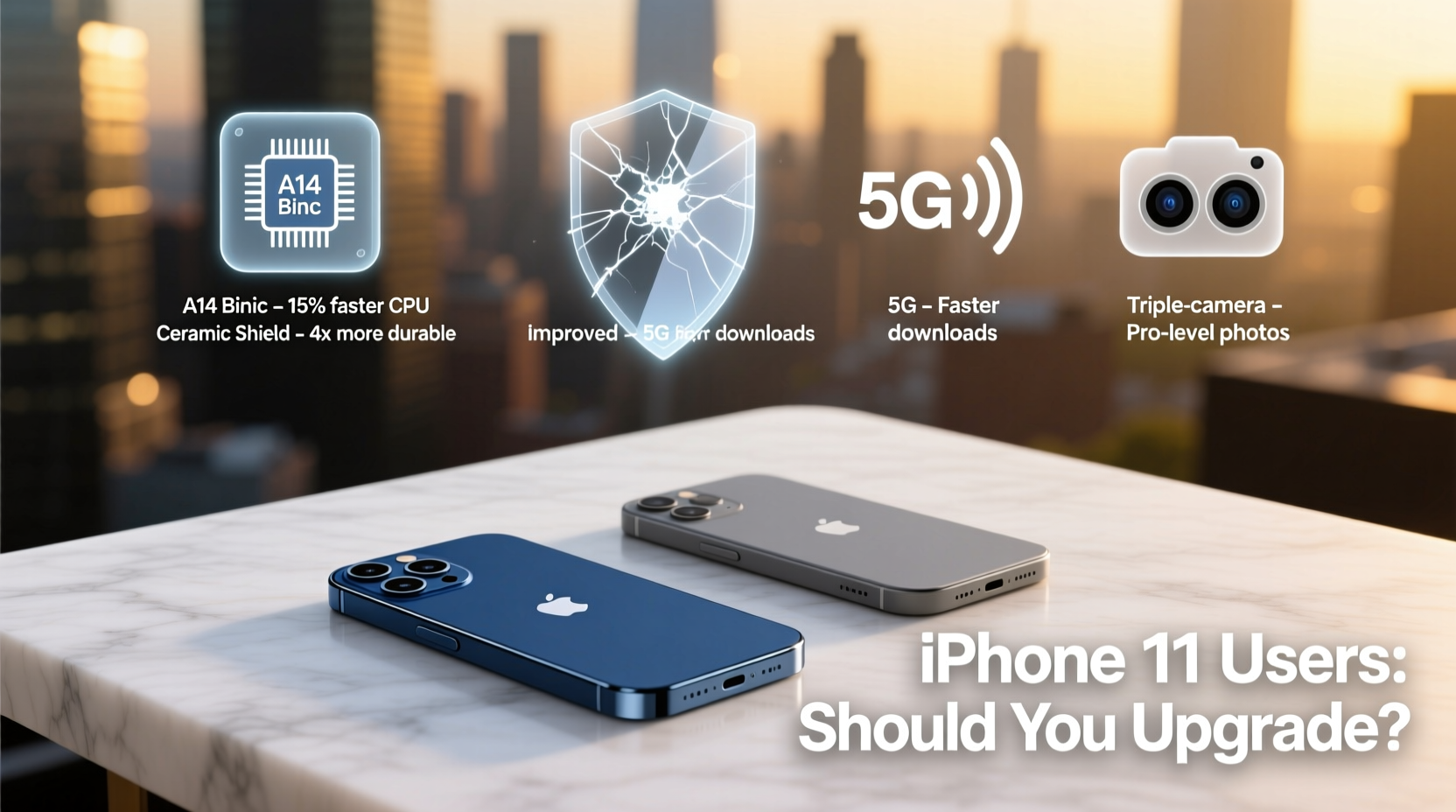
The iPhone 12 runs on Apple’s A14 Bionic chip—the first smartphone processor built on a 5-nanometer process. Compared to the A13 chip in the iPhone 11, the A14 delivers around 16% faster CPU performance and 8% better GPU efficiency. While both chips handle daily tasks with ease, the A14 provides smoother multitasking, faster app launches, and improved responsiveness in graphics-heavy applications like gaming or augmented reality.
For users who frequently edit photos or videos on their phones, play high-end mobile games, or plan to keep their device for three to four years, this extra headroom can extend the phone’s usable lifespan. The A14 also improves machine learning capabilities, which enhances photo processing, voice recognition, and future software updates.
Display and Design: Flattening the Curve
One of the most visible changes between the iPhone 11 and iPhone 12 is the shift from curved edges to flat aluminum rails, giving the latter a more modern, boxy design reminiscent of the iPad Pro. This not only improves grip but also makes cases easier to align and remove.
More importantly, the iPhone 12 features Super Retina XDR OLED display technology, replacing the LCD panel of the iPhone 11. OLED screens offer deeper blacks, higher contrast ratios (up to 2,000,000:1), and better color accuracy. Brightness peaks at 1,200 nits for HDR content—significantly better than the iPhone 11’s 625 nits.
While casual users might not immediately notice these differences, frequent media consumers—especially those watching HDR movies or editing photos—will appreciate the richer visuals and improved outdoor visibility.
Camera Enhancements: Subtle But Meaningful
On paper, both phones have dual 12MP rear cameras: wide and ultra-wide. However, the iPhone 12 introduces Night mode across all lenses, including the front-facing camera, whereas the iPhone 11 only supports Night mode on the main sensor.
The biggest photographic upgrade is **Deep Fusion**, a computational photography feature that processes textures and details at the pixel level before you even take the shot. It works best in medium-light conditions, producing sharper images with better noise control.
Additionally, the iPhone 12 supports **Smart HDR 3**, which uses machine learning to balance highlights, shadows, and skin tones more naturally. Video recording also improves with Dolby Vision HDR support up to 4K at 60fps—an industry-first for smartphones at the time.
“Even without adding a new lens, Apple refined image processing enough to make the iPhone 12 a genuine step forward in photo quality.” — David Nagel, Mobile Imaging Analyst at DXOMARK
5G Connectivity: Future-Proofing Your Device
This is where the iPhone 12 draws a clear line between itself and the iPhone 11: 5G support. The iPhone 11 lacks any form of 5G connectivity, while the iPhone 12 includes mmWave (in U.S. models) and sub-6GHz bands, enabling faster download and upload speeds, lower latency, and improved streaming quality.
However, real-world benefits depend heavily on your location and carrier coverage. In urban centers with strong 5G infrastructure, downloading large files or streaming 4K video becomes significantly faster. In rural areas, the advantage may be negligible.
Battery impact is another consideration: 5G use increases power consumption. Apple implemented Smart Data Mode to automatically switch between LTE and 5G based on task demands, helping preserve battery life.
Battery Life and Charging: Efficiency Over Capacity
Despite having a slightly smaller battery (2,815 mAh vs. 3,110 mAh), the iPhone 12 achieves comparable battery life thanks to the energy-efficient A14 chip and OLED display. Apple rates both devices similarly for video playback: up to 17 hours.
Charging improvements include support for MagSafe, Apple’s magnetic wireless charging system that enables alignment-free Qi charging at up to 15W (vs. standard 7.5W). MagSafe also unlocks accessories like wallets, stands, and car mounts that snap securely into place.
That said, neither phone comes with a charger in the box—a change Apple introduced with the iPhone 12. You’ll need to reuse your existing power adapter or purchase one separately.
Comparison Table: iPhone 11 vs. iPhone 12
| Feature | iPhone 11 | iPhone 12 |
|---|---|---|
| Processor | A13 Bionic | A14 Bionic (5nm) |
| Display | 6.1\" Liquid Retina HD (LCD) | 6.1\" Super Retina XDR (OLED) |
| Resolution | 1792 x 828 | 2532 x 1170 |
| Contrast Ratio | 1400:1 | 2,000,000:1 |
| Max Brightness | 625 nits | 1,200 nits (HDR) |
| Rear Camera | Dual 12MP (Wide, Ultra-Wide) | Dual 12MP + Night mode on all cameras, Deep Fusion |
| Video Recording | 4K at 60fps (no HDR) | 4K Dolby Vision HDR at 60fps |
| Connectivity | LTE only | 5G (mmWave & sub-6GHz) |
| Wireless Charging | Qi up to 7.5W | MagSafe up to 15W, Qi compatible |
| Design | Curved aluminum edges | Flat-edge aerospace-grade aluminum |
| Durability | IP68 (2m for 30 min) | IP68 (6m for 30 min) |
Real-World Example: Sarah’s Upgrade Decision
Sarah, a freelance photographer based in Chicago, used her iPhone 11 for nearly three years. She edited photos on Lightroom Mobile and streamed client galleries directly from her phone. When she began experiencing slower export times and inconsistent HDR previews, she considered upgrading.
After testing the iPhone 12 at a retail store, she noticed immediate improvements: smoother zooming in high-res images, truer colors on the OLED screen, and faster uploads via 5G at downtown hotspots. The ability to record Dolby Vision video also appealed to her side projects in short filmmaking.
She upgraded and found that the combination of A14 speed, superior display, and enhanced camera processing reduced her post-production time by nearly 20%. For her workflow, the iPhone 12 wasn’t just a luxury—it was a productivity tool.
Upgrade Checklist: Is the iPhone 12 Right for You?
- ✅ Need faster performance for apps, gaming, or multitasking
- ✅ Want better photo quality in low light (Night mode on all cameras)
- ✅ Value a brighter, higher-contrast OLED display
- ✅ Live in an area with reliable 5G coverage
- ✅ Plan to keep your phone for 3+ years and want longer software support
- ✅ Interested in MagSafe accessories for convenience or productivity
- ✅ Prioritize build quality and durability (6-meter water resistance)
Frequently Asked Questions
Should I upgrade from iPhone 11 to iPhone 12 in 2024?
If your iPhone 11 is still performing well, the upgrade may not be urgent. However, if you want access to 5G, better displays, improved cameras, and longer iOS support (iPhone 12 likely supported until 2026–2027), it can be a worthwhile move—especially if purchased secondhand or refurbished.
Does the iPhone 12 camera beat the iPhone 11 significantly?
Not dramatically, but yes in specific areas. Low-light performance, HDR processing, and video capabilities are meaningfully better. If you take lots of night shots or record video, the difference is tangible.
Is 5G really necessary on the iPhone 12?
It depends on your habits. If you frequently download large files, stream 4K content on the go, or work remotely with cloud tools, 5G adds real value. Otherwise, LTE on the iPhone 11 remains sufficient for most daily tasks.
Final Thoughts: Making the Smart Move
The iPhone 12 isn't a revolutionary leap from the iPhone 11, but it refines nearly every aspect: performance, display, camera intelligence, connectivity, and design. For users whose needs have evolved—whether due to work, content creation, or desire for future-ready tech—the upgrade offers measurable benefits.
Yet, if your iPhone 11 meets your daily needs and you’re mindful of e-waste and cost, holding off is perfectly reasonable. Apple continues to support older devices with updates, and iOS optimization ensures longevity.
Ultimately, the decision hinges on how much you value incremental advancements that add up over time. If you're ready for a more responsive, visually rich, and connected experience, the iPhone 12 stands as a smart, balanced upgrade path.




 浙公网安备
33010002000092号
浙公网安备
33010002000092号 浙B2-20120091-4
Comments
No comments yet. Why don't you start the discussion?