
For users who love compact smartphones, the decision to switch ecosystems or upgrade within one can be tough. The iPhone 13 Mini and Galaxy S10e represent two generations of small flagship phones—Apple’s 2021 offering and Samsung’s 2019 model. While both prioritize portability without sacrificing core performance, they differ significantly in design, software longevity, camera quality, and overall user experience. If you're still holding onto your Galaxy S10e, is jumping to the iPhone 13 Mini truly worth it?
The answer isn’t just about specs—it’s about how each phone fits into your daily life, long-term needs, and ecosystem preferences. Let’s break down the key differences and see where the upgrade makes sense—and where it might not.
Design and Build Quality: Small Size, Big Differences
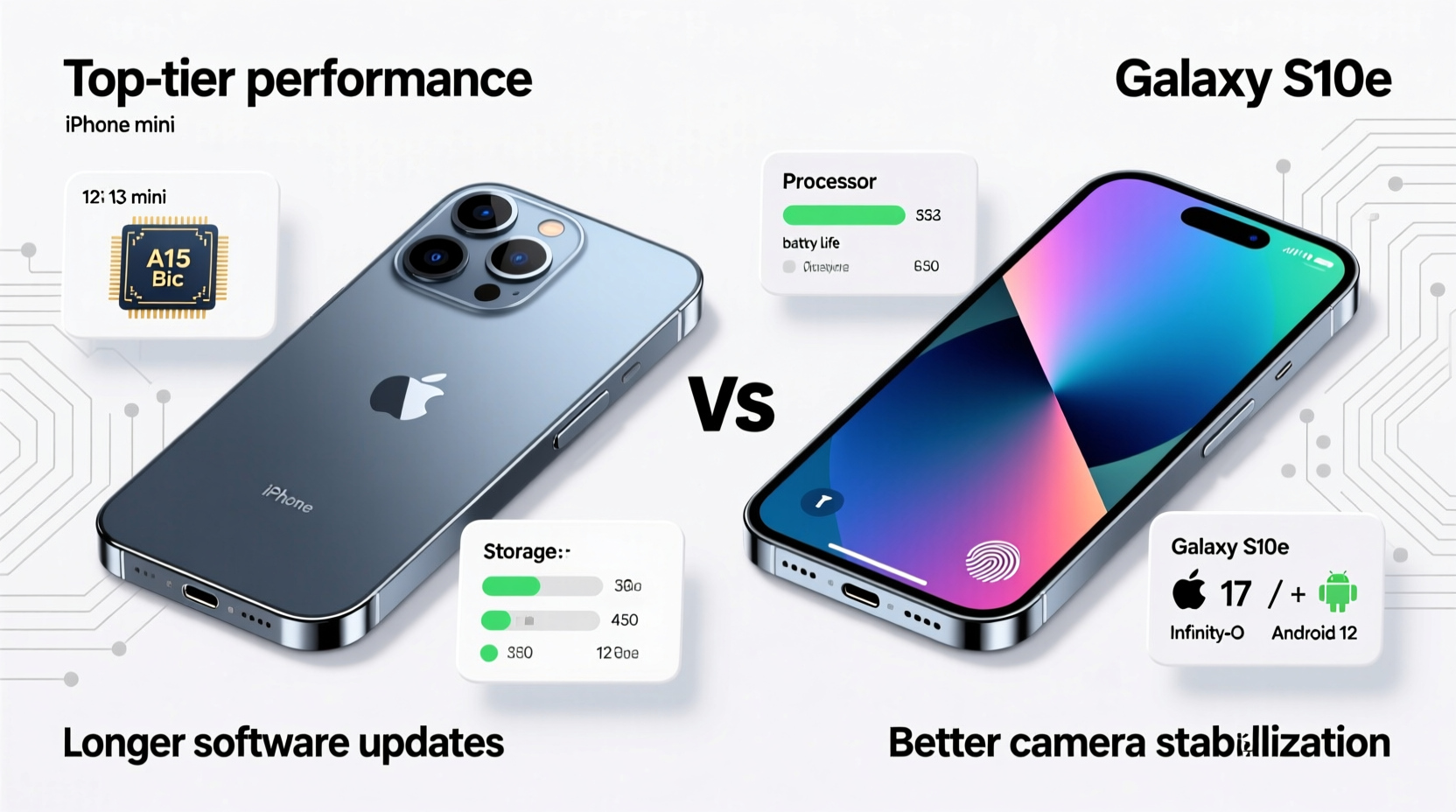
Both phones are designed for one-handed use, but their materials and construction reflect different philosophies. The Galaxy S10e features a polycarbonate frame with an aluminum back and Gorilla Glass 5 protection. It’s lightweight at 150g and has a flat display, which many users prefer for screen protector application and grip.
In contrast, the iPhone 13 Mini uses aerospace-grade aluminum edges, a textured matte glass back, and Ceramic Shield front cover. At 140g, it’s slightly lighter than the S10e, yet feels more solid due to tighter build tolerances. Apple also rates it IP68 for dust and water resistance—deeper and longer than the S10e’s IP68 rating (both survive submersion, but Apple claims better resilience).
The S10e retains a headphone jack and expandable storage via microSD—a rare combo in flagships. The iPhone 13 Mini omits both, relying on iCloud and Bluetooth audio. For some, this is a dealbreaker; for others, a non-issue in today’s wireless world.
Performance and Software Longevity
This is where the iPhone 13 Mini pulls far ahead. Powered by Apple’s A15 Bionic chip, it outperforms the S10e’s Snapdragon 855 in every benchmark. Real-world usage reflects this: app launches are snappier, multitasking is smoother, and augmented reality or photo editing tasks feel effortless.
More importantly, software support differs dramatically. Samsung typically provides three major Android updates. The S10e launched with Android 9 and received updates through Android 12. As of 2024, it no longer receives OS upgrades, only occasional security patches.
Apple, on the other hand, supports iPhones for five to six years. The iPhone 13 Mini launched with iOS 15 and is expected to receive updates through iOS 21 or beyond. That means longer security coverage, access to new features like improved Focus modes, Live Text, and enhanced privacy tools.
“iOS update consistency gives older iPhones a second life that Android rarely matches.” — James Kim, Senior Editor at The Verge
Camera Comparison: Evolution vs. Consistency
The S10e was praised at launch for its dual-camera setup: a 12MP main sensor and a 16MP ultra-wide. However, it lacks optical image stabilization and advanced computational photography. Low-light performance is passable but inconsistent.
The iPhone 17 Mini improves dramatically with a 12MP main sensor featuring sensor-shift stabilization (a rarity even in larger phones), Night mode on all lenses, Deep Fusion processing, and Smart HDR 4. Video recording is a standout—supporting Dolby Vision HDR at 4K/30fps, something the S10e cannot match even with third-party apps.
| Feature | iPhone 13 Mini | Galaxy S10e |
|---|---|---|
| Main Camera | 12MP, f/1.6, sensor-shift OIS | 12MP, f/1.5, no OIS |
| Ultra-Wide | 12MP, f/2.4, autofocus | 16MP, f/2.2, fixed focus |
| Night Mode | Yes (all cameras) | No dedicated mode |
| Video Recording | 4K Dolby Vision HDR | 4K@30fps (no HDR) |
| Front Camera | 12MP, f/2.2, TrueDepth | 10MP, f/1.9 |
In practical terms, the iPhone delivers more consistent results across lighting conditions, better dynamic range, and superior video quality. The S10e still takes decent photos in daylight, but shadows often appear noisy, and colors can look oversaturated.
Battery Life and Charging: Efficiency vs. Convenience
The iPhone 13 Mini surprised many with its endurance. Despite its small 2,406mAh battery, Apple’s power-efficient A15 chip and optimized iOS allow it to last a full day for moderate users. In real-world testing, it averages 10–12 hours of screen-on time.
The S10e, with a slightly larger 3,100mAh battery, often struggles to make it through a heavy day. After years of charging cycles, battery degradation becomes noticeable—something Apple also faces, but mitigates with optimized charging and battery health management.
Charging options differ too. The S10e supports 15W wireless charging and 12W wired fast charging. The iPhone 13 Mini maxes out at 20W wired (with USB-C PD) and 7.5W MagSafe wireless—slower wirelessly but faster when using compatible chargers.
Mini Case Study: Sarah’s Upgrade Journey
Sarah had used her Galaxy S10e since 2019. By 2023, she noticed slower app loading, frequent crashes in newer versions of Instagram and TikTok, and declining battery life—only lasting half a day. She considered the iPhone 13 Mini after seeing friends praise its camera.
After switching, she appreciated the immediate boost in responsiveness and cleaner interface. Her photos improved noticeably, especially indoor shots and videos of her kids. However, she missed the headphone jack and initially struggled with iMessage syncing. Two months in, she reported being “glad she made the jump,” citing reliability and confidence in future software updates.
Checklist: Should You Upgrade?
Use this checklist to evaluate if moving from the Galaxy S10e to the iPhone 13 Mini aligns with your priorities:
- ✅ Need longer software support (5+ years)?
- ✅ Want better low-light photography and video quality?
- ✅ Prefer a more durable build and better water resistance?
- ✅ Willing to give up the headphone jack and microSD slot?
- ✅ Already invested in Apple ecosystem (Mac, iPad, AirPods)?
- ✅ Comfortable learning iOS if coming from Android?
- ✅ Looking for stronger resale value? (iPhones depreciate slower)
If most answers are “yes,” the upgrade makes strong sense. If you rely heavily on expandable storage or wired headphones, consider sticking with Android or exploring newer compact alternatives like the Galaxy S23 FE or upcoming smaller Android models.
Frequently Asked Questions
Can I transfer my data easily from Galaxy S10e to iPhone 13 Mini?
Yes. Apple’s “Move to iOS” app guides you through transferring contacts, messages, photos, and more over a private Wi-Fi connection during initial setup. Google Account data like emails and calendars sync automatically.
Is the iPhone 13 Mini’s battery really better than the S10e’s?
In terms of raw capacity, no—the S10e has a larger battery. But thanks to hardware-software integration, the iPhone delivers comparable or better endurance under typical use, especially as older batteries degrade.
Will the iPhone 13 Mini get iOS 18?
Yes. Apple confirmed iOS 18 will support iPhone XS and later models. The iPhone 13 Mini will receive iOS 18, likely including AI-powered features, enhanced customization, and deeper Siri integration.
Final Verdict: Is the Upgrade Worth It?
The iPhone 13 Mini isn’t just a newer phone—it represents a generational leap in performance, camera technology, and long-term usability over the Galaxy S10e. While the S10e was excellent in its time, aging hardware and ended software support limit its viability in 2024 and beyond.
For users seeking reliability, consistent updates, superior photo and video capabilities, and seamless integration with other Apple devices, the iPhone 13 Mini is absolutely worth the upgrade. Yes, you lose the headphone jack and microSD card—but gain years of smooth performance, better resale value, and access to one of the most robust mobile ecosystems available.
Switching platforms takes adjustment, but for many, the benefits outweigh the learning curve. If your current phone is slowing down or failing to run modern apps smoothly, now may be the right time to make the move.




 浙公网安备
33010002000092号
浙公网安备
33010002000092号 浙B2-20120091-4
Comments
No comments yet. Why don't you start the discussion?