
Apple’s strategy in recent years has been clear: push larger screens, higher prices, and more advanced features. But for users who value compactness, one-handed usability, and affordability, two models stand out — the iPhone 13 Mini and the iPhone SE (2022). On paper, they serve different audiences. In practice, the lines blur. The real question isn’t just about specs; it’s whether the trade-offs in size, performance, and design make one a better daily driver than the other.
The iPhone 13 Mini packs flagship-tier internals into a rare 5.4-inch form factor. The iPhone SE (2022) revives the classic iPhone 8 design with modern internals, offering powerful performance at a lower price. So when faced with these two options, does shrinking down really cost you too much? Or can the SE hold its own despite its age-old design?
Design and Usability: Small Size vs Familiar Form
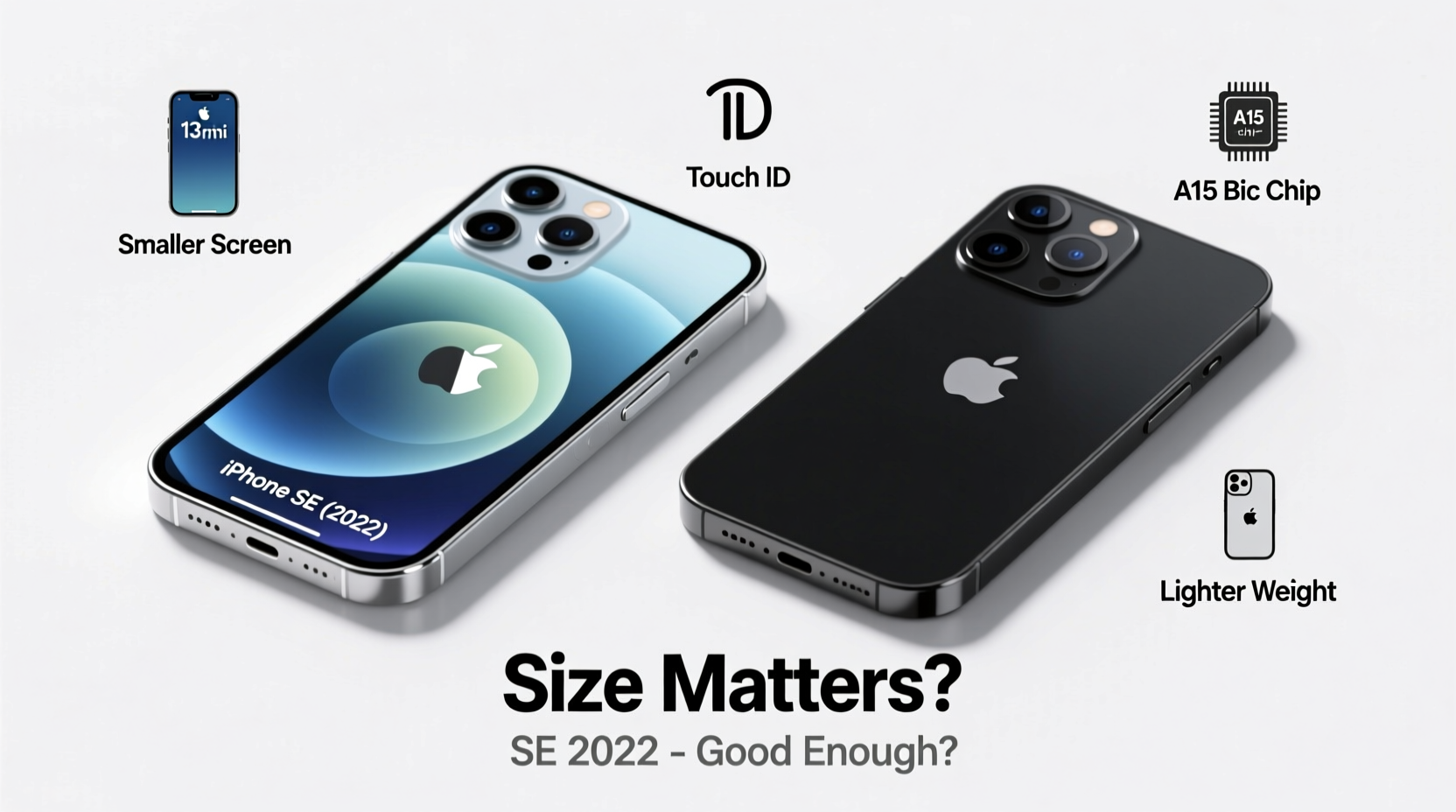
The most immediate difference between the two phones is how they feel in hand. The iPhone 13 Mini measures 131.5 x 64.2 x 7.65 mm and weighs 140g. It fits comfortably in small hands and slips easily into tight pockets. Its OLED Super Retina XDR display delivers deep blacks, vibrant colors, and excellent outdoor visibility. The notch houses Face ID, which remains one of the fastest and most secure biometric systems available.
In contrast, the iPhone SE (2022) uses the iPhone 8’s chassis: 138.4 x 67.3 x 7.3 mm and 144g. While only slightly larger, the thicker bezels and home button give it a distinctly older aesthetic. It uses Touch ID embedded in the home button — a feature some users still prefer for convenience, especially when wearing masks. The 4.7-inch Retina HD LCD screen lacks the punch of the Mini’s OLED, with lower contrast and less vivid color reproduction.
Performance: Nearly Identical Power, Different Experiences
Under the hood, both devices run Apple’s A15 Bionic chip — the same processor found in the iPhone 13 Pro. This means raw CPU and GPU performance are nearly identical. Both handle demanding apps, multitasking, and mobile gaming with ease. You won’t notice a speed difference in day-to-day tasks like browsing, messaging, or streaming.
However, real-world performance doesn’t stop at the chipset. The iPhone 13 Mini benefits from 4GB of RAM compared to the SE’s 3GB. While iOS manages memory efficiently, this extra RAM helps the Mini sustain smoother multitasking — keeping more apps open in the background without reloading.
Additionally, the 13 Mini supports ProMotion-like optimizations through its OLED panel, resulting in smoother scrolling and animations, even though it doesn’t have a 120Hz refresh rate. The SE, limited by its LCD and legacy architecture, feels slightly less fluid during rapid UI transitions.
“Even with the same chip, system-level integration makes a noticeable difference. The 13 Mini feels more future-proof due to better thermal management and display responsiveness.” — David Chen, Mobile Hardware Analyst
Camera Comparison: One Sensor vs Three Generations of Progress
This is where the gap widens significantly. The iPhone 13 Mini features a dual-camera system: a 12MP main sensor with sensor-shift optical image stabilization and a 12MP ultra-wide lens. It supports Night mode on both cameras, Deep Fusion, Smart HDR 4, and Cinematic Mode for portrait video recording. Low-light performance is excellent, and the ultra-wide lens adds creative flexibility.
The iPhone SE (2022), meanwhile, has a single 12MP rear camera — the same one used in the iPhone 11. It supports Night mode and Smart HDR 3 but lacks ultra-wide capability and sensor-shift stabilization. While photos in daylight are sharp and well-exposed, low-light shots show more noise and less dynamic range. Video is capped at 4K/60fps, but without advanced features like Dolby Vision HDR recording, which the 13 Mini offers.
For casual photographers who mostly shoot in good light, the SE is sufficient. But for anyone interested in creative photography, travel, or social media content, the 13 Mini’s additional lens and computational photography advantages are meaningful.
Camera Feature Comparison
| Feature | iPhone 13 Mini | iPhone SE (2022) |
|---|---|---|
| Rear Cameras | Dual: 12MP Wide + 12MP Ultra-Wide | Single: 12MP Wide |
| Front Camera | 12MP TrueDepth (supports Cinematic Mode) | 7MP FaceTime HD |
| Night Mode | Yes (all cameras) | Yes (rear only) |
| Video Recording | 4K Dolby Vision HDR up to 30fps | 4K up to 60fps, no HDR |
| Sensor-Shift Stabilization | Yes | No |
Battery Life and Charging: The Hidden Cost of Small Size
Despite its advanced components, the 13 Mini struggles with battery life. Apple rates it for up to 17 hours of video playback, but real-world usage often lands between 8–10 hours of screen-on time. Heavy users may need to charge midday. It supports 20W fast charging and MagSafe wireless charging, aligning with modern standards.
The iPhone SE (2022), while less power-efficient due to its older display and baseband, actually lasts longer in many scenarios. Its smaller screen draws less power, and iOS optimizes aggressively for efficiency. Users commonly report 10–12 hours of screen time. However, it only supports 20W fast charging if you buy a separate adapter — it ships with a 5W charger. Wireless charging works, but MagSafe alignment isn’t as precise due to internal layout differences.
Real-World Use Case: Who Actually Benefits From Each?
Consider Sarah, a freelance designer who commutes via bike and values portability. She switched from an iPhone 12 Pro Max to the 13 Mini for easier handling while navigating city streets. She loves the compact size and high-quality display for reviewing client work on the go. However, she carries a portable charger because the battery rarely lasts her full workday.
On the other hand, James, a teacher, chose the iPhone SE (2022) after years of using Android. He wanted iOS simplicity, strong performance, and a phone that wouldn’t break the bank. He appreciates the physical home button for quick unlocks and finds the camera adequate for scanning documents and snapping classroom moments. He rarely runs out of battery, even after long school days.
Their experiences highlight a key insight: the “better” phone depends on lifestyle, not just specs. The 13 Mini excels for users who prioritize modern design and photo quality. The SE shines for budget-conscious buyers and those who don’t need cutting-edge features.
Checklist: Choosing Between iPhone 13 Mini and SE (2022)
- ✅ Need a compact, modern smartphone with Face ID and OLED display? → iPhone 13 Mini
- ✅ Prefer Touch ID and don’t mind thicker bezels? → iPhone SE (2022)
- ✅ Want the best camera in a small phone? → iPhone 13 Mini
- ✅ On a tight budget but want flagship-level performance? → iPhone SE (2022)
- ✅ Frequently run out of battery on other phones? → iPhone SE (2022) likely lasts longer
- ✅ Use your phone for video calls or content creation? → iPhone 13 Mini offers superior front camera and audio
Frequently Asked Questions
Is the iPhone SE (2022) waterproof?
No, it’s not officially waterproof, but it has IP67 dust and water resistance, meaning it can survive submersion in up to 1 meter of water for 30 minutes. The 13 Mini also has IP68 rating, allowing for slightly deeper and longer exposure.
Can the iPhone SE (2022) run the latest apps smoothly?
Yes. Thanks to the A15 chip, it handles all current iOS apps and games without issue. It’s expected to receive software updates until at least 2027, making it a durable long-term option.
Why is the 13 Mini more expensive than the SE if they share the same chip?
The price difference reflects the 13 Mini’s newer design, OLED display, advanced cameras, improved audio, and better materials. You’re paying for the full flagship experience in a smaller package.
Final Verdict: Does Size Matter — or Is Good Enough Actually Good Enough?
Size matters — but not always in the way we expect. The iPhone 13 Mini proves that a truly compact flagship is possible, offering cutting-edge tech in a pocket-friendly body. Yet its limited battery and premium price make it a niche choice.
The iPhone SE (2022) reminds us that “good enough” can be remarkably capable. With top-tier processing power, reliable performance, and a starting price $200 lower than the 13 Mini, it’s an outstanding value. It sacrifices modern design and camera versatility, but delivers where it counts for many users.
If you crave the latest in smartphone innovation and love small phones, the 13 Mini is worth the trade-offs. But if your needs are practical and budget-sensitive, the SE isn’t just “good enough” — it’s smart, efficient, and surprisingly future-ready.




 浙公网安备
33010002000092号
浙公网安备
33010002000092号 浙B2-20120091-4
Comments
No comments yet. Why don't you start the discussion?