
For users still holding onto an iPhone 7, the idea of upgrading to a modern flagship like the iPhone 13 Pro Max can feel both exciting and overwhelming. The leap in technology over six years is dramatic—but so is the jump in size, price, and complexity. Many wonder: Is this upgrade truly worth it, especially when the new device is significantly larger and heavier than the compact iPhone 7?
The answer depends on your priorities: Are you chasing better performance, photography, or longevity? Or are you concerned about ergonomics, pocketability, and simplicity? Let’s dissect the real-world implications of moving from the iPhone 7 to the iPhone 13 Pro Max, with a focus on how the size difference impacts usability and whether the benefits outweigh the trade-offs.
Performance: A Quantum Leap in Speed and Efficiency
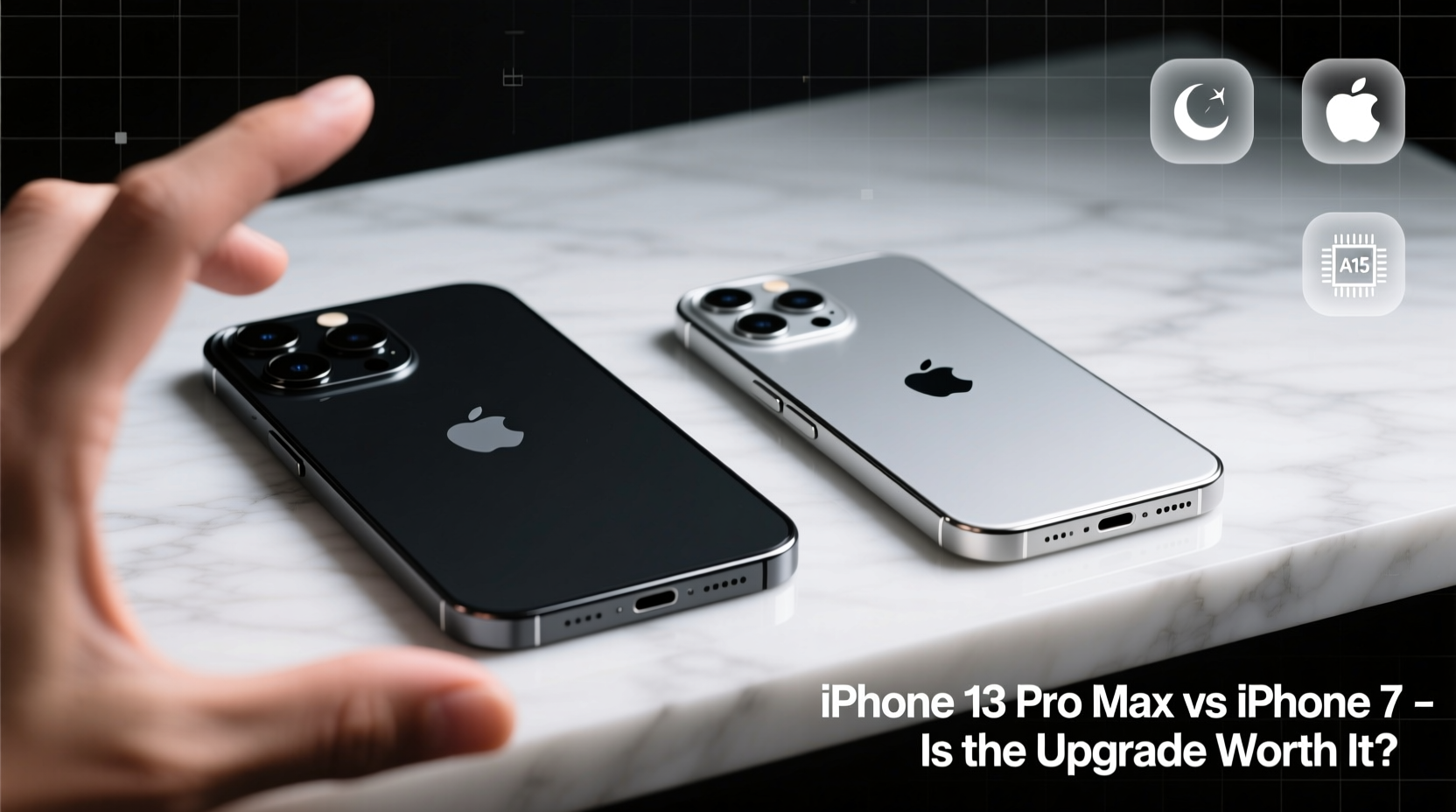
The iPhone 7 runs on Apple’s A10 Fusion chip, a solid performer in its time. However, by today’s standards, it struggles with multitasking, app loading times, and newer iOS updates that demand more processing power. In contrast, the iPhone 13 Pro Max features the A15 Bionic chip—one of the most powerful mobile processors ever built.
Benchmarks tell only part of the story. Real-world usage reveals far greater differences:
- App launches are nearly instantaneous on the 13 Pro Max.
- 4K video editing, augmented reality apps, and high-end gaming run smoothly without throttling.
- iOS 17 and future updates will likely drop support for older devices like the iPhone 7, making the upgrade necessary for continued security and feature access.
“Moving from an iPhone 7 to a 13 Pro Max is less like upgrading and more like switching decades.” — David Kim, Mobile Technology Analyst at TechPulse Weekly
If you rely on your phone for work, content creation, or heavy daily use, the performance gap alone makes the upgrade compelling—even if the size takes some getting used to.
Camera Capabilities: Night Mode, Telephoto, and Computational Photography
The iPhone 7 introduced Portrait Mode via software simulation, but the iPhone 13 Pro Max delivers true depth-sensing through a triple-lens system: wide, ultra-wide, and telephoto. More importantly, it includes advanced features like:
- Night mode on all lenses
- Cinematic Mode for video (with automatic focus shifting)
- ProRes video recording for professional editing
- Sensor-shift stabilization for sharper photos in motion
Low-light photography, once a weakness of the iPhone 7, is now one of the 13 Pro Max’s strongest suits. You can capture detailed, noise-free images after sunset—something unimaginable on the older model.
Size and Ergonomics: Can You Adapt?
This is where the upgrade becomes controversial. The iPhone 7 measures 5.44 x 2.64 inches and weighs 4.87 oz. The iPhone 13 Pro Max is 6.33 x 3.07 inches and weighs 8.47 oz—nearly 70% heavier.
For many users, especially those with smaller hands or who value one-handed operation, this is a major shift. Pocket fit becomes an issue, particularly with slim jeans or tight pockets. One-handed typing requires adjustment, and accidental drops increase due to reduced grip security.
Yet, there are mitigating factors:
- Larger screens enhance media consumption, reading, and productivity.
- The edge-to-edge OLED display offers superior brightness, contrast, and HDR support.
- Reachability mode helps bring top elements within thumb reach.
Adaptation is possible, but not guaranteed. If comfort and portability are top priorities, consider the iPhone 13 mini instead—it’s closer in size to the iPhone 7 while offering modern internals.
Detailed Comparison: iPhone 13 Pro Max vs iPhone 7
| Feature | iPhone 13 Pro Max | iPhone 7 |
|---|---|---|
| Display | 6.7” Super Retina XDR OLED (2778x1284) | 4.7” Retina HD LCD (1334x750) |
| Processor | A15 Bionic (6-core CPU, 5-core GPU) | A10 Fusion (4-core CPU, 2-core GPU) |
| Rear Cameras | Triple 12MP (Wide, Ultra-Wide, Telephoto), Sensor-shift OIS | Dual 12MP (Wide + Simulated Portrait), No OIS |
| Front Camera | 12MP TrueDepth with Night Mode | 7MP FaceTime HD |
| Battery Life | Up to 28 hours video playback | Up to 14 hours video playback |
| Water Resistance | IP68 (6m for 30 mins) | IP67 (1m for 30 mins) |
| Storage Options | 128GB, 256GB, 512GB, 1TB | 32GB, 128GB (original models) |
| Weight | 240g (8.47 oz) | 138g (4.87 oz) |
| Charging | MagSafe, Qi wireless, USB-C to Lightning | Qi wireless (via case), Lightning cable |
Real-World Example: Sarah’s Upgrade Journey
Sarah had been using her iPhone 7 since 2017. She loved its compact size and long-standing reliability. But by 2023, she noticed her phone freezing during Zoom calls, struggling to load maps, and failing to capture clear photos at her daughter’s evening soccer games.
She upgraded to the iPhone 13 Pro Max primarily for the camera and battery life. Initially, she found the phone unwieldy and dropped it twice in the first week. She invested in a grippy case and began using voice commands more frequently. Within a month, she adapted—and now praises the device’s ability to handle multiple tasks, record 4K videos of her kids, and last two full days on a single charge.
“I didn’t realize how much I was missing until I had it,” she said. “Yes, it’s big. But what it does every day makes the size worth it.”
Upgrade Checklist: Are You Ready for the Jump?
Before making the switch, ask yourself these questions:
- Is your iPhone 7 slowing down significantly? Frequent crashes, long load times, and app incompatibility are signs it’s time.
- Do you need better photo/video quality? If you document family moments or create content, the 13 Pro Max’s camera system is transformative.
- Can you adapt to a larger device? Try holding a demo model at an Apple Store or borrowing a friend’s large phone for a day.
- Are you concerned about battery life? The 13 Pro Max lasts nearly twice as long under heavy use.
- Will you benefit from newer features? MagSafe, LiDAR scanning, ProMotion display (120Hz), and improved speakers add tangible value.
Frequently Asked Questions
Can I use my iPhone 7 accessories with the iPhone 13 Pro Max?
No—due to size and design changes, cases and screen protectors are not interchangeable. However, both use Lightning cables, so chargers and headphones remain compatible unless they rely on 3.5mm headphone jacks (which the 13 Pro Max lacks).
Will the iPhone 13 Pro Max feel too bulky in my pocket?
Many users report it fits in larger pockets (like jacket or cargo pants), but may bulge or be uncomfortable in tight jeans. Consider your daily carry habits before deciding.
Is the price difference justified?
At launch, the iPhone 13 Pro Max started at $1,099 compared to the iPhone 7’s original $649. While expensive, the performance, camera, battery, and software support (likely through 2027+) offer long-term value. For frequent users, it pays off over time.
Conclusion: Making the Right Choice for Your Lifestyle
Upgrading from the iPhone 7 to the iPhone 13 Pro Max isn’t just about size—it’s about stepping into a new era of mobile computing. The performance, camera quality, battery endurance, and software longevity represent a generational leap. Yes, the device is larger and heavier, but modern features compensate with enhanced usability and functionality.
If you prioritize convenience, speed, and creative potential, the upgrade is absolutely worth it—even with the size difference. But if pocketability and lightweight handling are non-negotiable, explore alternatives like the iPhone 13 mini or iPhone SE (3rd gen) to balance modern tech with compact design.




 浙公网安备
33010002000092号
浙公网安备
33010002000092号 浙B2-20120091-4
Comments
No comments yet. Why don't you start the discussion?