
For users still holding onto an iPhone XS Max—released in 2018—the question isn’t just whether to upgrade, but whether doing so to the iPhone 13 Pro Max makes sense given the physical similarities and subtle differences in size. Both devices feature a 6.5-inch and 6.7-inch OLED display respectively, placing them in the same general category of large iPhones. Yet beneath the surface, the technological leap between these two models is substantial. This isn't merely about screen inches; it's about longevity, performance, camera capability, and daily usability.
The iPhone XS Max was once Apple’s flagship powerhouse. But five years of rapid advancement in mobile technology mean that even though the size difference seems minimal, the experience gap is significant. Let’s break down whether trading in your trusty XS Max for the 13 Pro Max delivers value proportional to its bulk, cost, and footprint in your pocket.
Design and Physical Dimensions: Closer Than You Think
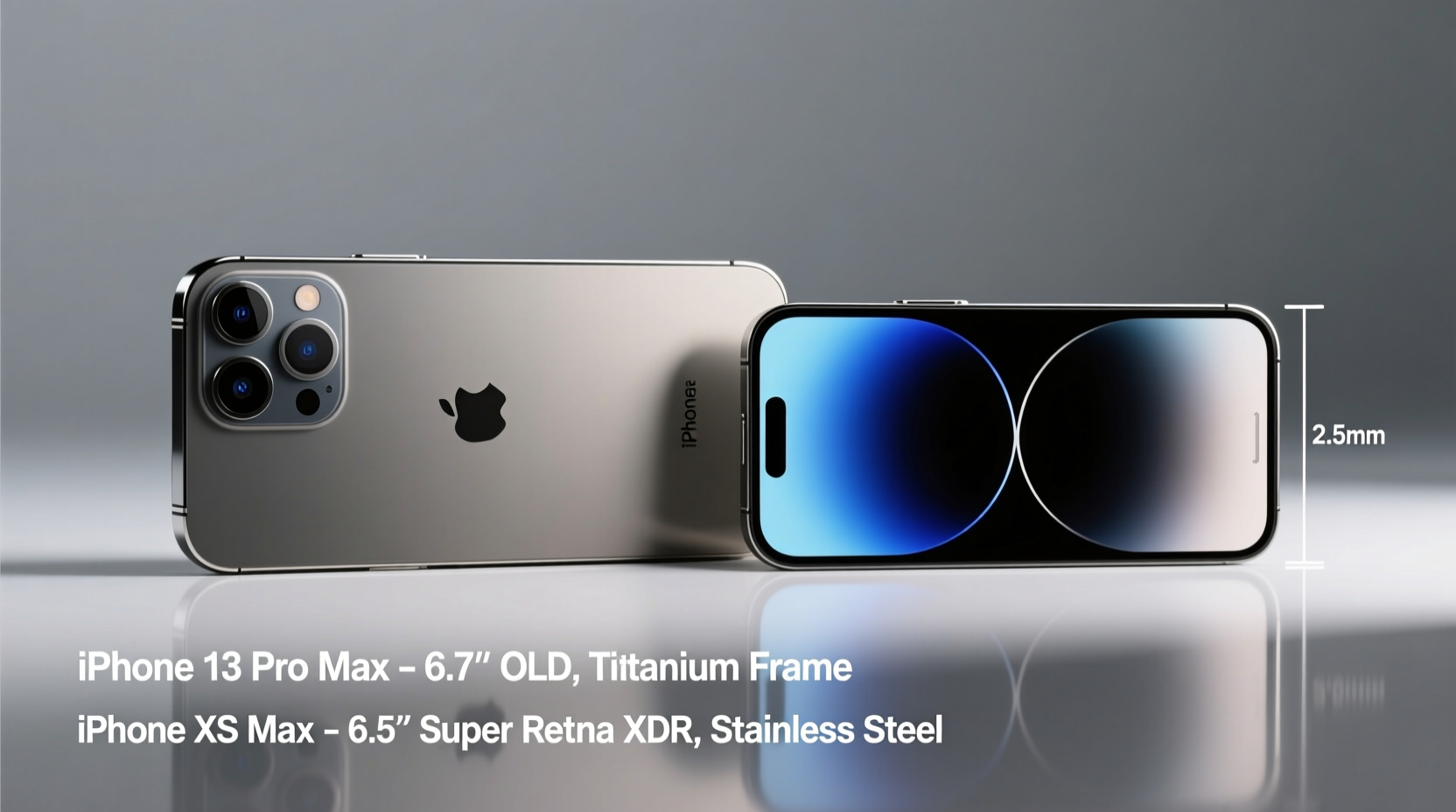
At first glance, both phones occupy similar ergonomic territory. The iPhone XS Max measures 157.5 x 77.4 x 7.7 mm and weighs 208 grams. The iPhone 13 Pro Max is slightly larger at 160.8 x 78.1 x 7.65 mm and marginally heavier at 240 grams. That’s a 3.3 mm increase in height, 0.7 mm in width, and an extra 32 grams—roughly the weight of three U.S. quarters.
This small shift doesn’t drastically alter how the phone feels in hand or slips into a pocket, but the added mass becomes noticeable during extended one-handed use. The 13 Pro Max’s design also features flatter edges reminiscent of the iPhone 5 era, which some find more secure than the rounded frame of the XS Max.
Performance: A Generational Leap
The most dramatic difference lies under the hood. The iPhone XS Max runs on the A12 Bionic chip—a capable processor in its time. However, the iPhone 13 Pro Max uses the A15 Bionic chip with a 5-core GPU (in the Pro model), offering up to 50% faster graphics performance and significantly improved machine learning efficiency.
In real-world terms, this means:
- Apps launch noticeably faster
- Graphics-heavy games run smoothly at high settings
- Multitasking between photo editing, video rendering, and streaming is seamless
- Future iOS updates will be supported longer—likely through 2027 or beyond
According to data from Geekbench 5, the A15 scores nearly double the multi-core performance of the A12. For users relying on productivity tools, creative apps, or augmented reality experiences, this isn’t incremental—it’s transformative.
“Upgrading from an A12-based device to an A15 is like moving from a four-cylinder sedan to a turbocharged sports car. The engine may look the same under the hood, but the driving experience is entirely different.” — Raj Patel, Senior Mobile Analyst at TechPulse Insights
Display and Battery Life: Where Daily Use Shines
The screen size difference is only 0.2 inches, but the quality jump is massive. The iPhone 13 Pro Max introduces ProMotion technology with a 120Hz adaptive refresh rate. This means smoother scrolling, responsive animations, and reduced eye strain over long usage periods. The XS Max, limited to 60Hz, feels sluggish by comparison—even if the resolution and color accuracy were excellent for their time.
Battery life has seen one of the most impactful improvements. Apple rates the 13 Pro Max for up to 28 hours of video playback; the XS Max manages about 15. Real-world testing shows the newer model lasting two full days with moderate use, while the older one often requires midday charging.
| Feature | iPhone XS Max | iPhone 13 Pro Max |
|---|---|---|
| Chipset | A12 Bionic | A15 Bionic (Pro) |
| RAM | 4GB | 6GB |
| Refresh Rate | 60Hz | 120Hz (Adaptive) |
| Battery Life (Video Playback) | 15 hours | 28 hours |
| Water Resistance | IP68 (2m for 30 min) | IP68 (6m for 30 min) |
| Rear Cameras | Dual 12MP | Triple 12MP + LiDAR |
| Zoom | 2x optical | 3x optical, 15x macro, 35x digital |
Camera System: Night and Day Difference
If photography matters to you, the upgrade is undeniable. The iPhone 13 Pro Max adds a third telephoto lens, sensor-shift stabilization, Night mode on all cameras, and Cinematic Mode for depth-controlled video recording.
Low-light performance alone justifies the move for many users. The larger sensors and advanced computational photography produce cleaner images with better dynamic range. Portrait mode now detects eyes and adjusts focus more accurately, and macro photography allows extreme close-ups starting at 2 cm.
Video capabilities take another leap with Dolby Vision HDR recording at 4K up to 60fps—something the XS Max cannot match. Editors working directly on the phone benefit from ProRes support (on 256GB+ models), enabling professional-grade post-production.
Real-World Example: Sarah’s Upgrade Journey
Sarah, a freelance travel photographer based in Portland, used her iPhone XS Max for four years. She loved its compactness compared to Android flagships but began struggling with slow app switches when editing RAW files and frequent battery drain during shoots.
After switching to the iPhone 13 Pro Max, she noticed immediate gains. Her Lightroom edits loaded twice as fast, and she could shoot 4K video without overheating issues. Despite the slight increase in size, she adapted quickly thanks to the matte aluminum edges improving grip. Most importantly, she gained confidence that her phone wouldn’t die halfway through a client session.
“I was hesitant because the size looked almost identical,” she said. “But the extra half-inch gave Apple room to fit a much bigger battery and better cooling. It’s not just an upgrade—it’s a tool that keeps up with my workflow.”
Step-by-Step: Should You Upgrade?
Follow this decision framework to evaluate your personal case:
- Assess current pain points: Does your XS Max lag, overheat, or die before evening?
- Evaluate camera needs: Do you take photos in low light or record videos regularly?
- Check iOS support timeline: The XS Max stopped receiving major updates with iOS 17 (2023). The 13 Pro Max will likely get iOS 20+.
- Test ergonomics: Visit an Apple Store to hold the 13 Pro Max. Note wrist strain after prolonged use.
- Calculate total cost: Factor in trade-in value (XS Max still holds ~$200–$300) and potential accessory upgrades (new case, charger).
Frequently Asked Questions
Is the size difference between the iPhone 13 Pro Max and XS Max really that big?
No, the dimensional change is minor—just over 3mm taller and 32g heavier. However, the increased weight distribution and flat edges make the 13 Pro Max feel denser and more substantial, which some users prefer for stability.
Can the iPhone 13 Pro Max last longer than my XS Max?
Yes, both in daily battery life and overall lifespan. With better optimization, modern components, and continued software support, expect 3–4 more years of reliable performance versus 1–2 on the aging XS Max.
Do I need the Pro Max size for the best camera?
While all iPhone 13 models share core imaging features, only the Pro Max includes the full triple-lens system with 3x optical zoom and sensor-shift stabilization. For serious photographers, the Max variant offers tangible advantages.
Conclusion: Future-Proofing Meets Functionality
The upgrade from iPhone XS Max to iPhone 13 Pro Max isn’t defined by size—it’s defined by substance. Yes, the newer model is slightly larger and heavier, but those fractions of millimeters accommodate critical advancements: a far superior processor, dramatically better battery, pro-level cameras, and a fluid 120Hz display.
If you rely on your phone for work, creativity, or staying connected throughout the day, the investment pays off in responsiveness, endurance, and longevity. The modest increase in footprint supports a significantly enhanced user experience—one that aligns with modern expectations of what a smartphone should do.




 浙公网安备
33010002000092号
浙公网安备
33010002000092号 浙B2-20120091-4
Comments
No comments yet. Why don't you start the discussion?