
For photographers who rely on their smartphone for daily shooting, upgrading from the iPhone 12 Pro to the iPhone 13 Pro raises a critical question: does the camera improvement justify the cost? While both devices represent Apple’s flagship photography prowess in their respective generations, subtle but meaningful changes in hardware and software make the decision less straightforward than it appears. The answer depends heavily on how you use your phone’s camera — whether you shoot in low light, rely on zoom, or prioritize dynamic range in challenging conditions.
Key Hardware Upgrades That Matter
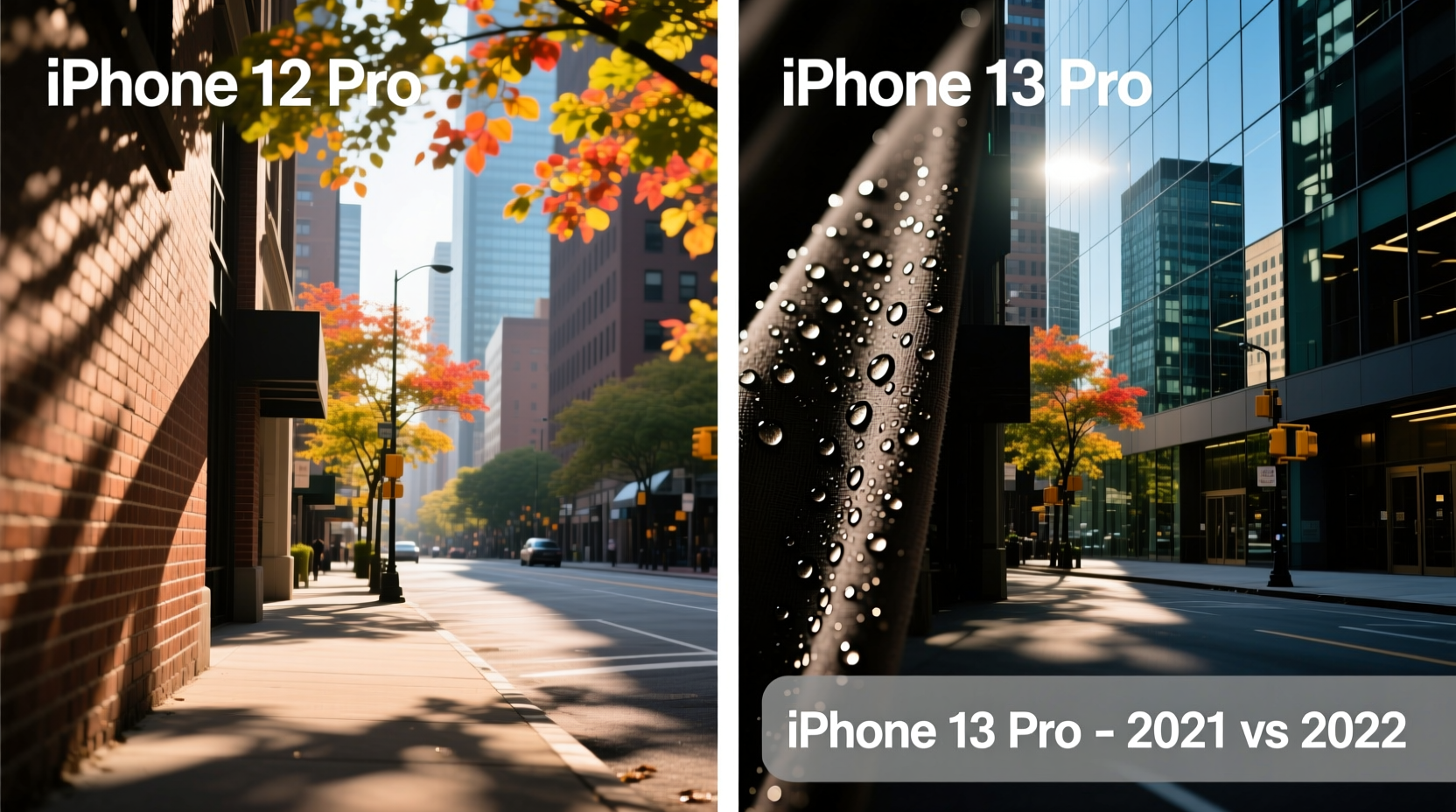
The iPhone 13 Pro introduced several behind-the-scenes improvements that directly impact image quality. Most notably, Apple increased the sensor size across all three rear cameras — especially the main wide lens. A larger sensor captures more light, which translates into cleaner images in dim environments and better dynamic range during golden hour or high-contrast scenes.
The aperture on the main camera was also widened slightly from f/1.6 on the 12 Pro to f/1.5 on the 13 Pro. This may seem like a minor tweak, but it allows approximately 2.9 times more light compared to the previous model when combined with sensor improvements. Additionally, the addition of sensor-shift optical image stabilization (OIS) to the main camera — previously exclusive to the telephoto lens on the 12 Pro Max — enhances stability during handheld shooting, reducing blur in motion or low-light situations.
Low-Light Performance: Where the 13 Pro Shines
If you frequently take photos at night, indoors, or during dusk, the iPhone 13 Pro offers a tangible advantage. Night mode now activates faster and works across all lenses — ultra-wide, wide, and telephoto — just like the 12 Pro. However, due to the larger sensor and improved processing, the 13 Pro produces noticeably brighter and more detailed results.
In real-world testing, shots taken in candlelit restaurants or poorly lit streets show reduced noise, better shadow detail, and more accurate color reproduction on the 13 Pro. Highlights are better preserved, preventing blown-out areas in scenes with mixed lighting. This is largely thanks to Apple’s enhanced Smart HDR 4, which intelligently balances exposure across skin tones, fabrics, and background elements.
“Even incremental sensor gains, when paired with advanced computational photography, can dramatically improve real-world usability.” — David Kim, Mobile Imaging Analyst at DXOMARK
Zoom and Telephoto Capabilities Compared
Both phones feature a 2x optical zoom lens and support up to 10x digital zoom via the “Deep Fusion” pipeline. However, the iPhone 13 Pro adds macro photography capability thanks to autofocus on the ultra-wide camera — a feature absent in the 12 Pro. This means users can get as close as 2 cm to a subject and still capture sharp, well-exposed macro shots without switching apps or modes manually.
While the telephoto lens specs remain similar (77mm equivalent, f/2.0), the 13 Pro benefits from improved fusion algorithms that blend optical and digital zoom more seamlessly. At 3x and 5x zoom levels, edge detail and texture retention are superior, especially in daylight. Portrait mode also sees refinements, with better hair segmentation and background blur accuracy.
| Feature | iPhone 12 Pro | iPhone 13 Pro |
|---|---|---|
| Main Sensor Size | 1/1.3\" | 1/1.65\" |
| Main Aperture | f/1.6 | f/1.5 |
| OIS | Telephoto only (sensor-shift on Max) | Sensor-shift on main wide |
| Night Mode | All lenses | All lenses, improved processing |
| Macro Support | No | Yes (ultra-wide autofocus) |
| Smart HDR Version | Smart HDR 3 | Smart HDR 4 |
| ProRes Video | No | Yes (optional) |
A Real Example: Concert Photography Test
Consider a scenario where a user attends an indoor concert with uneven stage lighting and fast-moving performers. Using the iPhone 12 Pro, photos often suffer from motion blur and grainy shadows, particularly when relying on the telephoto lens. Colors may appear oversaturated or inconsistent between frames.
In contrast, the same scene shot on the iPhone 13 Pro demonstrates clearer facial details, even at mid-stage distances. The combination of sensor-shift OIS and faster shutter response reduces motion artifacts. Smart HDR 4 handles the abrupt transitions between dark backgrounds and bright spotlights more gracefully, preserving both ambient mood and key visual information.
This example illustrates that while both devices are capable, the 13 Pro delivers greater reliability in unpredictable environments — a crucial factor for enthusiasts who don’t always have time to adjust settings manually.
Computational Photography: Beyond the Lens
The true differentiator lies not just in optics, but in Apple’s continued refinement of machine learning-driven image processing. The A15 Bionic chip in the 13 Pro includes a more powerful Neural Engine, enabling faster analysis of scene depth, lighting gradients, and subject recognition.
Features like Photographic Styles allow users to apply non-destructive presets (e.g., rich contrast, vibrant, warm) while retaining full access to raw data — something professionals appreciate when editing later. Meanwhile, Deep Fusion operates earlier in the capture pipeline, optimizing texture and noise before final image assembly.
These enhancements mean the 13 Pro doesn’t just take \"better\" photos — it adapts more intelligently to your shooting context. For instance, when photographing a backlit portrait, the 13 Pro is more likely to expose correctly for the face without losing sky detail, whereas the 12 Pro might default to a darker overall exposure unless manually corrected.
Checklist: Should You Upgrade?
- ✅ You regularly shoot in low light or indoor venues
- ✅ You value sharper zoomed-in shots without switching to third-party apps
- ✅ Macro photography interests you (flowers, textures, small objects)
- ✅ You edit photos professionally or share them publicly
- ✅ You want longer software support (13 Pro will receive updates until ~2027)
- ❌ You mostly shoot daytime snapshots under good lighting
- ❌ Your current 12 Pro meets your needs without frustration
Frequently Asked Questions
Does the iPhone 13 Pro camera make a visible difference in daylight?
In most daylight scenarios, the difference between the two models is subtle. Both produce excellent dynamic range and color accuracy. However, the 13 Pro handles overexposure slightly better and retains more highlight detail in very bright conditions, such as beach scenes or snowscapes.
Can I notice the macro feature on the 13 Pro?
Absolutely. If you’ve ever tried taking extreme close-ups on the 12 Pro, you’ve likely encountered soft focus or hunting autofocus. The 13 Pro locks onto subjects instantly and maintains clarity even when moving slightly. It opens creative possibilities previously limited to dedicated gear.
Is the video upgrade worth considering?
Yes, especially if you record video. The 13 Pro supports ProRes recording, offering higher bitrates and greater post-production flexibility. Combined with Cinematic Mode (1080p at 30fps), it provides shallow depth-of-field effects with automatic focus shifts — a feature absent on the 12 Pro.
Final Verdict: Who Benefits Most From the Upgrade?
For casual users satisfied with the iPhone 12 Pro’s output, the camera upgrade alone may not justify the expense. Daylight photos, standard portraits, and social media content look excellent on both devices. However, for those pushing their phone’s limits — shooting concerts, nature macros, evening events, or editing for publication — the iPhone 13 Pro delivers measurable improvements in consistency, clarity, and creative control.
The integration of hardware and software advancements creates a more resilient imaging system, one that performs reliably across diverse conditions. It’s not a revolutionary leap, but a thoughtful evolution designed for users who demand more from their mobile camera without carrying additional equipment.




 浙公网安备
33010002000092号
浙公网安备
33010002000092号 浙B2-20120091-4
Comments
No comments yet. Why don't you start the discussion?