
For millions of iPhone users still relying on the iPhone 7 Plus, the question isn’t just about desire—it’s about practicality. Is upgrading to the iPhone 13 Pro actually worth the investment in current_year? After all, the 7 Plus was a landmark device in its time: durable, reliable, and equipped with a beloved dual-camera system. But technology doesn’t stand still. Over five years separate these two models, and in smartphone terms, that’s an eternity. This article breaks down every major upgrade category—performance, camera, battery life, software support, and overall user experience—to help you decide whether making the leap makes financial and functional sense.
Performance: A Quantum Leap in Speed and Efficiency
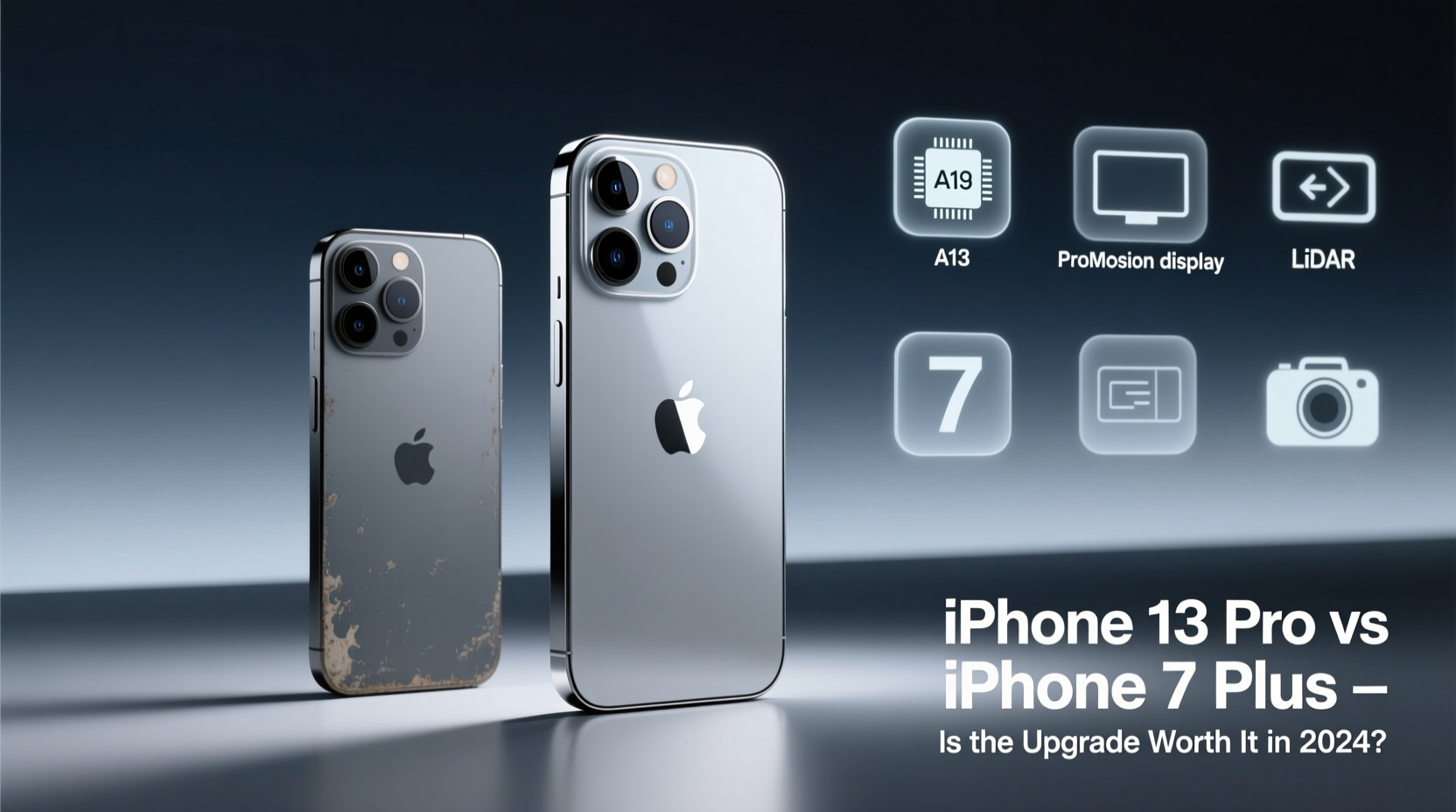
The most dramatic difference between the iPhone 7 Plus and iPhone 13 Pro lies under the hood. The 7 Plus runs on Apple’s A10 Fusion chip, a solid performer in 2016 but now significantly outpaced by modern standards. In contrast, the iPhone 13 Pro is powered by the A15 Bionic chip—one of the fastest mobile processors ever built at its release.
Benchmarks tell a clear story. The A15 delivers nearly four times the CPU performance and over six times the GPU power compared to the A10. What does this mean in real life?
- Faster app launches—even complex ones like Adobe Lightroom or video editors open almost instantly.
- Smoother multitasking: switching between apps feels effortless, even with multiple Safari tabs and background music.
- Future-proofing: iOS updates are becoming more demanding. By current_year, newer versions of iOS may run sluggishly—or not at all—on the 7 Plus.
Camera Comparison: From Good to Professional-Grade
The iPhone 7 Plus was one of the first iPhones to feature a dual-lens rear camera setup (12MP wide + 12MP telephoto), enabling 2x optical zoom and Portrait Mode. At the time, it was revolutionary. Today, it struggles with low-light scenes, lacks Night mode, and captures flat dynamic range.
The iPhone 13 Pro introduces a triple-camera system (wide, ultra-wide, telephoto) with sensor-shift stabilization, macro photography, Night mode on all lenses, and Cinematic Mode for video. More importantly, computational photography has advanced dramatically. Smart HDR 4, Deep Fusion, and Photographic Styles make photos look richer and more natural—even in challenging lighting.
| Feature | iPhone 7 Plus | iPhone 13 Pro |
|---|---|---|
| Rear Cameras | Dual 12MP | Triple 12MP with LiDAR |
| Low-Light Performance | Limited, no Night mode | Excellent, Night mode on all lenses |
| Video Recording | 4K at 30fps | 4K at 60fps with Dolby Vision HDR |
| Zoom | 2x optical, up to 10x digital | 3x optical, up to 15x digital |
| Front Camera | 7MP | 12MP with Night mode and Deep Fusion |
“Smartphone photography today isn’t just about megapixels—it’s about how the hardware and software work together. The 13 Pro represents a full generational shift.” — Lena Torres, Mobile Photography Analyst at TechLens Review
Battery Life and Charging: From All-Day to Multi-Day Usability
The iPhone 7 Plus offered decent battery life in 2016—around 12–13 hours of mixed use. However, after years of charging cycles, most existing units have degraded batteries that struggle to last a full day, especially with modern app demands.
The iPhone 13 Pro features a much larger battery and far more efficient architecture. Apple claims up to 22 hours of video playback. Real-world testing shows 14–16 hours of screen-on time, which often translates to two full days of moderate use.
Additionally, the 13 Pro supports:
- Faster wired and wireless charging
- Magsafe compatibility for convenient magnetic accessories
- USB Power Delivery for rapid top-ups (50% charge in about 30 minutes)
Display and Design: From Solid to Stunning
The iPhone 7 Plus featured a 5.5-inch LCD display with a resolution of 1920×1080. While sharp for its era, it lacks the vibrancy, brightness, and smoothness of modern OLED panels.
The iPhone 13 Pro boasts a 6.1-inch Super Retina XDR OLED display with ProMotion technology—offering a 120Hz adaptive refresh rate. This means smoother scrolling, more responsive touch input, and less eye strain during prolonged use. Brightness peaks at 1000 nits (HDR) and 250 nits typically, compared to 500 nits on the 7 Plus—making outdoor visibility vastly superior.
Design-wise, the 13 Pro uses Ceramic Shield front cover and stainless steel frame, making it more durable and premium-feeling than the aluminum-bodied 7 Plus. It’s also IP68 water-resistant (up to 6 meters for 30 minutes), whereas the 7 Plus only has basic splash resistance.
Software Support and Longevity
This is perhaps the most critical factor. As of current_year, the iPhone 7 Plus is no longer receiving major iOS updates. It topped out at iOS 16, meaning it won’t get new features, security patches, or app compatibility improvements released in iOS 17 and beyond.
In contrast, the iPhone 13 Pro will likely receive iOS updates through at least 2027. This ensures access to future innovations like enhanced privacy controls, AI-powered tools, and improved ecosystem integration with Apple Watch, AirPods, and HomeKit.
App developers are increasingly optimizing for newer hardware. Some emerging apps—especially those using AR, machine learning, or high-resolution media—may not run on older devices at all.
Mini Case Study: Sarah’s Upgrade Decision
Sarah, a freelance photographer based in Portland, held onto her iPhone 7 Plus for six years. She appreciated its compact size and familiarity. But by late 2023, she noticed her editing apps crashed frequently, her photos looked dull compared to peers’, and her phone died by mid-afternoon during shoots.
After testing a friend’s iPhone 13 Pro, she was struck by how fast Lightroom ran, how well Night mode captured ambient light, and how long the battery lasted. She upgraded in early current_year and reported saving nearly two hours per week in post-processing time alone. “It wasn’t just a new phone,” she said. “It became a real tool for my business.”
Checklist: Is It Time to Upgrade?
Answer the following to determine if upgrading is right for you:
- Does your iPhone 7 Plus struggle to install the latest iOS update?
- Do apps frequently crash or freeze?
- Is your battery dead by 3 PM with moderate use?
- Are you unable to use newer camera features like Night mode or 4K video?
- Have you noticed slower performance when browsing or messaging?
- Do newer apps fail to download or run properly?
If you answered “yes” to three or more, the iPhone 13 Pro—or even a newer model—could offer significant quality-of-life improvements.
Frequently Asked Questions
Will my iPhone 7 Plus stop working if I don’t upgrade?
No, it will continue to function as a phone, but you’ll miss critical security updates and new app features. Over time, more apps may become incompatible, limiting functionality.
Can I save money by choosing an iPhone 13 instead of the 13 Pro?
Yes. The standard iPhone 13 offers the same A15 chip, excellent camera, and great battery life but lacks the 120Hz ProMotion display and telephoto lens. For most users, it’s a more affordable sweet spot.
What should I do with my old iPhone 7 Plus?
You can trade it in (Apple still offers minimal credit), repurpose it as a dedicated music or security camera device, or recycle it responsibly through certified e-waste programs.
Conclusion: The Value of Modern Capabilities
Upgrading from the iPhone 7 Plus to the iPhone 13 Pro isn’t just about having a newer gadget—it’s about gaining reliability, capability, and peace of mind. The improvements in speed, camera quality, battery life, and software support are substantial and directly impact daily usability.
While the cost of a new iPhone is significant, consider the cumulative effect of small frustrations: waiting for apps to load, missing photo moments due to poor low-light performance, or carrying chargers everywhere. These add up over time. For many users, especially those using their phone for work, creativity, or communication, the upgrade pays for itself in efficiency and enjoyment.




 浙公网安备
33010002000092号
浙公网安备
33010002000092号 浙B2-20120091-4
Comments
No comments yet. Why don't you start the discussion?