
The Galaxy Note 8 was a flagship powerhouse in its time — released in 2017, it set standards for large displays, stylus integration, and multitasking on Android. Fast forward to 2024, and the iPhone 13 represents a modern benchmark in efficiency, longevity, and ecosystem cohesion. If you're still holding onto a Galaxy Note 8, the question isn't just whether you *can* upgrade — it's whether you *should*. The answer depends on your needs, usage patterns, and expectations from a smartphone in today’s context.
Performance & Hardware: A Generational Leap
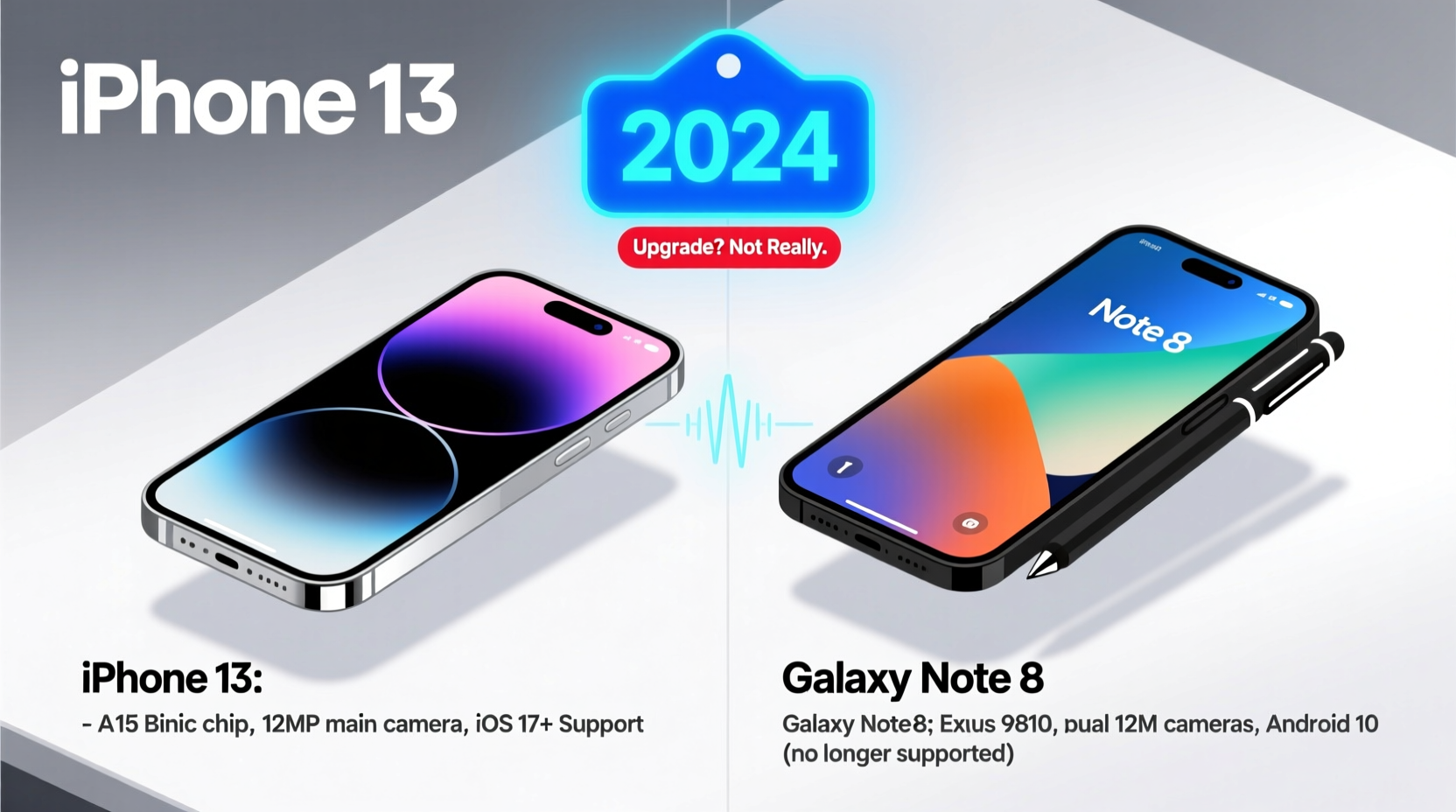
The gap between the iPhone 13 and Galaxy Note 8 spans nearly five years of technological evolution. The Note 8 runs on the Qualcomm Snapdragon 835 (or Exynos 8895 in some regions), paired with 6GB of RAM. While this was top-tier in 2017, it struggles today with multitasking, app loading times, and background processes, especially with newer versions of Android demanding more resources.
In contrast, the iPhone 13 features Apple’s A15 Bionic chip — one of the most powerful mobile processors even by 2024 standards. Built on a 5nm process, it delivers up to 50% better CPU performance and double the graphics power compared to the Snapdragon 835. Apps launch instantly, games run smoothly at high settings, and system animations remain fluid over extended use.
Storage is another key differentiator. The Note 8 maxed out at 256GB, but base models started at 64GB — now considered minimal. The iPhone 13 starts at 128GB, offering more breathing room for photos, videos, and apps without constant file management.
Camera Capabilities: From Good to Exceptional
The Galaxy Note 8 had a solid dual-camera setup: 12MP wide and telephoto lenses with optical zoom and portrait mode. For its era, it delivered crisp images and reliable low-light performance. But fast-forward to 2024, and its sensor technology, image processing, and dynamic range fall short compared to modern standards.
The iPhone 13 improves dramatically in every metric. Its dual 12MP system includes a wider aperture (ƒ/1.6) on the main sensor, significantly enhancing low-light photography. Smart HDR 4, Deep Fusion, and Night mode across all cameras mean consistently balanced exposures, accurate colors, and reduced noise — even in dim environments.
Video recording sees an even starker contrast. The Note 8 tops out at 4K@30fps with limited stabilization. The iPhone 13 supports Dolby Vision HDR recording at 4K@60fps, cinematic mode, and advanced sensor-shift stabilization. For anyone creating content or simply capturing life’s moments, the leap is transformative.
“Smartphone cameras have evolved from point-and-shoot tools to full creative instruments. The difference between a 2017 and 2021+ device isn’t just resolution — it’s computational intelligence.” — David Lin, Mobile Photography Analyst
Software Support & Longevity
This is where the decision becomes clearer. Samsung ended major Android updates for the Galaxy Note 8 with Android 9 (Pie), and security patches ceased years ago. That means no access to new features, performance improvements, or critical security fixes. Using the device in 2024 exposes you to potential vulnerabilities, especially when handling sensitive data like banking or messaging.
Apple, on the other hand, continues to support the iPhone 13 with iOS 17 and will likely receive iOS 18 and possibly iOS 19. This gives the device a total software lifespan of 5–6 years — far exceeding typical Android support windows. Regular updates ensure compatibility with new apps, improved battery management, and ongoing privacy enhancements.
If you rely on apps like WhatsApp, Google Workspace, or banking platforms, many now require recent OS versions. The Note 8 may fail to install updates or lose functionality entirely in the near future.
Detailed Comparison Table
| Feature | Galaxy Note 8 (2017) | iPhone 13 (2021) |
|---|---|---|
| Processor | Snapdragon 835 / Exynos 8895 | Apple A15 Bionic (5nm) |
| RAM | 6GB | 4GB (optimized via iOS) |
| Storage Options | 64GB / 128GB / 256GB (expandable via microSD) | 128GB / 256GB / 512GB (no expandable storage) |
| Rear Cameras | Dual 12MP (wide + telephoto) | Dual 12MP (wide + ultra-wide), Night mode, Deep Fusion |
| Video Recording | 4K@30fps | 4K@60fps with Dolby Vision HDR |
| Battery Capacity | 3300mAh | 3240mAh (better efficiency) |
| Software Support (2024) | No updates since 2019 | iOS 17, expected through 2026 |
| Display | 6.3” Quad HD+ AMOLED | 6.1” Super Retina XDR OLED (brighter, more efficient) |
| Stylus | S Pen included | No stylus support (without third-party accessories) |
Real-World Example: Sarah’s Upgrade Dilemma
Sarah, a freelance designer, held onto her Galaxy Note 8 for sentimental and practical reasons — she loved the S Pen for sketching ideas on the go. By 2023, however, she noticed delays in opening design apps, frequent crashes in Adobe Illustrator Draw, and difficulty exporting files due to storage limits. Her phone also failed to connect reliably to cloud services after a recent app update.
She upgraded to an iPhone 13 and paired it with a Bluetooth stylus. Though the transition required learning iOS workflows, she gained faster app performance, seamless iCloud integration, and the ability to record client calls in high-quality audio — something her old phone struggled with. After three months, she reported a 40% increase in productivity and fewer frustrations during client work.
Her experience reflects a broader trend: legacy devices may retain niche strengths, but modern ecosystems offer holistic improvements that outweigh isolated features.
Is Upgrading Worth It in 2024? A Checklist
Before making the switch, evaluate your current situation using this checklist:
- ✅ Does your phone take more than 5 seconds to unlock or open apps?
- ✅ Have you stopped receiving OS or security updates?
- ✅ Is storage consistently below 10% free?
- ✅ Do you struggle with poor photo quality in low light?
- ✅ Are newer versions of essential apps no longer compatible?
- ✅ Do you rely on the S Pen for notes or sketches?
- ✅ Is battery life less than 6 hours of screen-on time?
If you answered “yes” to three or more of the first six, upgrading is not just beneficial — it’s necessary for a functional digital experience. If the S Pen is critical, consider alternatives like the iPhone with third-party styluses (e.g., Logitech Crayon or PencilGrip), or explore current Samsung Note successors like the Galaxy S24 Ultra.
Frequently Asked Questions
Can the Galaxy Note 8 still be used safely in 2024?
Limited use for basic tasks like calls or offline media is possible, but security risks are significant. Without security patches, the device is vulnerable to malware, phishing, and data breaches — especially when browsing or using financial apps.
Will my Note 8 accessories work with an iPhone 13?
Most wired headphones, chargers (via USB-C to Lightning cable), and Bluetooth devices will work. However, proprietary S Pen docks or Note-specific cases won’t be compatible. Consider investing in universal accessories post-upgrade.
Is the iPhone 13 still a good buy in 2024?
Absolutely. Despite being a 2021 model, the iPhone 13 remains highly capable. Apple continues to optimize iOS for older devices, and the A15 chip ensures smooth performance. With refurbished models widely available at lower prices, it offers excellent value compared to buying a new mid-range Android phone.
Final Verdict: Upgrade for Future-Proofing
Upgrading from a Galaxy Note 8 to an iPhone 13 in 2024 isn’t just about better specs — it’s about entering a supported, secure, and evolving ecosystem. The iPhone 13 delivers superior performance, vastly improved cameras, long-term software support, and tighter integration with cloud services, wearables, and smart home devices.
While the loss of the built-in S Pen may feel like a downgrade for creatives or note-takers, the overall gains in speed, reliability, and future readiness make the iPhone 13 a compelling choice. Technology from 2017 was never designed to carry the demands of 2024’s app landscape, security standards, or connectivity expectations.




 浙公网安备
33010002000092号
浙公网安备
33010002000092号 浙B2-20120091-4
Comments
No comments yet. Why don't you start the discussion?