
Choosing between an iPhone and a flagship Android device has always been more than just a hardware decision—it’s about ecosystems, long-term usability, and personal preference. The iPhone 13 and Galaxy S22 represent two of the most compelling smartphones from 2021 and 2022 respectively, both still highly relevant in today’s market. But if you're entrenched in one camp, is switching really worth it? Or are these devices so similar that the choice comes down to brand loyalty?
The short answer: they’re not the same. While both deliver premium experiences, their strengths lie in different areas—ecosystem integration, camera behavior, software updates, and user interface philosophy. Let’s break down where they align, where they diverge, and whether making the switch could genuinely improve your daily mobile experience.
Performance and Hardware: Close, But With Key Differences
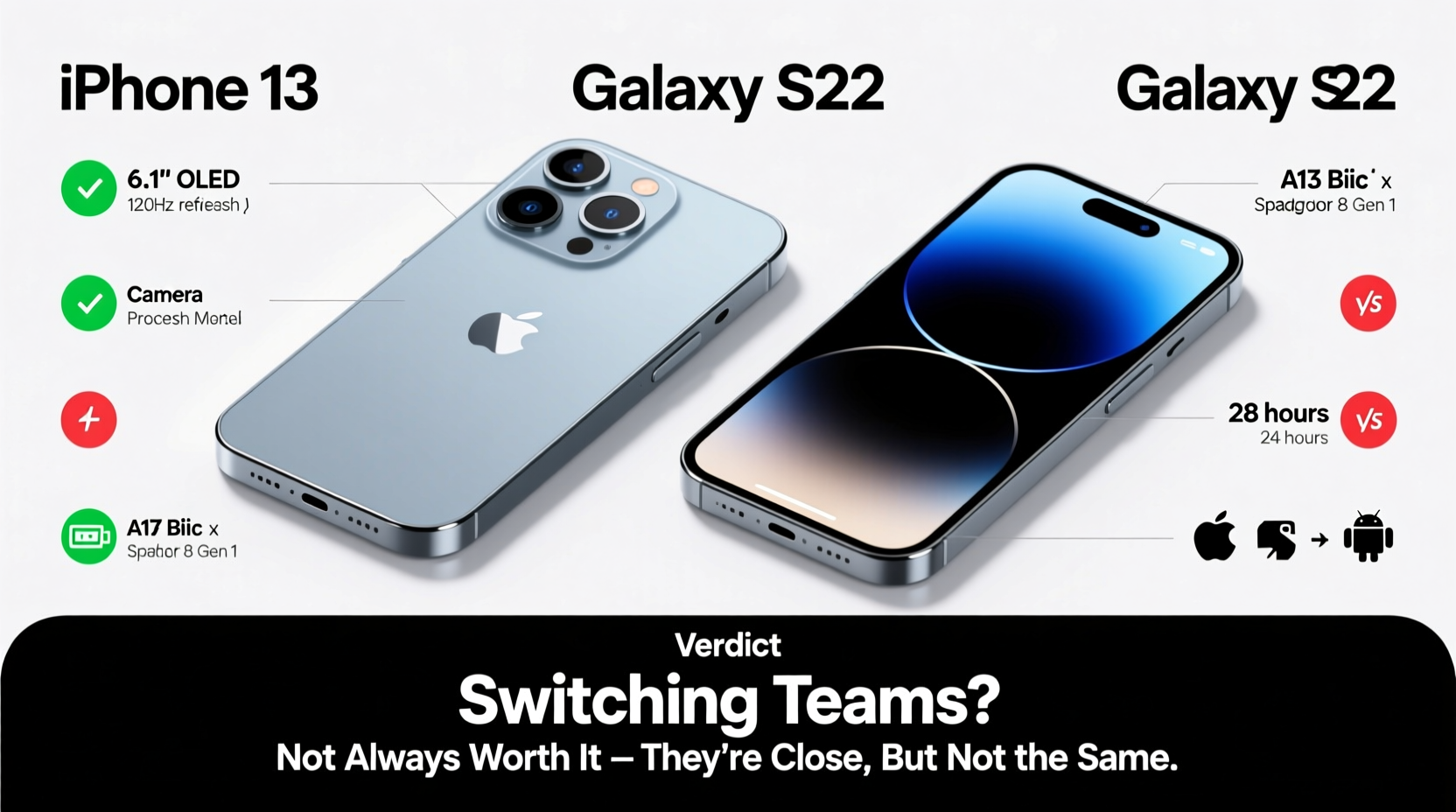
At first glance, both phones offer top-tier performance for everyday use. The iPhone 13 runs on Apple’s A15 Bionic chip, which remains one of the fastest mobile processors ever made. Its single-core performance still outpaces many newer chips, ensuring smooth operation across apps, games, and multitasking.
The Galaxy S22, powered by either the Exynos 2200 or Snapdragon 8 Gen 1 (depending on region), delivers strong multi-core performance and excellent graphics handling thanks to AMD-based GPU architecture. However, under sustained loads—like gaming or video editing—the Snapdragon variant holds thermal advantage over Exynos, while the A15 maintains consistent efficiency with minimal throttling.
RAM is another point of contrast. The iPhone 13 has 4GB of RAM; the Galaxy S22 has 8GB. On paper, this seems like a massive gap. In practice, iOS manages memory more aggressively, closing background apps faster. Android keeps more apps alive, which can be convenient but sometimes leads to quicker battery drain.
Camera Comparison: Philosophy Over Specs
Both phones take excellent photos, but their approach differs fundamentally. The iPhone 13 uses computational photography to produce natural-looking images with accurate color science and dynamic range. It excels in consistency—what you see is what you get. Night mode works well, and Portrait mode now includes autofocus and depth capture for post-shot adjustments.
The Galaxy S22 leans into AI enhancement. It brightens shadows aggressively, enhances skin tones, and applies sharpening that can sometimes look artificial. In good light, results are vibrant and eye-catching. In low light, the S22 often pushes exposure higher than reality, creating brighter but noisier shots compared to the iPhone’s balanced, slightly darker output.
“Apple prioritizes realism; Samsung prioritizes visual impact.” — David Kim, Mobile Imaging Analyst at TechLens Review
Video is where the iPhone pulls significantly ahead. The iPhone 13 supports Cinematic Mode (1080p at 30fps), Dolby Vision HDR recording up to 4K/60fps, and superior stabilization. The S22 records 8K video (a spec bump) but lacks the end-to-end optimization for editing and playback that Apple’s ecosystem offers.
Ecosystem Lock-In: The Real Switching Cost
This is the hidden factor most reviews overlook. Switching from iPhone to Android—or vice versa—isn’t just about transferring contacts and photos. It’s about breaking habits, relearning workflows, and potentially losing access to seamless integrations.
- iOS users benefit from iMessage, FaceTime, AirDrop, iCloud Photos syncing, Handoff, and tight integration with Macs and Apple Watches.
- Android users enjoy Google Assistant, richer customization, file system access, expandable storage (on some models), and better cross-platform flexibility with non-Samsung devices.
If you own other Apple products, leaving the ecosystem means giving up instant hotspot sharing, Universal Clipboard, and Find My network advantages. Conversely, Android offers easier sideloading, default app selection, and split-screen multitasking—features iOS still limits.
Detailed Feature Comparison
| Feature | iPhone 13 | Galaxy S22 |
|---|---|---|
| Processor | A15 Bionic | Snapdragon 8 Gen 1 / Exynos 2200 |
| Rear Cameras | Dual 12MP (Wide, Ultra-Wide) | Triple 50MP (Main), 10MP (Telephoto), 12MP (Ultra-Wide) |
| Front Camera | 12MP TrueDepth | 10MP |
| Battery Life | Up to 19 hours video playback | Up to 16 hours video playback |
| Charging | MagSafe & Lightning (20W max) | USB-C (25W fast charging supported) |
| Software Updates | 5+ years expected (iOS) | 4 OS upgrades, 5 years security (One UI) |
| Water Resistance | IP68 (6m for 30 mins) | IP68 (1.5m for 30 mins) |
| Display | 6.1\" Super Retina XDR OLED (60Hz) | 6.1\" Dynamic AMOLED 2X (120Hz) |
Note: Despite identical screen sizes, the S22’s 120Hz refresh rate makes scrolling and animations feel noticeably smoother. The iPhone 13 sticks with 60Hz, which feels dated next to modern Android flagships—even though Apple optimizes touch response well.
Real-World Example: Sarah’s Cross-Platform Transition
Sarah had used iPhones exclusively since 2014. She upgraded to the iPhone 13 in 2021 and loved its simplicity. But after getting a Samsung tablet for work, she found herself constantly frustrated by slow file transfers and lack of drag-and-drop between devices.
In early 2023, she switched to the Galaxy S22. The first week was rocky—iMessage gaps left friends confused, she missed FaceTime grid view, and iCloud photos took time to migrate. But within a month, she appreciated the 120Hz display, faster charging, and ability to edit files directly on her phone. Most importantly, her tablet and phone now shared clipboards and notifications seamlessly via Samsung’s ecosystem.
She didn’t regret the switch—but acknowledged it required patience and adjustment. “It wasn’t the hardware,” she said. “It was finally having control over how my devices worked together.”
When Should You Switch Teams?
Here’s a checklist to help determine if switching makes sense for you:
- You value high-refresh-rate displays and faster charging over ecosystem continuity.
- You frequently share files across non-Apple devices or prefer open file systems.
- You want more customization options (launchers, icons, widgets, defaults).
- You rely heavily on Google services (Gmail, Drive, Docs, Meet).
- You’re frustrated by Apple’s slower adoption of modern conveniences (USB-C, high refresh rates).
Conversely, stay with iPhone if:
- You communicate mostly with other Apple users (iMessage is a major pain point when leaving).
- You record or edit a lot of video (Dolby Vision, seamless Final Cut integration).
- You plan to keep the phone for 4+ years (iOS typically offers longer update support).
- You use a Mac, iPad, or Apple Watch regularly.
Frequently Asked Questions
Can I transfer my data easily from iPhone to Galaxy S22?
Yes. Samsung’s Smart Switch app allows wireless transfer of contacts, messages, photos, calendars, and even app data from iPhone to Galaxy. iMessage threads will appear as green bubbles, and group chats may not transfer perfectly, but core data moves smoothly.
Which phone gets updates longer?
The iPhone 13 is expected to receive iOS updates through at least 2027. The Galaxy S22 will get four major Android OS upgrades (up to Android 16) and five years of security patches, ending around 2027 as well. In practice, Apple tends to support older devices more uniformly.
Is the Galaxy S22 camera better than the iPhone 13?
It depends on your priorities. The S22 has more lenses and higher megapixel counts, but the iPhone produces more consistent, natural-looking photos and far superior video. For social media or casual sharing, the S22’s vibrant output may appeal more. For creative work or long-term archiving, the iPhone is the safer choice.
Final Verdict: Not the Same—Choose Based on Values
The iPhone 13 and Galaxy S22 are not interchangeable. They reflect opposing philosophies: Apple focuses on integration, longevity, and controlled user experience. Samsung emphasizes hardware innovation, flexibility, and immediate functionality.
Switching teams isn’t trivial, but it’s not impossible. The real question isn’t technical parity—it’s whether your needs align more with ecosystem harmony or hardware freedom. If you’ve never tried the other side, consider borrowing a friend’s device or testing in-store for 30 minutes with your own SIM. Real-world feel often trumps specs.




 浙公网安备
33010002000092号
浙公网安备
33010002000092号 浙B2-20120091-4
Comments
No comments yet. Why don't you start the discussion?