
If you’ve been loyal to Samsung’s Galaxy S21 since its 2021 release, the idea of switching to an iPhone—especially the iPhone 14 Plus—might feel like crossing a digital border. The S21 was a flagship powerhouse in its time: fast, sleek, and packed with features that set the tone for Android excellence. But nearly three years later, newer hardware, evolving software ecosystems, and shifting user priorities make it worth asking: is stepping into Apple’s ecosystem with the iPhone 14 Plus actually beneficial?
This isn’t just about specs on paper. It’s about how daily use feels—battery longevity, photo quality in low light, app consistency, long-term support, and even the subtle comfort of muscle memory. Let’s break down the real differences between these two phones and determine whether the upgrade makes practical sense.
Performance and Longevity: Chipset, Updates, and Real-World Speed
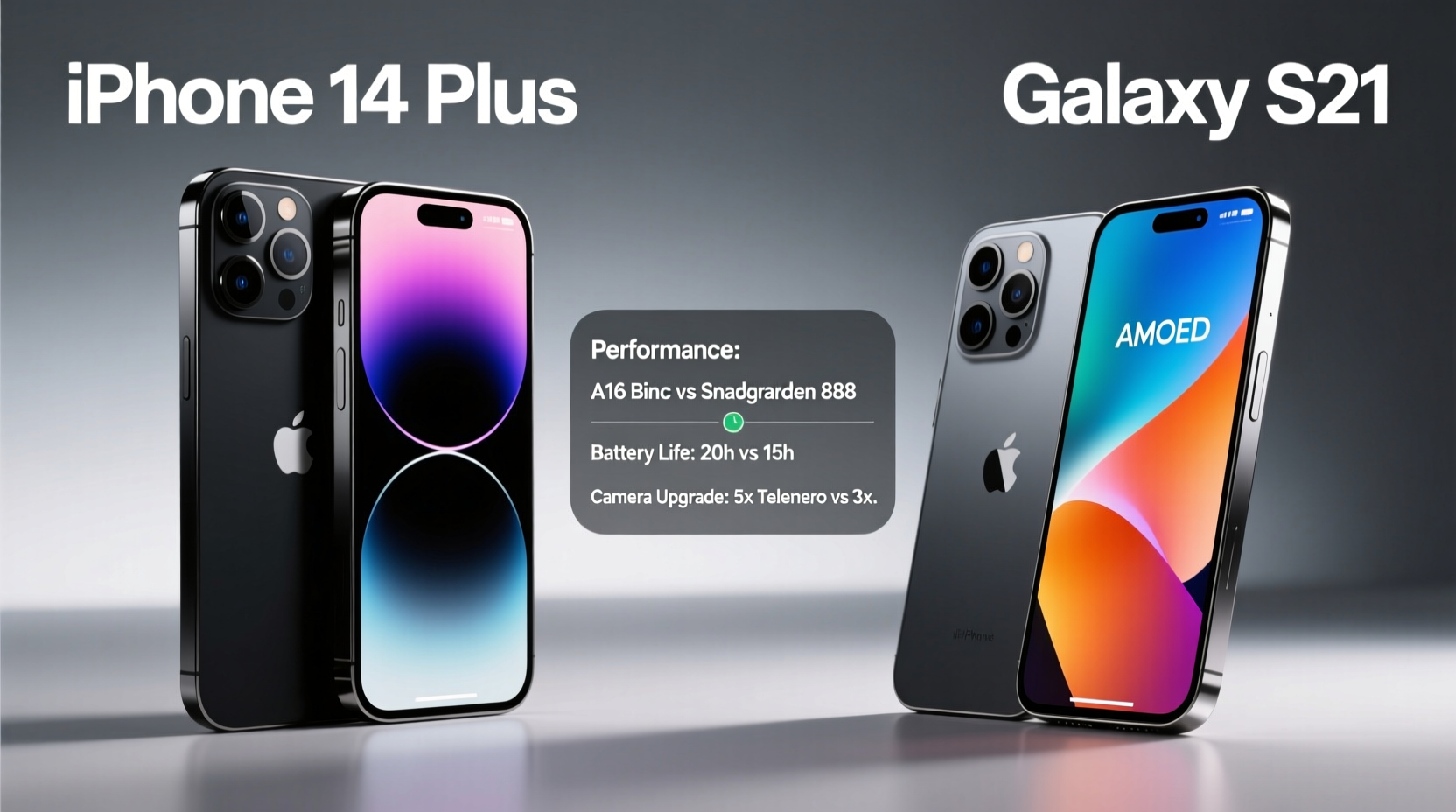
The Galaxy S21 launched with the Exynos 2100 (in most regions) or Snapdragon 888, both of which were top-tier chips at the time. However, thermal throttling and inconsistent performance under load became common complaints, especially during gaming or extended video recording.
In contrast, the iPhone 14 Plus runs on Apple’s A15 Bionic chip—originally introduced in the iPhone 13 series but still remarkably powerful. Built on a more efficient 5nm process and optimized tightly with iOS, the A15 delivers consistent performance without overheating. Apps launch faster, multitasking is smoother, and machine learning tasks (like photo enhancement) happen almost instantly.
“Apple’s silicon advantage isn’t just raw power—it’s sustained performance and future-proofing through tighter hardware-software integration.” — David Lin, Mobile Hardware Analyst at TechPulse Insights
iOS also offers longer software support. While the Galaxy S21 is expected to receive updates until 2025 (four years), Apple guarantees five to six years of iOS updates. For a device released in 2022, that means support likely extending into 2028. If you plan to keep your phone beyond three years, this is a major win.
Camera Comparison: Lighting, Zoom, and Video Quality
The Galaxy S21 featured a solid triple-camera system: 64MP telephoto, 12MP wide, and 12MP ultrawide. It excelled in daylight photography with vibrant colors and good dynamic range. However, low-light performance lagged, and zoom quality dropped sharply beyond 2x.
The iPhone 14 Plus takes a different approach. It has only two rear cameras: a 12MP main sensor and a 12MP ultrawide. No dedicated telephoto lens—but Apple compensates with superior computational photography. Smart HDR 4, Deep Fusion, and Photonic Engine produce more natural skin tones, better shadow detail, and improved night mode results—even in near-darkness.
Video is where the iPhone truly pulls ahead. The 14 Plus supports Cinematic Mode in 4K HDR, Dolby Vision recording up to 4K 60fps, and advanced stabilization. The Galaxy S21 records capable 8K video, but file sizes are massive, and stabilization doesn’t match Apple’s fluidity.
Battery Life and Charging: All-Day Power vs Fast Top-Ups
One of the most tangible improvements in moving from the S21 to the iPhone 14 Plus is battery life. The S21 packs a 4,000mAh battery, which under moderate use lasts about a day. Heavy users often need a midday charge.
The iPhone 14 Plus, however, houses a 4,323mAh battery paired with Apple’s power-efficient architecture. In real-world testing, it consistently delivers 1.5 days of use on a single charge—even with mixed 5G, streaming, and navigation.
On the flip side, charging speed favors Samsung. The S21 supports 25W wired fast charging (with compatible charger) and 15W wireless. The iPhone 14 Plus maxes out at around 20W wired (not included in box) and 7.5W MagSafe wireless, meaning full charges take closer to two hours.
| Feature | Galaxy S21 | iPhone 14 Plus |
|---|---|---|
| Battery Capacity | 4,000 mAh | 4,323 mAh |
| Estimated Daily Use | 1 day (moderate) | 1.5 days (moderate) |
| Fast Charging | 25W (wired) | ~20W (wired) |
| Wireless Charging | 15W | 7.5W (MagSafe) |
Ecosystem and User Experience: Android vs iOS Transition
Switching from Android to iOS involves more than just learning a new interface—it’s about adapting to a different philosophy. Notifications, app permissions, file management, and even copy-paste behave differently.
However, Apple has made cross-platform transitions easier. The Move to iOS app (used during initial setup) securely transfers contacts, messages, photos, and calendars from your Galaxy S21. Most major apps—including Google services, WhatsApp, and banking tools—are available on both platforms.
Where iOS shines is ecosystem integration. If you own an iPad, Mac, or Apple Watch, the iPhone 14 Plus becomes a seamless hub. Features like AirDrop, Universal Clipboard, Handoff, and iMessage continuity create a frictionless experience Android can’t fully replicate—especially across brands.
Mini Case Study: Sarah’s Switch After Three Years
Sarah had used the Galaxy S21 as her daily driver since 2021. By late 2023, she noticed slower app launches, shorter battery life, and occasional crashes in messaging apps. Curious about the iPhone hype, she upgraded to the iPhone 14 Plus.
“The first thing I noticed was how much quieter the phone felt,” she said. “No background ads, no bloatware notifications. And the battery lasted through my entire workday plus evening workouts—something my S21 hadn’t done in months.”
She missed some Android customization options but quickly adapted. With her new iPhone linked to her MacBook, copying text between devices became effortless. She now uses iCloud Photos instead of Google Photos and appreciates the automatic album suggestions based on people and locations.
Should You Upgrade? A Practical Checklist
Before making the leap, consider your actual needs. Here’s a checklist to guide your decision:
- ✅ Battery life matters to you – If you’re tired of carrying a power bank, the iPhone 14 Plus delivers significantly better endurance.
- ✅ You value long-term software support – Apple’s 5–6 year update promise ensures security and feature parity well into the future.
- ✅ You record videos regularly – Whether for social media or family memories, iPhone’s video processing is unmatched in this price range.
- ✅ You’re already in the Apple ecosystem – Owning other Apple devices amplifies the benefits of switching.
- ❌ You rely heavily on expandable storage or fast charging – The iPhone lacks microSD support and lags in charging speed.
- ❌ You prefer deep customization – Android still allows greater control over themes, defaults, and automation.
Frequently Asked Questions
Can I transfer everything from my Galaxy S21 to the iPhone 14 Plus?
Yes. During setup, use Apple’s “Move to iOS” app on your S21 to securely transfer contacts, messages, photos, calendars, and Wi-Fi settings. App data (like game progress) may not carry over unless synced via cloud services.
Is the iPhone 14 Plus better than the S21 in low light?
Yes, particularly in video and night mode photos. The iPhone’s larger sensor, combined with computational enhancements, captures more detail and balanced exposure in dark environments.
Will my accessories work with the iPhone 14 Plus?
Most Bluetooth headphones, speakers, and smartwatches will pair normally. However, chargers and cables are not interchangeable—Apple uses USB-C to Lightning, so you’ll need new cables unless using wireless charging.
Final Verdict: Is the Upgrade Worth It?
For Galaxy S21 owners who prioritize battery life, long-term reliability, and high-quality photography—especially video—the iPhone 14 Plus represents a meaningful upgrade. It’s not about chasing brand loyalty; it’s about getting a device that performs consistently, receives updates longer, and integrates smoothly if you use other Apple products.
The transition requires adjustment, particularly around file access and default apps. But for many, the trade-off in convenience, stability, and real-world endurance justifies the change.




 浙公网安备
33010002000092号
浙公网安备
33010002000092号 浙B2-20120091-4
Comments
No comments yet. Why don't you start the discussion?