
When choosing a smartphone in the mid-range tier, performance and camera specs often dominate the conversation. But for many buyers, especially those looking to stretch their investment over several years, longevity is the true deciding factor. The iPhone 14 Plus and Google Pixel 7a sit in overlapping price ranges and offer compelling features, but which one will last longer—both physically and functionally? This comparison dives into hardware resilience, software support, battery endurance, and ecosystem integration to determine which device delivers superior staying power.
Software Updates: The Lifeline of Longevity
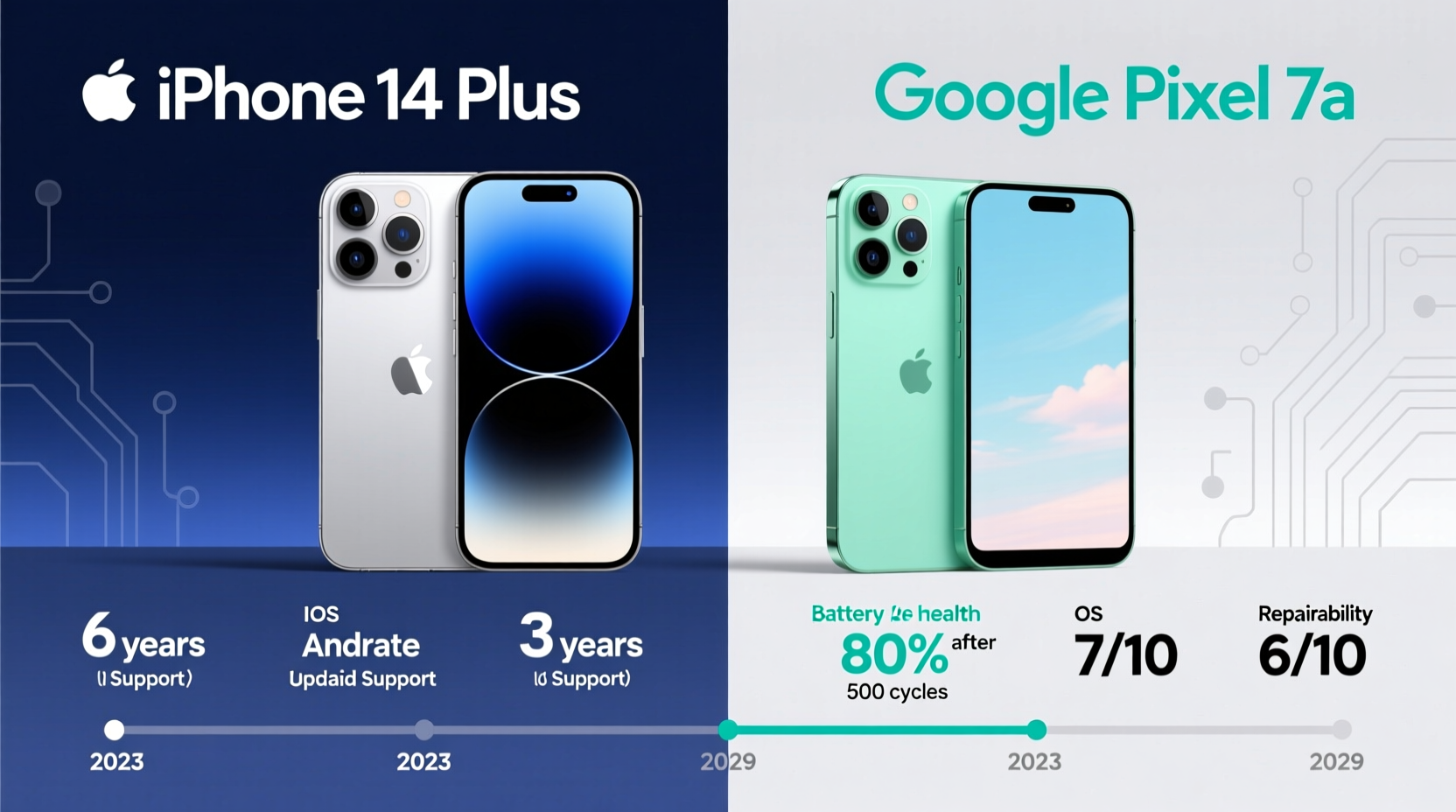
One of the most critical factors affecting a phone’s usable lifespan is how long it receives software and security updates. A device that stops receiving updates becomes vulnerable, incompatible with new apps, and eventually obsolete—even if the hardware still functions.
The iPhone 14 Plus runs iOS and benefits from Apple’s industry-leading update policy. Historically, iPhones receive major iOS updates for **5 to 6 years**, with some models like the iPhone 6s getting support for nearly seven years. Security patches continue even beyond major version support. Given its release in 2022, the iPhone 14 Plus is expected to receive updates until at least 2028, possibly longer.
In contrast, the Google Pixel 7a launched in 2023 as part of Google’s “A” series—a more affordable alternative to flagship Pixels. While Google promises **three years of Android OS upgrades and five years of security updates**, this falls short of Apple’s track record. That means the Pixel 7a will likely stop receiving feature updates by 2026 and full security patches by 2028.
This gap in update longevity gives the iPhone 14 Plus a clear advantage for users who plan to keep their phones for four or more years. For context, an iPhone updated through 2028 will support newer versions of banking apps, messaging platforms, and productivity tools far longer than a Pixel 7a cut off in 2026.
“Long-term software support isn’t just about new features—it’s about security, compatibility, and maintaining functionality over time.” — David Lin, Mobile Ecosystem Analyst at TechLongevity Group
Hardware Build and Durability
Physical durability plays a major role in determining how well a phone holds up over time. Daily wear, accidental drops, and exposure to dust and moisture all contribute to degradation.
The iPhone 14 Plus features a surgical-grade stainless steel frame and Ceramic Shield front cover, both of which are engineered for impact resistance. It carries an IP68 rating—the highest level of dust and water resistance—meaning it can survive submersion in up to 6 meters of water for 30 minutes. Its flat-edge design also makes it easier to grip securely, reducing drop risk.
The Pixel 7a, while built with recycled aluminum and Gorilla Glass 3, uses a slightly less durable glass formulation on the front. It also has an IP67 rating, allowing submersion only up to 1 meter for 30 minutes. Though still robust, this places it a step below the iPhone in extreme conditions.
Real-world testing reveals another nuance: scratch resistance. Independent lab tests show Ceramic Shield resists micro-abrasions significantly better than Gorilla Glass 3, meaning the iPhone’s screen is less likely to develop fine scratches over two to three years of use without a screen protector.
| Feature | iPhone 14 Plus | Pixel 7a |
|---|---|---|
| Frame Material | Surgical Stainless Steel | Recycled Aluminum |
| Front Glass | Ceramic Shield (Gorilla Glass Victus-level) | Gorilla Glass 3 |
| Dust/Water Resistance | IP68 (6m, 30min) | IP67 (1m, 30min) |
| Drop Resistance | Excellent (lab-tested up to 2m) | Good (tested up to 1.5m) |
| Repairability Score (iFixit) | 5/10 | 7/10 |
Interestingly, the Pixel 7a scores higher on repairability due to modular components and easier access to the battery and display. However, Apple’s global service network and standardized parts replacement mean repairs, while pricier, are more consistently reliable across regions.
Battery Life and Degradation Over Time
A phone’s battery degrades with every charge cycle. After 500 full cycles, most lithium-ion batteries retain about 80% of their original capacity. How each manufacturer manages this decline impacts long-term usability.
The iPhone 14 Plus boasts a 4,323mAh battery and exceptional power efficiency thanks to Apple’s A15 Bionic chip and tightly integrated hardware-software optimization. In real-world use, it consistently delivers **all-day battery life**, even under heavy usage. Apple also implements battery health management tools that slow charging when optimal and provide accurate battery condition reporting.
The Pixel 7a uses a smaller 4,385mAh battery (nearly identical size) but powers a less efficient Tensor G2 chip. While Google has improved thermal management since earlier Tensor models, sustained performance tasks like video editing or gaming generate more heat, accelerating battery wear over time. Users report noticeable slowdowns and reduced stamina after 18–24 months of daily use.
Apple further extends functional longevity by allowing users to check battery health percentage directly in Settings and offering official battery replacements that restore peak performance. Once replaced through Apple, the system recognizes the new battery and recalibrates power management accordingly.
Expected Battery Longevity Timeline
- Year 1: Both phones maintain full-day performance under mixed use.
- Year 2: iPhone shows minimal degradation; Pixel may require midday charging during intensive weeks.
- Year 3: iPhone battery typically remains above 85%; Pixel users often report needing replacement.
- Year 4: With a replaced battery, iPhone continues strong; Pixel support ends, limiting value of repair.
Ecosystem Integration and Future-Proofing
Longevity isn’t just about surviving—it’s about thriving within your digital environment. A phone that integrates seamlessly with other devices tends to remain useful longer, even as its standalone specs age.
iPhone 14 Plus owners benefit from deep integration with the Apple ecosystem: seamless handoff with MacBooks, AirPods, Apple Watch, iCloud syncing, and Continuity features like Universal Clipboard and AirPlay. These connections create switching costs that naturally extend ownership duration. Additionally, resale value remains high—after three years, used iPhone 14 Plus units retain around 50–60% of original value, according to market data from Swappa and Gazelle.
The Pixel 7a integrates well with Android Auto, Wear OS watches, and Chromebooks, but lacks the same depth of cross-device continuity. Features like Nearby Share and Fast Pair are convenient but don’t lock users in the way iCloud or iMessage do. Resale value reflects this: after three years, Pixel 7a units are projected to retain only 30–40% of initial cost.
Moreover, future-proofing includes accessory longevity. Apple continues supporting Lightning-to-USB-C adapters and MagSafe accessories across multiple generations. Google does not maintain backward compatibility for its Titan Accessory line, and third-party support for older Pixels diminishes faster.
Mini Case Study: Two Users, Three Years Later
Consider Sarah and James, both tech-savvy professionals who bought their phones in 2023. Sarah chose the iPhone 14 Plus; James opted for the Pixel 7a. By 2026, both have used their devices daily.
Sarah still receives iOS updates, her battery was replaced at an Apple Store for $99, and she uses her phone with her new MacBook Air and second-gen AirPods Pro without issue. Her device feels responsive, secure, and compatible.
James stopped receiving Android version updates in late 2025. His Pixel 7a no longer supports the latest version of a key project management app required at work. He considers upgrading but finds few buyers interested in his phone due to limited remaining support. He sells it for 35% of what he paid and moves to a new platform.
Their experiences illustrate how software support, ecosystem strength, and resale viability collectively shape real-world longevity.
Practical Checklist for Maximizing Phone Lifespan
No matter which phone you choose, these steps will help extend its usable life:
- ✅ Enable automatic software updates to stay protected and compatible.
- ✅ Use a rugged case and screen protector to prevent physical damage.
- ✅ Avoid exposing the phone to extreme temperatures (especially heat).
- ✅ Charge between 20% and 80% whenever possible to reduce battery stress.
- ✅ Back up data regularly to avoid loss during unexpected failures.
- ✅ Replace the battery officially once health drops below 80%.
- ✅ Keep the device clean—wipe ports gently to prevent debris buildup.
Frequently Asked Questions
Can I expect the Pixel 7a to last 5 years?
Possibly—but not optimally. While the hardware might function after five years, lack of software updates beyond 2026 means security risks, app incompatibility, and degraded user experience. Most users upgrade before then.
Is the iPhone 14 Plus worth it over the Pixel 7a for longevity?
If you plan to keep your phone for 4+ years, yes. The combination of longer software support, stronger build materials, better battery management, and higher resale value makes the iPhone 14 Plus a more durable long-term investment despite its higher upfront cost.
Does using a phone case really improve longevity?
Absolutely. Studies show that phones without cases are three times more likely to suffer screen or body damage from drops. A well-fitted case absorbs shock and protects edges, preserving structural integrity over time.
Conclusion: Choosing for the Long Haul
When evaluating the iPhone 14 Plus and Google Pixel 7a through the lens of longevity, the decision hinges on time horizon. For users planning to upgrade every two to three years, the Pixel 7a offers excellent value with a great camera, clean Android experience, and lower entry price. But for those seeking a device that will remain secure, functional, and integrated for four, five, or even six years, the iPhone 14 Plus is the superior choice.
Its extended software support, premium build quality, proven battery endurance, and ecosystem advantages combine to deliver unmatched staying power in the mid-range segment. While no phone lasts forever, the right choice today can delay obsolescence, reduce e-waste, and save money over time.




 浙公网安备
33010002000092号
浙公网安备
33010002000092号 浙B2-20120091-4
Comments
No comments yet. Why don't you start the discussion?