
The smartphone market today offers a vast range of options across every price tier. At one end, you have premium flagships like the iPhone 14 Pro Max, priced well over $1,000. On the other, mid-range devices such as the Samsung Galaxy A54 deliver solid performance for around $450. The gap in cost is significant—often more than double. But does that translate into twice the experience? For many consumers, the real question isn’t just about specs, but whether the extra investment delivers meaningful, day-to-day benefits.
This comparison dives deep into core aspects—performance, camera quality, display, battery life, software support, and long-term value—to determine if the iPhone 14 Pro Max’s steep price tag truly justifies skipping the capable and affordable Samsung A54.
Performance: Power vs Practicality
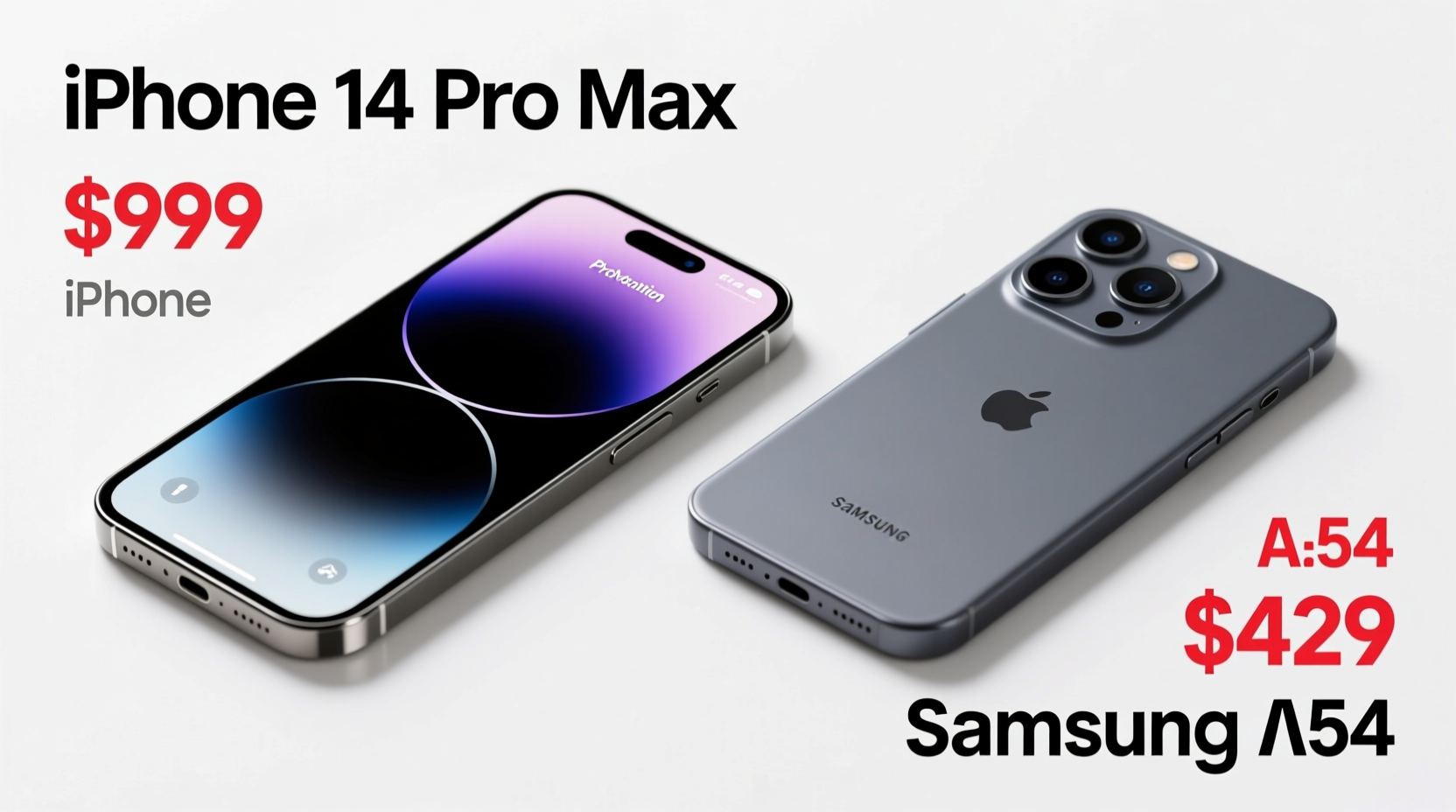
The iPhone 14 Pro Max is powered by Apple’s A16 Bionic chip, built on a 4nm process and designed specifically for efficiency and speed. It handles intensive tasks like 4K video editing, augmented reality apps, and mobile gaming with ease. Paired with 6GB of RAM and iOS optimization, the device feels snappy and responsive even after extended use.
In contrast, the Samsung Galaxy A54 runs on the Exynos 1380 (or Snapdragon 1280 in select regions), a mid-tier processor with four performance cores and four efficiency cores. While not flagship-grade, it manages everyday tasks—web browsing, social media, streaming, and light multitasking—smoothly. However, users may notice occasional stutters when switching between heavy apps or during prolonged gaming sessions.
For most people, the A54's performance is more than sufficient. Unless you're editing videos on your phone or playing graphics-intensive games daily, the real-world difference in speed between these two phones is minimal. The A16 Bionic will outperform the Exynos 1380 in benchmarks, but daily usability remains close enough that the average user won’t feel shortchanged.
Camera Comparison: Quality Meets Consistency
Apple has long emphasized computational photography, and the iPhone 14 Pro Max reflects that with a triple-lens system: 48MP main sensor, 12MP ultra-wide, and 12MP telephoto with 3x optical zoom. Its standout feature is the ability to capture 48MP ProRAW photos, offering professional-level detail and editing flexibility. Low-light performance is exceptional, and video recording supports Dolby Vision HDR at up to 4K/60fps—unmatched in the Android mid-range segment.
The Galaxy A54 features a 50MP main sensor, 12MP ultra-wide, and 5MP macro lens. While it lacks a dedicated telephoto lens, its main camera produces vibrant, well-balanced photos in daylight. Night mode is competent but can’t match the depth and clarity of the iPhone’s low-light processing. Video tops out at 4K/30fps without advanced stabilization or dynamic range enhancements.
Where the iPhone excels is consistency. Whether shooting indoors, outdoors, or in mixed lighting, colors remain true, exposure is balanced, and HDR processing is seamless. The A54 sometimes oversaturates images or struggles with dynamic range, requiring manual adjustments via Pro mode.
“Smartphone cameras aren't just about megapixels—they’re about how the hardware and software work together. Apple leads in integration; Samsung competes on versatility.” — David Lin, Mobile Imaging Analyst at TechVision Insights
Battery Life and Charging: Real-World Endurance
The iPhone 14 Pro Max packs a 4,323mAh battery, supporting up to 29 hours of video playback. In real-world usage, it easily lasts a full day, even with heavy screen-on time. However, charging remains limited to 20W wired and 15W MagSafe, meaning a full charge takes over two hours without fast charging beyond what Apple provides.
The Galaxy A54 counters with a larger 5,000mAh battery and 25W fast charging support. While its screen brightness and software overhead reduce efficiency slightly, most users report 1.5 days of moderate use. The faster charging means going from 0% to 50% in about 30 minutes—a tangible advantage for those always on the move.
If longevity per charge matters most, both phones perform well. But if quick top-ups are essential, the A54 wins on convenience despite the smaller overall power lead of the iPhone.
Display and Build: Premium Feel vs Functional Design
The iPhone 14 Pro Max features a 6.7-inch Super Retina XDR OLED with ProMotion technology (120Hz adaptive refresh rate) and peak brightness up to 2,000 nits. The Always-On Display adds utility, and Ceramic Shield glass enhances durability. Combined with surgical-grade stainless steel frame and IP68 rating, it feels solid and luxurious in hand.
The A54 also uses an OLED panel—6.4 inches, 120Hz refresh rate—but peaks at 1,000 nits. While bright enough for outdoor use, it lacks the punch and HDR vibrancy of Apple’s display. The plastic frame keeps weight down but gives a less premium impression. Still, it carries IP67 water resistance and Gorilla Glass 5 protection, making it durable for daily wear.
Build quality is where the price difference becomes tactile. Holding the iPhone 14 Pro Max conveys craftsmanship; the A54 feels functional but not luxurious. Yet, for users who prioritize screen size and smooth scrolling over material prestige, the A54 holds its ground.
Software, Updates, and Longevity
iOS offers a distinct advantage: long-term software support. iPhones typically receive 5–6 years of OS updates. The iPhone 14 Pro Max will likely be supported through 2029 or beyond, ensuring security patches, new features, and app compatibility far into the future.
Samsung promises four major Android upgrades and five years of security updates for the A54—excellent for an Android mid-ranger, but still trailing Apple’s track record. Given the slower pace of hardware obsolescence on iOS, the iPhone may retain usability longer before feeling outdated.
This extended lifespan can justify part of the upfront cost. Over six years, the effective annual cost of the iPhone drops significantly, especially if resold later at higher residual value compared to mid-range Androids.
| Feature | iPhone 14 Pro Max | Samsung Galaxy A54 |
|---|---|---|
| Price (Launch) | $1,099 | $449 |
| Processor | A16 Bionic | Exynos 1380 |
| Rear Cameras | 48MP + 12MP + 12MP | 50MP + 12MP + 5MP |
| Front Camera | 12MP (Dynamic Island) | 13MP |
| Battery & Charging | 4,323mAh, 20W wired | 5,000mAh, 25W wired |
| Software Support | ~6 years (est.) | 4 OS + 5 security |
| Water Resistance | IP68 | IP67 |
| Expected Lifespan | 5–6 years | 3–4 years |
Mini Case Study: Maria’s Upgrade Dilemma
Maria, a freelance photographer and traveler, needed a new phone. Her old iPhone 11 was slowing down, and she wanted better camera quality. She considered both the iPhone 14 Pro Max and the Samsung A54. Initially drawn to the A54’s lower price and longer battery life, she tested both in-store.
After trying the camera in low light and reviewing sample photos side by side, she noticed the iPhone produced consistently sharper, more natural-looking images—especially in shaded environments. The ability to shoot ProRAW gave her editing flexibility critical for her work. Though the A54 handled Instagram posts and casual shots well, it lacked the precision she needed.
She ultimately chose the iPhone 14 Pro Max, financing it over 24 months. For her, the extra cost translated directly into professional capability and peace of mind knowing the phone would stay updated and functional for years. For someone less reliant on photo quality, the A54 might have been the smarter pick.
Frequently Asked Questions
Is the iPhone 14 Pro Max overkill for everyday use?
For basic tasks like calling, texting, browsing, and social media, yes—it offers more power and features than most users need. However, its superior build, camera, and long-term software support provide lasting value that can justify the cost over time.
Can the Samsung A54 replace a flagship phone?
For the majority of users, absolutely. It handles daily tasks efficiently, has a great display, solid battery, and timely updates. Only power users, creatives, or those invested in the Apple ecosystem will miss flagship-level performance and camera features.
Which phone holds its value better?
The iPhone 14 Pro Max retains resale value significantly better. After two years, it may still fetch 50–60% of its original price, while the A54 typically drops to 20–30%. This depreciation gap can offset some of the initial cost difference if you plan to upgrade later.
Conclusion: Value Depends on Your Needs
The price difference between the iPhone 14 Pro Max and the Samsung Galaxy A54 is substantial—over $600. But whether it’s “worth it” depends entirely on how you use your phone. If you value top-tier camera performance, seamless iOS integration, maximum longevity, and premium materials, the iPhone delivers a superior experience that justifies the cost for many.
However, if your needs center on reliable performance, good-enough photography, long battery life, and budget-conscious spending, the Galaxy A54 proves that flagship-like features are now accessible at half the price.




 浙公网安备
33010002000092号
浙公网安备
33010002000092号 浙B2-20120091-4
Comments
No comments yet. Why don't you start the discussion?