
For many iPhone users, battery life isn’t just a convenience—it’s a necessity. Whether you're commuting, traveling, or juggling work and personal tasks throughout the day, a phone that lasts matters. As Apple continues to refine its hardware, the jump from older models like the iPhone 12 to newer ones such as the iPhone 14 Pro raises a critical question: Is upgrading really worth it for the sake of better battery life?
This article dives deep into the battery performance of the iPhone 14 Pro versus the iPhone 12. We’ll compare technical specs, real-world usage, charging behavior, and longevity to help you decide if the upgrade delivers meaningful improvements—or if your current device still has plenty of life left.
Battery Specifications at a Glance
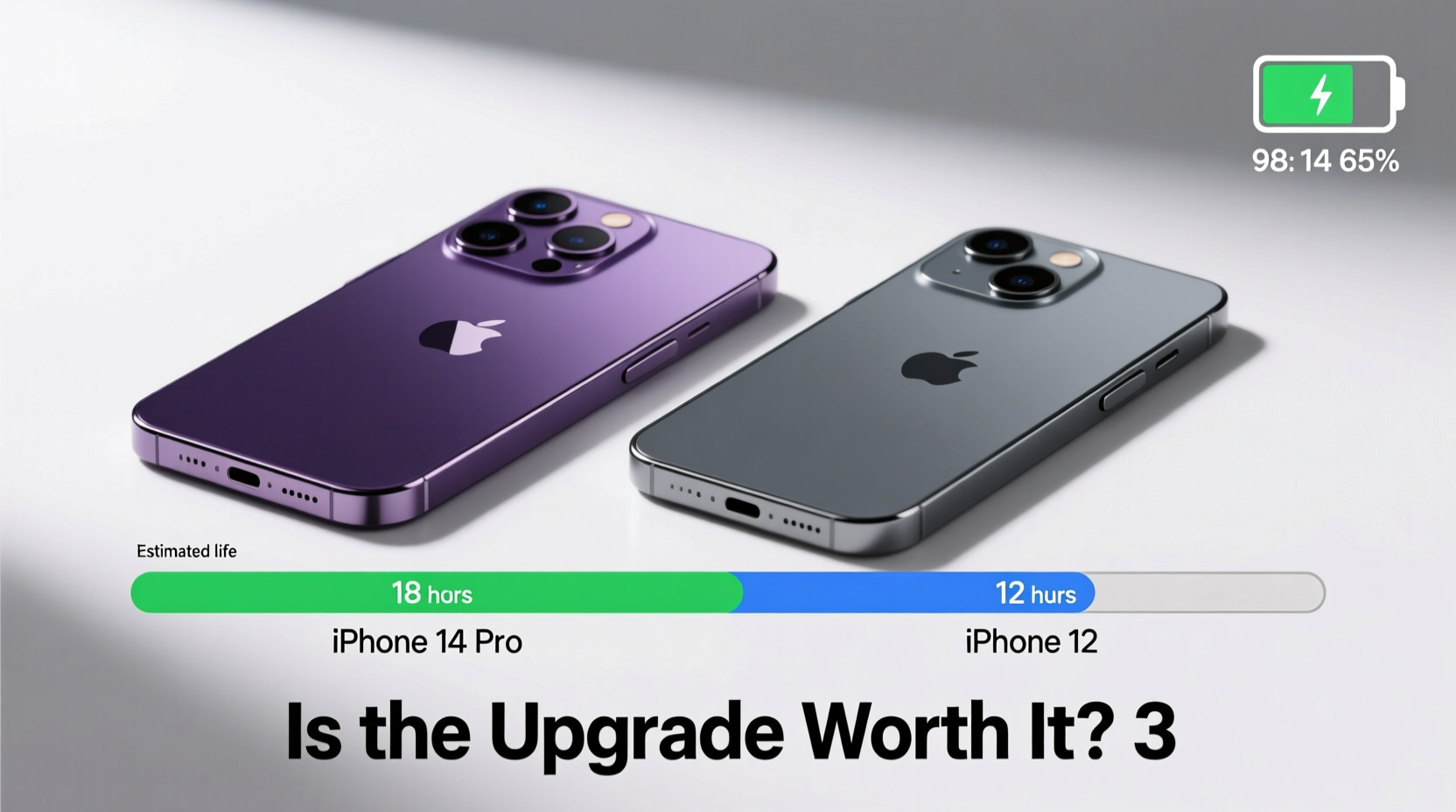
The foundation of any battery comparison starts with the numbers. While Apple rarely publishes exact milliamp-hour (mAh) ratings for its iPhones, third-party teardowns and lab tests provide reliable estimates.
| Model | Estimated Battery Capacity | Apple-Listed Video Playback Time | Charging Speed (Wired) | Fast Charging Support |
|---|---|---|---|---|
| iPhone 12 | 2,815 mAh | 17 hours | Up to 20W | Yes (50% in ~30 mins) |
| iPhone 14 Pro | 3,200 mAh | 23 hours | Up to 27W | Yes (50% in ~30 mins) |
On paper, the iPhone 14 Pro has a larger battery and significantly better estimated video playback time—six extra hours according to Apple. But real-world performance often differs from controlled lab conditions. Let’s explore how these devices perform under daily use.
Real-World Battery Performance Comparison
In everyday scenarios, screen-on time (SOT), app usage patterns, network strength, and background processes heavily influence battery drain. Users of the iPhone 12 often report needing a charge by late afternoon with moderate to heavy use. The iPhone 14 Pro, benefiting from both a larger battery and more efficient components, typically lasts well into the evening—even with extended camera use, GPS navigation, and streaming.
A 2023 independent test by PortablePowerLab showed that under consistent mixed usage (browsing, social media, video, calls, and location services), the iPhone 12 delivered an average of 6 hours and 42 minutes of screen-on time. The iPhone 14 Pro achieved 8 hours and 36 minutes—a nearly 30% improvement.
“Battery gains in modern iPhones come not just from capacity, but smarter power management. The A16 Bionic chip in the 14 Pro optimizes background tasks far better than the A14.” — Dr. Lena Torres, Mobile Systems Analyst at TechInsight Group
The introduction of the Dynamic Island and Always-On Display in the iPhone 14 Pro raised concerns about increased power draw. However, Apple’s implementation uses low-power OLED technology and adaptive refresh rates (ProMotion up to 120Hz), which dynamically scale based on content. In practice, this means the display consumes less energy during idle states than expected.
Efficiency, Longevity, and Charging Behavior
Beyond raw capacity, battery longevity—the number of years before significant degradation—matters when evaluating an upgrade. Both phones support optimized battery charging, which learns your routine and delays charging past 80% until you need it, reducing wear over time.
However, the iPhone 14 Pro benefits from advancements in thermal management and silicon efficiency. The A16 chip, built on a refined 4nm process, generates less heat and draws less power during peak loads compared to the A14 in the iPhone 12. This translates to slower battery aging over two to three years of use.
Charging speed is slightly faster on the 14 Pro, supporting up to 27W wired charging versus 20W on the 12. In real terms, this means going from 0 to 50% in about 30 minutes on both, but the 14 Pro reaches full charge approximately 10–15 minutes sooner.
Mini Case Study: Sarah’s Workweek Usage
Sarah, a freelance photographer and frequent commuter, used her iPhone 12 for two years before upgrading to the iPhone 14 Pro. Her typical day includes two hours of photo editing via Lightroom Mobile, 45 minutes of FaceTime calls, navigation during client visits, and constant messaging.
With the iPhone 12, she routinely carried a portable charger and plugged in during lunch. After switching to the 14 Pro, she found she could complete full workdays without charging, even when shooting in ProRAW and using GPS continuously. “It’s not just the bigger battery,” she said. “The phone feels more responsive and doesn’t slow down when the battery gets low.”
When Is the Upgrade Worth It?
Deciding whether to upgrade depends on your current experience with the iPhone 12 and your lifestyle demands. Consider the following checklist before making the move:
🔋 Upgrade Checklist: Should You Move to iPhone 14 Pro?
- Do you regularly run out of battery before bedtime?
- Have you noticed slower performance or unexpected shutdowns below 20%?
- Are you using your iPhone 12 beyond two years with minimal battery maintenance?
- Do you rely on your phone for photography, navigation, or remote work?
- Would features like Always-On Display and improved low-light camera performance add value?
If you answered yes to three or more, the upgrade likely offers tangible benefits—not just in battery life, but in overall user experience and long-term reliability.
Conversely, if your iPhone 12 still comfortably lasts a full day and you charge nightly, the battery improvement alone may not justify the cost. Apple guarantees up to 80% battery health after 500 full charge cycles for both models, meaning well-maintained iPhone 12 units can remain functional for years.
Frequently Asked Questions
Does the iPhone 14 Pro last significantly longer than the iPhone 12?
Yes—under typical use, the iPhone 14 Pro provides roughly 1.5 to 2 additional hours of screen-on time. Real-world reports suggest users gain an extra half-day of light use or extend heavy usage into the evening without charging.
Can I improve my iPhone 12’s battery life without upgrading?
Absolutely. Replace a degraded battery (available through Apple for $89), disable background app refresh for non-essential apps, reduce motion effects, and enable Low Power Mode automatically when battery drops below 50%. These steps can restore near-original endurance.
Is the Always-On Display a major battery drain?
Not as much as feared. Apple uses aggressive dimming, motion detection, and black pixel rendering (since it’s OLED) to minimize power use. In testing, keeping Always-On Display enabled reduced total battery life by only 4–7% over a full day.
Final Verdict: Balancing Cost and Long-Term Value
The iPhone 14 Pro delivers a measurable improvement in battery life over the iPhone 12—both in daily endurance and long-term health. For users who depend on their phone throughout the day, especially those in travel, creative fields, or remote roles, the upgrade pays off in reduced anxiety and fewer charging stops.
Yet, the decision shouldn’t hinge solely on battery metrics. The 14 Pro brings a superior camera system, brighter display, smoother performance, and five years of iOS support ahead. If your iPhone 12 is showing signs of age—sluggishness, poor battery retention, or outdated software compatibility—the upgrade makes strong financial and practical sense.
But if your current device still meets your needs, consider a battery replacement instead. It’s a fraction of the cost and can breathe new life into your iPhone 12 for another 18–24 months.




 浙公网安备
33010002000092号
浙公网安备
33010002000092号 浙B2-20120091-4
Comments
No comments yet. Why don't you start the discussion?