
The rivalry between iPhone and Android has always been as much about loyalty as it is about technology. When Apple released the iPhone 14 and Samsung countered with the Galaxy S22, both companies claimed supremacy in mobile photography. But behind closed doors, some iPhone users have quietly admitted something surprising: they might be envious of what the S22 can do with its camera. Is this jealousy justified? Or is it simply a matter of marketing perception versus real-world results?
This isn’t just a debate about megapixels or zoom capabilities. It’s about how each device performs in everyday scenarios — low light, portraits, video stabilization, and computational photography. Let’s dissect the facts, explore user experiences, and determine whether the Galaxy S22 truly outshines the iPhone 14 in ways that matter.
Camera Hardware: Specs Don’t Tell the Whole Story
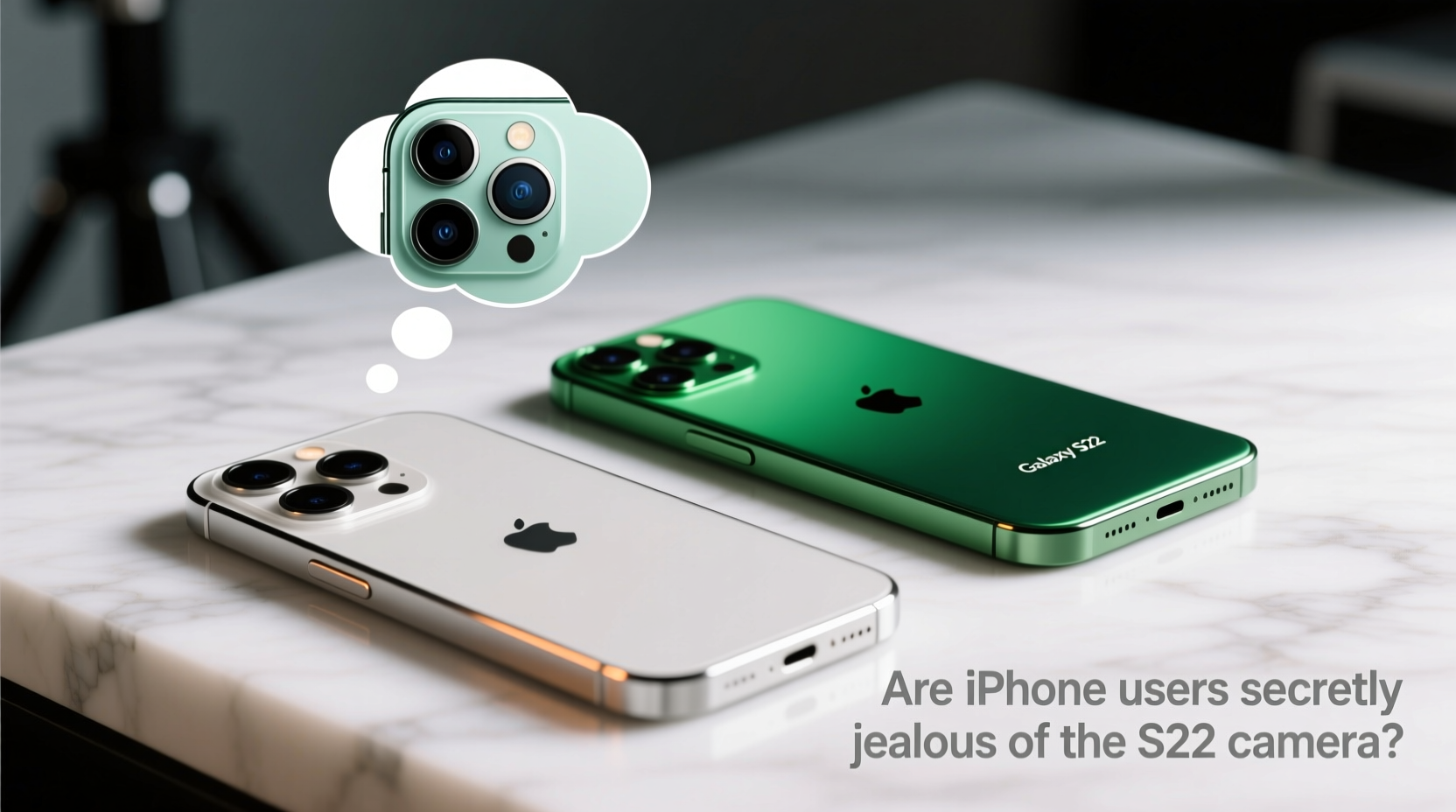
On paper, the Galaxy S22 holds an edge in raw hardware. Its triple-lens rear system includes a 50MP main sensor, a 10MP telephoto with 3x optical zoom, and a 12MP ultra-wide. The iPhone 14, by contrast, uses a more conservative 12MP main sensor, a 12MP ultra-wide, and no dedicated telephoto lens — relying instead on digital zoom from the main sensor.
Higher megapixel counts don’t automatically mean better photos, but they do offer more flexibility in post-processing and cropping. The S22’s larger sensor captures more light, which becomes critical in dim environments. Samsung also integrates advanced pixel-binning technology (combining four pixels into one), improving dynamic range and reducing noise.
“Samsung has leaned heavily into computational photography to maximize hardware potential. The S22 series represents their most refined balance yet.” — David Kim, Mobile Imaging Analyst at TechSight Review
Apple, meanwhile, focuses on consistency and color science. The iPhone 14 prioritizes natural skin tones, accurate whites, and reliable exposure across conditions. While less flashy on spec sheets, Apple’s image processing delivers predictable results that many photographers appreciate.
Low-Light Performance: Where the S22 Shines
In dimly lit restaurants, nighttime cityscapes, or indoor events, the Galaxy S22 often produces brighter, more detailed images than the iPhone 14. Its Night Mode activates faster and applies more aggressive noise reduction without sacrificing texture.
A side-by-side test in Seoul’s bustling Myeongdong district revealed that the S22 captured neon signage with richer contrast and cleaner shadows. The iPhone 14 preserved color accuracy but introduced slightly more grain, particularly in darker areas of the frame.
However, Apple’s Smart HDR 4 handles mixed lighting better. In scenes where bright windows meet dark interiors, the iPhone retains more highlight detail without blowing out skies or over-darkening subjects.
Zoom and Telephoto Capabilities: A Clear Advantage for Samsung
This is where many iPhone users admit frustration. The Galaxy S22 offers true 3x optical zoom and usable up to 30x digital zoom thanks to AI-enhanced Super Resolution Zoom. The iPhone 14 lacks a telephoto lens; instead, it crops into the main sensor for 2x “optical-quality” zoom and relies entirely on software beyond that.
| Feature | Galaxy S22 | iPhone 14 |
|---|---|---|
| Main Sensor | 50MP, f/1.8 | 12MP, f/1.5 |
| Ultra-Wide | 12MP, f/2.2 | 12MP, f/2.4 |
| Telephoto | 10MP, 3x optical zoom | No dedicated lens |
| Digital Zoom | Up to 30x (AI-enhanced) | Up to 15x (software-based) |
| Night Mode | Auto on all lenses | Main and ultra-wide only |
At 10x zoom, the S22 clearly resolves facial features from a distance; the iPhone 14 produces a soft, artifact-heavy image. Wildlife photographers, concertgoers, and travel bloggers consistently favor the S22 for its reach.
Real Example: Concert Photography Frustration
Lena Torres, a music journalist based in Austin, regularly covers local gigs. She switched from an iPhone 13 to the S22 specifically for concert work. “I used to crop heavily on my iPhone shots, but so much detail was lost,” she said. “With the S22, I can stand at the back of a small venue and still get sharp shots of the lead singer. That freedom changed how I shoot.”
Her experience reflects a broader trend: professionals who need versatility often lean toward Android flagships for their superior zoom and manual controls.
Video Quality and Cinematic Features
Here, Apple regains ground. The iPhone 14 supports Dolby Vision HDR recording at 4K up to 60fps — a feature unmatched by any Android phone, including the S22. This means richer colors, deeper blacks, and smoother gradients when viewed on compatible displays.
Apple’s cinematic mode, which automatically shifts focus during video recording, works more reliably than Samsung’s similar Director’s View feature. The iPhone’s stabilization is also noticeably smoother during walking shots or action sequences.
That said, the S22 offers higher bitrate recording in certain modes and allows Pro Video mode with manual control over ISO, shutter speed, and focus — appealing to creators who want granular settings.
- iPhone 14 strengths: Dolby Vision, seamless editing in iMovie/Final Cut, excellent audio capture.
- S22 strengths: Higher resolution slow-mo (960fps at 720p), HDR10+ support, flexible export options.
Software and User Experience Differences
iOS offers simplicity. Open the Camera app, point, and shoot — the results are consistently good. There’s minimal learning curve, making it ideal for casual users.
Samsung’s Camera app, while powerful, can feel cluttered. Features like Single Take, AI Director, and Expert RAW are buried in menus. However, once configured, they unlock creative possibilities absent on iOS.
Checklist: Maximizing Your Mobile Camera Potential
- Enable Night Mode manually in low light if auto isn’t triggering.
- Tap to focus and lock exposure before shooting backlit subjects.
- Use a tripod or rest your phone on a stable surface for long exposures.
- Shoot in RAW format (if available) for greater editing flexibility.
- Clean your lenses regularly — smudges degrade image quality instantly.
- Update your OS and camera app to access the latest AI improvements.
FAQ: Common Questions About iPhone 14 vs S22 Cameras
Can the iPhone 14 compete with the S22 in daylight photos?
Yes. In well-lit conditions, both phones produce excellent results. The iPhone tends to render colors more naturally, while the S22 enhances saturation slightly for social media appeal. Neither has a decisive advantage here.
Is the S22’s zoom worth switching from iPhone?
If you frequently take distant shots — wildlife, sports, architecture — then yes. The lack of optical zoom on the iPhone 14 is a legitimate limitation. But if you mostly shoot people and landscapes up close, the difference may not justify changing ecosystems.
Which phone has better portrait mode?
The iPhone 14 edges ahead in subject detection and edge refinement. Its depth mapping is more accurate, especially around hair and glasses. The S22 sometimes over-blurs backgrounds or misidentifies boundaries, though recent software updates have narrowed the gap.
Conclusion: Jealousy or Justified Admiration?
Calling it “jealousy” might be too strong. But there’s no denying that certain iPhone users — especially those interested in photography — look at the Galaxy S22’s camera system with admiration. Its superior zoom, stronger low-light output, and greater manual control fill gaps left by Apple’s more conservative approach.
That doesn’t mean the iPhone 14 is inferior overall. It excels in video, consistency, and ecosystem integration. For most users, it remains an outstanding choice. But for those who push their phones creatively, the S22 offers tools that simply aren’t available on iOS.
Rather than brand loyalty, the decision should come down to usage. If you value reach, customization, and high-resolution stills, the S22 deserves serious consideration. If you prioritize seamless workflow, natural colors, and top-tier video, the iPhone 14 stays competitive.




 浙公网安备
33010002000092号
浙公网安备
33010002000092号 浙B2-20120091-4
Comments
No comments yet. Why don't you start the discussion?