
Nighttime photography has become a defining benchmark for smartphone cameras. As lighting conditions dim, the limitations of small sensors and narrow apertures are exposed—making computational photography and hardware design more critical than ever. The iPhone 14 and Google Pixel 8 represent two distinct philosophies in mobile imaging: Apple’s emphasis on natural color accuracy and consistent processing, versus Google’s AI-driven enhancements and superior software tuning. When it comes to low-light performance, both devices deliver impressive results, but their approaches yield different outcomes depending on the scene and user preference.
This comparison dives into real-world behavior, sensor capabilities, image processing techniques, and practical use cases to determine which phone truly excels when the lights go down.
Sensor and Hardware Differences
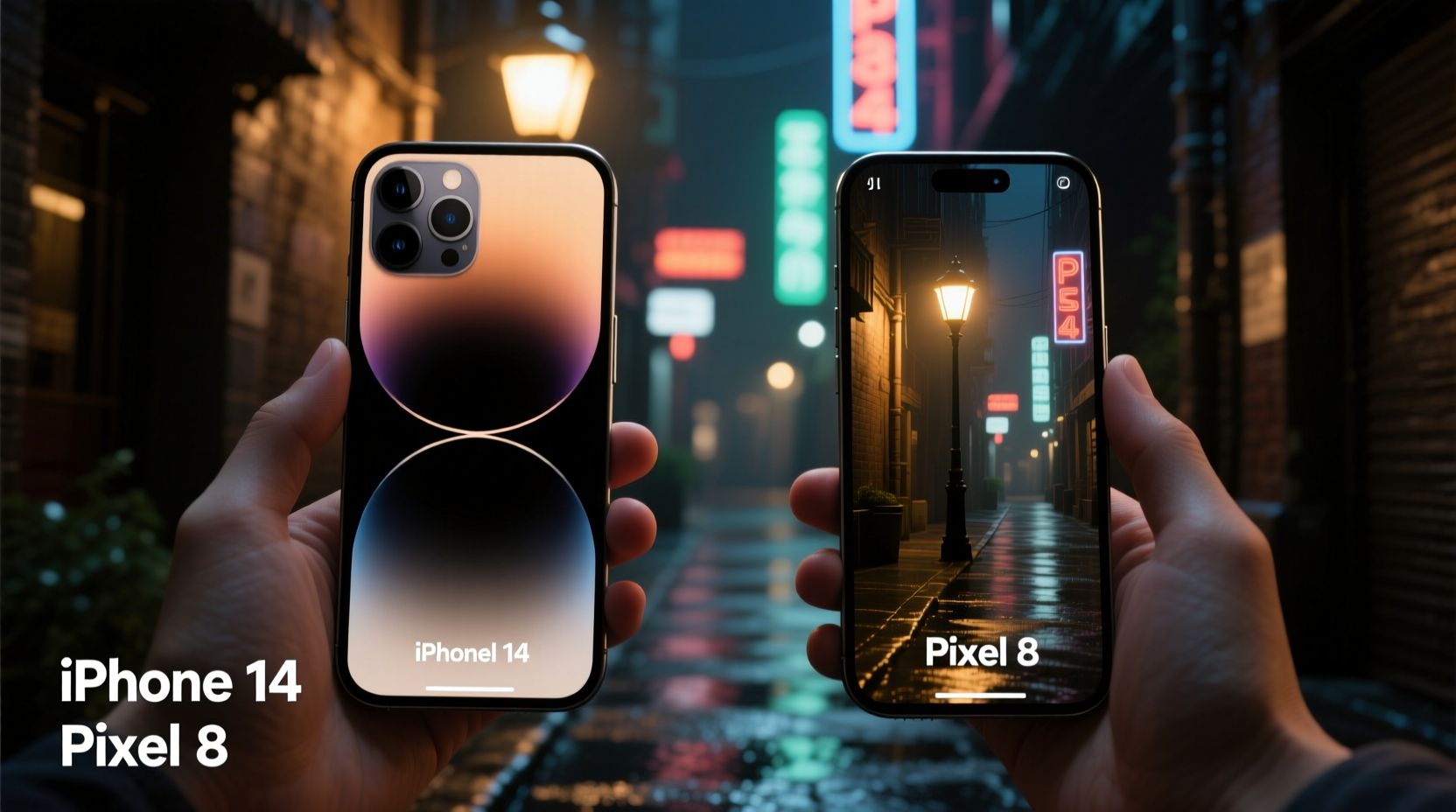
The foundation of any camera system lies in its physical components. The iPhone 14 and Pixel 8 take different paths in sensor selection and optical design, each influencing how well they capture light in dark environments.
The iPhone 14 features a 12MP main sensor with an f/1.5 aperture—the widest ever used in an iPhone at the time of its release. This larger aperture allows significantly more light to reach the sensor compared to previous models. Combined with sensor-shift optical image stabilization (OIS), the iPhone 14 improves motion compensation during longer exposures, especially useful in Night mode.
On the other hand, the Pixel 8 uses a 50MP main sensor (with pixel binning down to 12.5MP) and an f/1.69 aperture. While slightly narrower than the iPhone’s, Google compensates with advanced multi-frame capture and AI-based noise reduction. The sensor itself is larger than the one in the iPhone 14, giving it a theoretical advantage in dynamic range and light sensitivity.
| Feature | iPhone 14 | Pixel 8 |
|---|---|---|
| Main Sensor Resolution | 12MP | 50MP (binned to 12.5MP) |
| Aperture | f/1.5 | f/1.69 |
| Sensor Size | 1/1.7\" | 1/1.31\" |
| OIS Type | Sensor-shift | Standard OIS |
| Night Mode Default Exposure Time | 1–3 seconds | Up to 5 seconds (adaptive) |
While the iPhone benefits from sensor-shift stabilization—offering sharper results in handheld shots—the Pixel 8 leverages its larger sensor to gather more photons per frame. In theory, this gives Google an edge in extremely dim conditions, assuming optimal alignment and minimal movement during capture.
Computational Photography: Apple vs Google Philosophy
Hardware alone doesn’t define low-light performance. Both phones rely heavily on computational photography, but their strategies diverge sharply.
Apple’s approach with the iPhone 14 prioritizes realism and consistency. Its Smart HDR 4 and Deep Fusion technologies work behind the scenes to balance shadows, reduce noise, and preserve detail without over-processing. Night mode activates automatically below certain lux levels and uses machine learning to optimize exposure duration based on hand stability. The result is a natural-looking image that closely resembles what the human eye might perceive—if it had superhuman vision.
Google, by contrast, treats every photo as raw material for transformation. The Pixel 8 runs its images through the Tensor G3 chip using Super Res Zoom, HDR+, and Magic Eraser logic—all before you even see the preview. In low light, its Night Sight algorithm captures up to 15 frames at varying exposures, aligns them, and merges them into a single high-dynamic-range output. The process emphasizes brightness, clarity, and color vibrancy, often producing images that look “lit” even in near-darkness.
“Google doesn’t just capture photos—it reconstructs them. That’s powerful in darkness, but sometimes at the cost of authenticity.” — David Kim, Mobile Imaging Analyst at DXOMARK
In direct comparisons, Pixel 8 images frequently appear brighter and more detailed in pitch-black alleys or indoor restaurant settings. However, some observers note unnatural skin tones, oversharpened edges, or exaggerated textures—artifacts of aggressive AI enhancement. The iPhone 14 tends to retain more accurate colors and smoother gradients, though shadows may appear noisier or underexposed by comparison.
Real-World Performance: Urban Nights and Indoor Scenes
To evaluate true performance, testing must move beyond controlled labs. A realistic scenario helps reveal strengths and weaknesses under everyday conditions.
Mini Case Study: Street Photography After Sunset
Jamal, a travel blogger based in Chicago, regularly shoots cityscapes after dark. On a recent evening walk along the Chicago Riverwalk, he tested both the iPhone 14 and Pixel 8 under mixed lighting: distant streetlamps, neon signs reflecting off water, and deep shadows between buildings.
With the iPhone 14, Jamal found that highlights from boats and bridges were well-controlled, with minimal blown-out areas. Colors remained faithful to reality—blue lights stayed blue, not leaning purple or magenta. However, shadow details in alleyways required post-processing to lift, as the camera preserved the scene’s inherent darkness.
The Pixel 8, meanwhile, brightened those same alleys dramatically. Details in brickwork and graffiti became visible without editing. But reflections on the water appeared overly saturated, and artificial sky glow made the image feel less authentic. Jamal noted that while the Pixel 8 photo was more “shareable” straight out of the camera, it lost some of the moody atmosphere he wanted to convey.
This illustrates a key trade-off: the Pixel 8 enhances visibility; the iPhone 14 preserves mood.
Indoor Low-Light: Restaurants and Dimly Lit Rooms
In warm-lit restaurants—where flickering candles and amber overheads challenge white balance—both phones struggle differently.
- iPhone 14: Maintains accurate skin tones but may underexpose subjects seated across the table. Users often need to tap to focus and manually adjust exposure sliders.
- Pixel 8: Brightens faces aggressively, sometimes washing out contours. However, it recovers facial details better in backlit situations due to superior shadow lifting.
For portrait photography in dim spaces, the Pixel 8’s Face Unblur technology can detect micro-movements and sharpen eyes and lips intelligently. The iPhone relies more on autofocus precision and flash alternatives like Portrait Lighting, which can look artificial.
Step-by-Step Guide to Maximizing Low-Light Photos
Regardless of which device you own, technique plays a major role in nighttime results. Follow these steps to get the most from your camera:
- Enable Night Mode Manually: Don’t rely solely on auto-triggering. Open the Camera app and check if the moon icon is lit. If not, tap it to activate Night mode even in moderately low light.
- Stabilize Your Shot: Rest your elbows on a surface or lean against a wall. Even slight shakes blur long exposures. Consider using a mini tripod for critical shots.
- Avoid Digital Zoom: Zooming crops the sensor area, reducing light intake. Physically move closer or accept the wide-angle view.
- Use Burst Mode for Action: In dynamic scenes (e.g., live music), rapid-fire shooting increases chances of capturing a sharp frame before motion blur sets in.
- Edit Thoughtfully: Boost shadows carefully. Over-editing amplifies noise, especially on iPhone captures. Use selective adjustments rather than global sliders.
Which Phone Wins? A Balanced Verdict
Declaring a single winner depends on priorities.
If you value natural color reproduction, balanced contrast, and faithful representation of ambient lighting, the **iPhone 14** is likely the better choice. Its images feel grounded and cinematic, ideal for photographers who appreciate subtlety and plan to edit later. Sensor-shift stabilization also makes it more forgiving in shaky conditions.
If your goal is maximum visibility—getting usable shots in near-total darkness, reading menus in dim bars, or capturing kids’ faces at bedtime—the **Pixel 8** pulls ahead. Its AI-powered processing turns unusable footage into vibrant, detailed images. However, this comes with a risk of overprocessing, particularly in complex lighting.
For hybrid users who want both fidelity and flexibility, consider this: the Pixel 8 offers more dramatic improvements in extreme low light, but the iPhone 14 delivers greater consistency across diverse scenarios.
Checklist: Choosing Based on Your Needs
- ✅ Choose the iPhone 14 if:
- You prefer realistic, film-like photos
- You shoot handheld often and need reliable stabilization
- You do post-processing and want clean RAW files
- ✅ Choose the Pixel 8 if:
- You frequently shoot in very dark environments
- You share photos directly from the phone with minimal editing
- You prioritize facial clarity and shadow recovery
Frequently Asked Questions
Does the iPhone 14 have Night mode?
Yes, the iPhone 14 includes Night mode on all rear cameras and the front-facing camera. It activates automatically in low-light conditions and adjusts exposure time based on stability.
Why does my Pixel 8 take several seconds to save a photo in the dark?
This delay occurs because the Pixel 8 captures multiple frames and processes them using the Tensor chip. The longer processing time enables higher detail and lower noise but requires patience. Avoid moving the phone until the shutter sound completes.
Can either phone replace a dedicated camera in low light?
For casual use, yes—both surpass older point-and-shoot cameras in dim lighting. However, they still lack the dynamic range, shallow depth of field, and manual control of mirrorless or DSLR systems. They’re excellent substitutes for convenience, not professional-grade replacement.
Conclusion: Make the Right Choice for Your Vision
The battle between the iPhone 14 and Pixel 8 in low-light photography isn’t about specs—it’s about intent. Are you documenting reality, or enhancing it? Do you want a photo that feels true to the moment, or one that reveals what your eyes couldn’t see?
The iPhone 14 honors the atmosphere of darkness, preserving shadows and subtle hues. The Pixel 8 fights darkness head-on, illuminating hidden details with computational power. Neither is objectively better; each serves a different kind of photographer.
Understanding how each camera interprets low light empowers you to choose not just a device, but a creative partner. Whether you're walking home under city lights or capturing quiet moments indoors, the best camera is the one that aligns with how you see the world—even when it's nearly black.




 浙公网安备
33010002000092号
浙公网安备
33010002000092号 浙B2-20120091-4
Comments
No comments yet. Why don't you start the discussion?