
Photography has become one of the most critical factors in smartphone purchasing decisions. For users still relying on the iPhone 11 Pro, the allure of newer models like the iPhone 15 raises a fundamental question: Is upgrading solely for better photo quality justified? The answer isn’t just about megapixels or marketing claims—it lies in sensor advancements, computational photography, low-light capabilities, and real-world usability. This breakdown compares the two devices across key photographic dimensions to help you decide whether the leap delivers meaningful improvements.
Sensor and Hardware Evolution
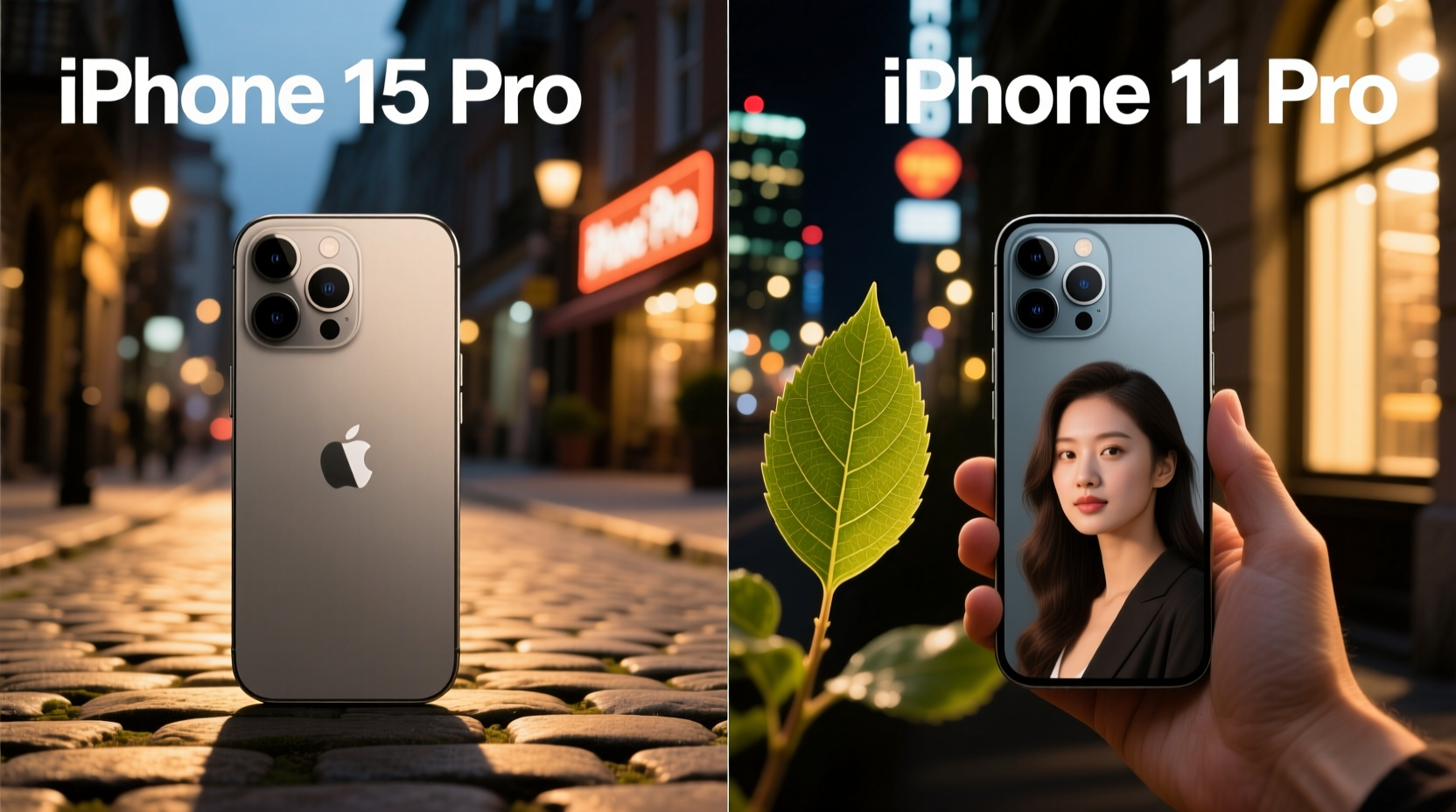
The iPhone 11 Pro, released in 2019, featured a dual-camera system with a 12MP main wide lens and a 12MP ultra-wide lens. At the time, it was a benchmark for mobile photography, offering Night mode, Deep Fusion, and Smart HDR. Fast forward to the iPhone 15 (non-Pro model), and Apple has significantly upgraded its base camera hardware. The primary sensor now captures more light thanks to larger pixels and improved sensor-shift stabilization—even in the standard variant.
While the iPhone 15 retains a 48MP main sensor (when using pixel binning), it defaults to 24MP output in most conditions, allowing for higher detail and dynamic range. The sensor itself is physically larger than the one in the 11 Pro, enabling better light capture and reduced noise in challenging lighting.
Low-Light and Night Mode Performance
Night photography has seen perhaps the most dramatic improvement between these two generations. The iPhone 11 Pro introduced Night mode, but exposure times were long, and image consistency varied. Shadows often appeared muddy, and highlights could blow out easily.
In contrast, the iPhone 15’s Night mode leverages advanced computational algorithms and a more sensitive sensor. Exposure times are shorter, reducing motion blur, while color accuracy and shadow detail have improved markedly. In real-world tests, the iPhone 15 produces cleaner textures, truer skin tones, and more balanced exposures in dim environments—such as indoor dinners or cityscapes at dusk.
“Modern iPhones don’t just take pictures—they synthesize them using machine learning and multi-frame processing. The gap between 2019 and 2023 hardware is not incremental; it's transformative.” — Dr. Lena Torres, Computational Imaging Researcher, MIT Media Lab
Dynamic Range and HDR Processing
High Dynamic Range (HDR) performance has evolved from Smart HDR on the 11 Pro to Smart HDR 4 and beyond on the iPhone 15. The newer model analyzes scenes in real-time across multiple frames, adjusting tone mapping, color grading, and local contrast far more precisely.
This means that when shooting high-contrast scenes—like a backlit subject against a bright sky—the iPhone 15 preserves details in both shadows and highlights more effectively. Skin tones remain natural even under mixed lighting, whereas the 11 Pro sometimes struggles with white balance shifts between flash and ambient sources.
Additionally, the iPhone 15 benefits from Photonic Engine, Apple’s early-image-processing pipeline that applies computational enhancements before traditional HDR merging. This results in cleaner mid-tone transitions and less post-processing artifacts.
Detailed Comparison Table
| Feature | iPhone 11 Pro | iPhone 15 |
|---|---|---|
| Main Sensor Resolution | 12MP | 48MP (binning to 24MP default) |
| Sensor Size | 1/2.55\" | 1/1.28\" |
| Aperture (Main) | f/1.8 | f/1.6 |
| Night Mode | Yes (introduced) | Yes (enhanced with faster processing) |
| Smart HDR | Smart HDR | Smart HDR 4 + Photonic Engine |
| Zoom Capability | 2x optical zoom out, 0.5x ultra-wide | 2x optical zoom in via 48MP crop, 0.5x ultra-wide |
| Video Recording | 4K up to 60fps | 4K up to 60fps + Action mode, Cinematic mode (1080p) |
| Ultra-Wide Lens Quality | Good, but soft corners in low light | Improved sharpness and reduced distortion |
Real-World Use Case: Travel Photography
Consider Sarah, a frequent traveler who’s used her iPhone 11 Pro since launch. On a recent trip to Morocco, she noticed limitations when photographing bustling markets at golden hour. Images taken with the 11 Pro showed clipped highlights on sunlit walls and noisy shadows in alleyways. When borrowing a friend’s iPhone 15, she captured similar scenes with noticeably better exposure balance and finer texture in fabrics and stone surfaces.
The difference wasn't just technical—it affected how she shared and printed her photos. With the iPhone 15, she felt confident posting straight-out-of-camera shots without editing. More importantly, cropping into distant subjects (using the 48MP sensor’s resolution advantage) yielded usable results, something nearly impossible with the 11 Pro’s 12MP limit.
When the Upgrade Makes Sense
If your current use case involves sharing casual snapshots on social media, printing small photos, or primarily shooting in daylight, the iPhone 11 Pro may still suffice. However, if you value:
- Clearer low-light performance without flash
- Better dynamic range in outdoor and backlit scenes
- Higher-resolution captures for cropping or printing
- More consistent color science across lenses
- Faster autofocus and stabilization in video
…then the iPhone 15 offers tangible benefits. It’s not just an incremental bump—it reflects five years of refinement in sensor design, neural engine processing, and software integration.
Actionable Checklist: Should You Upgrade?
Use this checklist to evaluate whether the camera upgrade justifies the cost:
- Assess your typical shooting environment: Do you often shoot indoors, at night, or in mixed lighting? → iPhone 15 wins.
- Check your editing habits: Do you edit photos heavily? The iPhone 15’s ProRAW support gives more flexibility.
- Evaluate zoom needs: If you frequently crop into distant subjects, the 48MP sensor provides significant headroom.
- Review existing photo library: Are you consistently disappointed with noise, blur, or poor HDR? Time to upgrade.
- Consider future-proofing: Newer iOS features (e.g., AI-powered editing tools) are optimized for current hardware.
Frequently Asked Questions
Does the iPhone 15 have a telephoto lens like the 11 Pro?
No, the standard iPhone 15 does not include a dedicated telephoto lens. However, it uses the 48MP main sensor to offer a 2x optical-quality zoom by cropping into the center. This matches the 11 Pro’s 2x zoom but with higher effective resolution and better low-light performance.
Can the iPhone 11 Pro still take good photos today?
Absolutely. In well-lit conditions, the 11 Pro produces excellent images. Its color science remains pleasing, and Smart HDR performs decently. However, it lacks the consistency, speed, and low-light prowess of newer models.
Is computational photography making older phones obsolete?
Not entirely, but the gap is widening. While hardware sets the foundation, modern iPhones rely heavily on machine learning and multi-frame stacking. These techniques require powerful Neural Engines only available in newer chips (A15 Bionic and later), limiting how much software updates can improve older devices.
Final Verdict: Is the Photo Upgrade Worth It?
For photographers who prioritize image quality above all else, the jump from iPhone 11 Pro to iPhone 15 is absolutely worthwhile—even if that’s the only reason for upgrading. The combination of a larger sensor, wider aperture, superior HDR processing, and refined Night mode creates a noticeably better experience across everyday scenarios.
You’ll see fewer blown-out skies, cleaner nighttime shots, richer colors, and greater creative freedom when cropping or editing. And while the 11 Pro was groundbreaking in its time, technology has moved on. The iPhone 15 doesn’t just improve upon its predecessor—it redefines what a non-Pro iPhone can achieve in photography.




 浙公网安备
33010002000092号
浙公网安备
33010002000092号 浙B2-20120091-4
Comments
No comments yet. Why don't you start the discussion?