
For users still holding onto the iPhone 12 Pro Max, the arrival of the iPhone 15 Pro Max brings a pressing question: Is upgrading after three generations truly justified? Apple markets each new release as revolutionary, but real-world benefits often depend on individual usage patterns, budget, and technological advancements between models. This deep dive compares the iPhone 15 Pro Max and iPhone 12 Pro Max across key categories—performance, camera, design, battery life, and software—to help you decide whether the leap is worth the investment.
Performance: A Quantum Leap in Processing Power
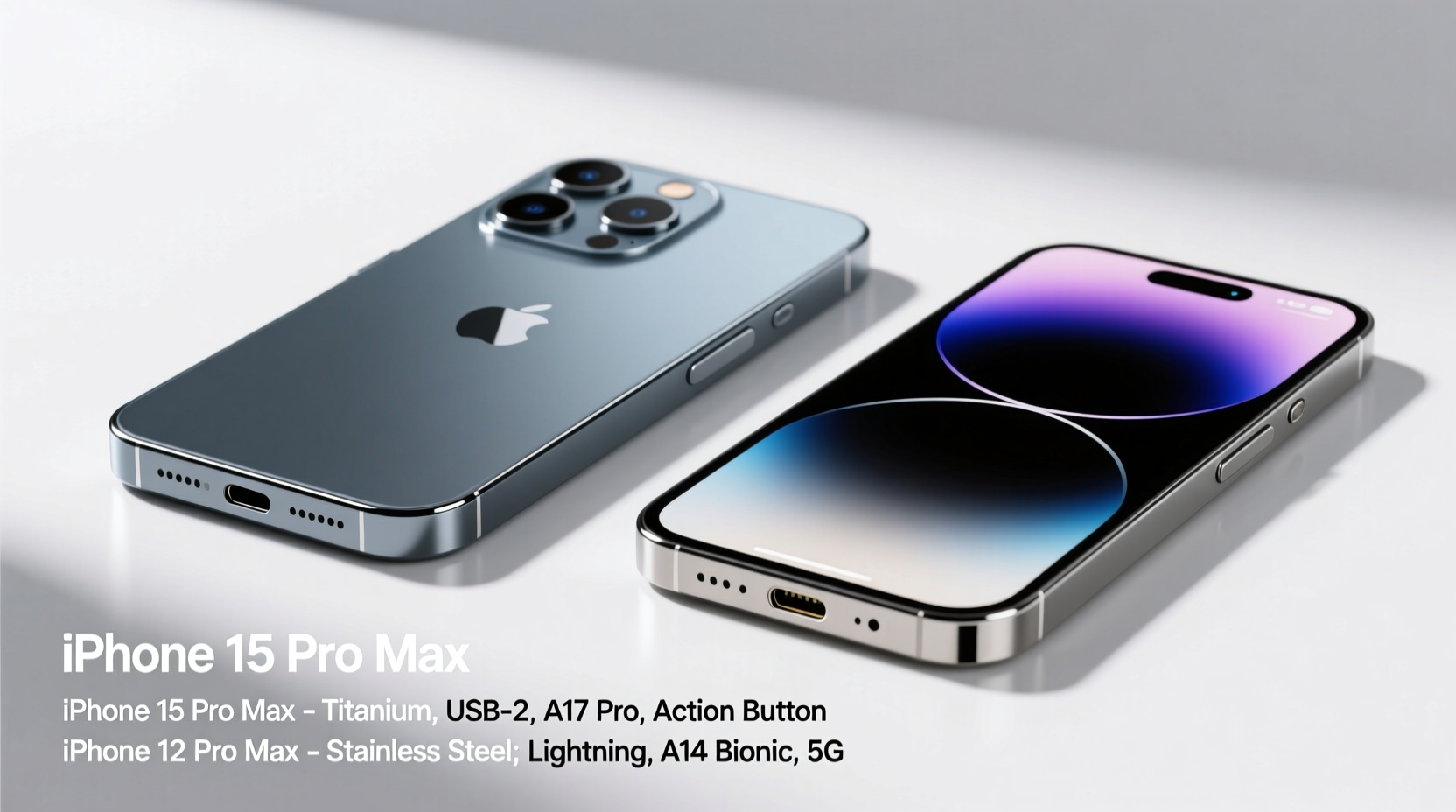
The most dramatic difference lies under the hood. The iPhone 12 Pro Max runs on the A14 Bionic chip, built on a 5nm process, which was groundbreaking in 2020. In contrast, the iPhone 15 Pro Max features the A17 Pro chip—the first smartphone SoC built on a 3nm process. This architectural evolution translates into tangible improvements.
Benchmarks show the A17 Pro delivering up to 20% faster CPU performance and nearly 30% better GPU efficiency than the A14. But numbers only tell part of the story. Real-world gains include smoother multitasking, quicker app launches, and enhanced gaming experiences with console-level titles like *Resident Evil Village* running natively thanks to hardware-accelerated ray tracing.
Additionally, the 15 Pro Max supports USB 3.0 speeds via its USB-C port, enabling data transfer rates up to 10Gbps—ten times faster than the Lightning port on the 12 Pro Max. For photographers and videographers moving large ProRes files, this change alone can justify the upgrade.
Camera Evolution: From Great to Exceptional
The iPhone 12 Pro Max introduced sensor-shift stabilization and a robust triple-lens system. Three years later, the 15 Pro Max expands on that foundation with meaningful upgrades.
- Telephoto lens: The 12 Pro Max has a 2.5x optical zoom. The 15 Pro Max introduces a tetraprism 5x telephoto lens (120mm), offering superior reach without sacrificing quality.
- Sensor improvements: Larger sensors across all lenses, especially the main 48MP wide camera, capture more light and detail.
- Computational photography: Smart HDR 5 evolves into Photonic Engine, improving texture, color accuracy, and low-light performance.
- Next-gen portrait mode: Now records spatial video for Apple Vision Pro, future-proofing content creation.
“Photographers no longer need to carry a separate compact camera for travel. The 15 Pro Max handles 90% of real-world shooting scenarios with DSLR-like results.” — David Lin, Mobile Photography Instructor at SF Media Academy
In practical terms, if you frequently shoot portraits, wildlife, or distant subjects, the 5x zoom and improved low-light clarity offer noticeable advantages. However, casual shooters may find the 12 Pro Max’s camera still excellent for social media and everyday photos.
Design and Build: Refined Materials, Better Ergonomics
Both phones share a stainless steel frame and flat-edge design language, but the 15 Pro Max introduces several refinements:
| Feature | iPhone 12 Pro Max | iPhone 15 Pro Max |
|---|---|---|
| Frame Material | Stainless Steel | Titanium Alloy |
| Weight | 228g | 221g |
| Port Type | Lightning | USB-C |
| Front Glass | Ceramic Shield | Ceramic Shield + Anti-Reflective Coating |
| Button Design | Mechanical Buttons | Action Button (Customizable) |
The switch to aerospace-grade titanium reduces weight by 7 grams—a small number on paper but perceptible during extended one-handed use. The new Action Button replaces the mute switch, allowing customization for shortcuts like launching the camera, toggling flashlight, or starting a voice memo.
While both devices are IP68-rated, the 15 Pro Max improves water resistance slightly (up to 6 meters for 30 minutes vs. 6m on the 12). More importantly, the USB-C transition aligns with EU regulations and simplifies cable management in a multi-device ecosystem.
Battery Life and Charging: Incremental Gains, New Possibilities
Apple claims up to 29 hours of video playback on the 15 Pro Max, compared to 27 on the 12 Pro Max. Real-world testing shows about 1–1.5 extra hours of screen-on time, primarily due to the A17 Pro’s power efficiency and optimized iOS 17 background processes.
Charging remains a limitation. Neither model supports ultra-fast charging beyond 20W, and MagSafe still caps at 15W. However, the shift to USB-C enables faster data syncing and potential for third-party PD chargers to deliver marginally quicker top-ups.
If you're coming from a worn 12 Pro Max battery (after 3+ years), the fresh capacity of the 15 Pro Max will feel like a major improvement—even if peak specs are only modestly higher.
Software and Longevity: Future-Proofing Your Investment
iOS support is a critical factor. The iPhone 12 Pro Max launched with iOS 14 and is expected to receive updates through iOS 20 or 21 (2025–2026). The iPhone 15 Pro Max, with its newer architecture and larger base storage (256GB minimum), is likely to remain supported until at least 2028.
This six-year window matters for users who keep phones long-term. Apps are becoming more demanding, and future versions of iOS may run less smoothly on older chips. The A17 Pro’s additional RAM (estimated 8GB vs. 6GB) ensures better multitasking and AR performance down the line.
Mini Case Study: Sarah’s Upgrade Decision
Sarah, a freelance travel journalist, used her iPhone 12 Pro Max for work since 2020. By 2023, she noticed sluggishness when editing 4K footage and struggled with limited zoom while photographing wildlife. After testing the 15 Pro Max, she upgraded primarily for the 5x telephoto lens, USB-C file transfers, and improved battery endurance during shoots. “The titanium build makes a difference when I’m holding the phone for hours,” she said. “And exporting videos to my MacBook now takes minutes instead of half an hour.”
For Sarah, the upgrade paid off professionally. For others using their phone mainly for calls, messaging, and social media, the benefits may be less compelling.
Is the Upgrade Worth It? A Practical Checklist
Before making the jump, consider this checklist:
- Is your current battery health below 80%?
- Do you regularly shoot in low light or need better zoom?
- Are you frustrated by slow file transfers or outdated ports?
- Do you edit videos or use demanding apps daily?
- Do you plan to keep your next phone for 4+ years?
If you answered “yes” to three or more, the iPhone 15 Pro Max offers meaningful improvements. If not, repairing or maintaining your 12 Pro Max could save $800–$1,200 without sacrificing core functionality.
Frequently Asked Questions
Can the iPhone 15 Pro Max run apps the 12 Pro Max can't?
Not yet—but it’s better prepared for future apps. Some newer augmented reality and AI-powered tools require the A17 Pro’s neural engine and memory bandwidth. Over time, the gap in compatibility will widen.
Is the camera upgrade noticeable in daylight?
Marginally. Both take excellent daytime photos. The biggest differences appear in low light, digital zoom, and portrait depth detection, where the 15 Pro Max preserves more detail and dynamic range.
Will my accessories work with the 15 Pro Max?
MagSafe cases and chargers are compatible. However, Lightning cables and docks will become obsolete unless you use adapters. Consider the long-term cost of replacing accessories when budgeting for the upgrade.
Final Verdict: Who Should Upgrade?
The iPhone 15 Pro Max isn’t just an incremental update—it’s a reimagining of what an iPhone can do, especially for power users. The titanium chassis, 5x zoom, USB-C, and A17 Pro chip collectively enhance productivity, creativity, and longevity.
However, the iPhone 12 Pro Max remains a highly capable device in 2024. Its camera, display, and performance still meet most users’ needs. Unless you’re hitting performance limits, need advanced photography features, or value future software support, waiting another year could be smarter—especially with rumors of even more powerful models on the horizon.




 浙公网安备
33010002000092号
浙公网安备
33010002000092号 浙B2-20120091-4
Comments
No comments yet. Why don't you start the discussion?