
The iPhone 15 Pro has redefined what a smartphone camera can do. With its 48MP main sensor, advanced computational photography, and seamless integration into Apple’s ecosystem, it’s more than capable for most everyday photography. At the same time, the Canon EOS R50, a compact mirrorless camera with interchangeable lenses and APS-C sensor, offers serious photographic capabilities at an accessible price point. So, in 2024, does investing in a dedicated camera like the R50 still make sense when your phone can capture stunning images?
This question isn’t just about specs—it’s about purpose, creative control, and long-term value. For casual users, social media creators, or travelers, the iPhone 15 Pro may be more than enough. But for those stepping into photography seriously, the R50 presents advantages that smartphones still can’t match.
Sensor Size and Image Quality: The Fundamental Difference
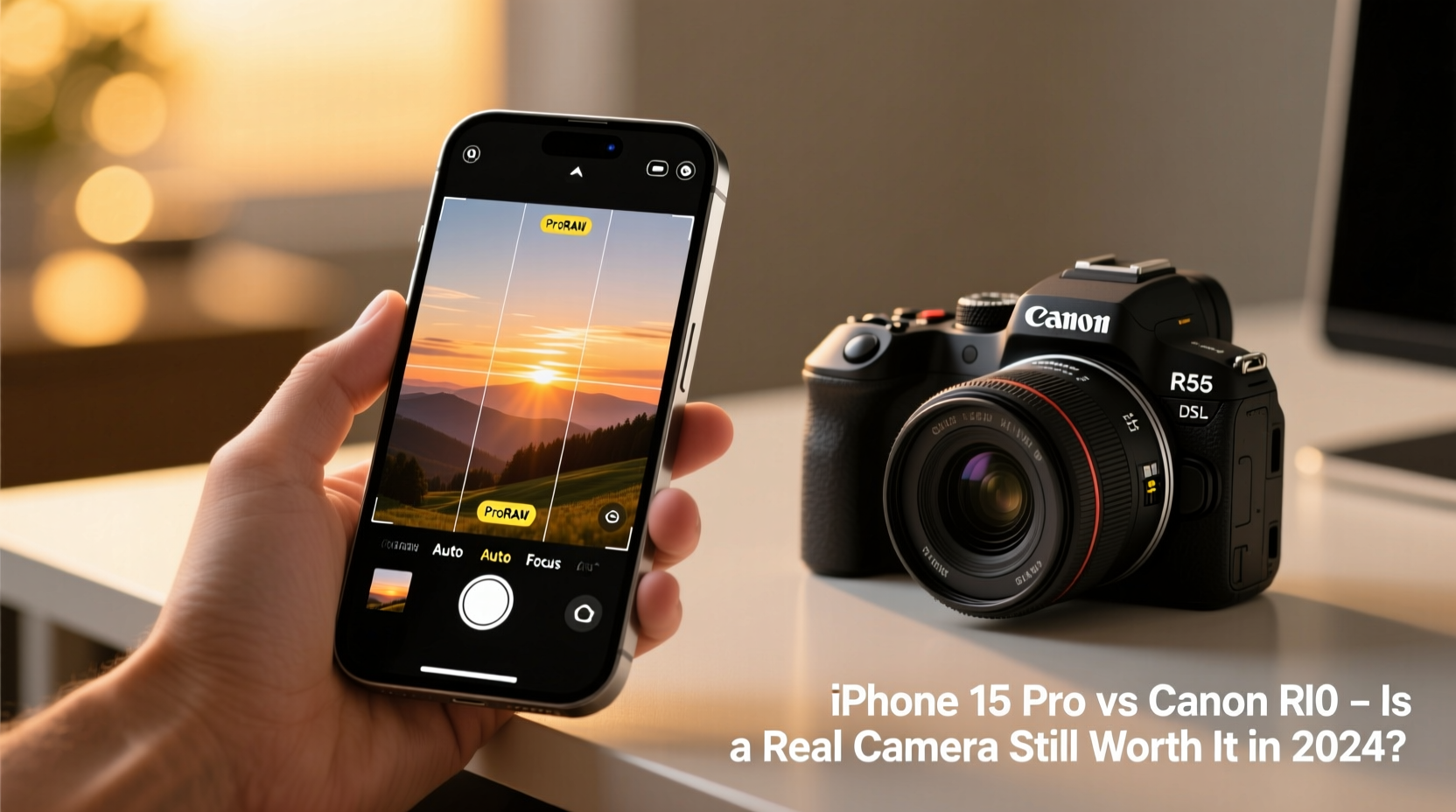
The core of any camera system is its sensor. The iPhone 15 Pro uses a 1/1.3-inch sensor in its primary camera—impressive for a phone—but the Canon R50 features an APS-C sensor measuring approximately 22.3 x 14.9mm. That’s over seven times larger in surface area.
Larger sensors capture more light, which translates directly into better dynamic range, lower noise in low light, and superior depth-of-field control. This becomes evident when comparing high-ISO performance or shooting in dimly lit environments. While the iPhone leverages smart HDR and night mode stacking, the R50 captures cleaner, more natural-looking images with less artificial processing.
| Feature | iPhone 15 Pro | Canon EOS R50 |
|---|---|---|
| Sensor Size | 1/1.3-inch (approx. 116 mm²) | APS-C (approx. 332 mm²) |
| Effective Megapixels | 48 MP (main) | 24.2 MP |
| Aperture Range (Main Lens) | f/1.78 – f/2.8 | f/4.5–6.3 (kit lens), down to f/1.2 with fast primes |
| Low-Light Performance | Excellent (via software enhancement) | Natural, less processed, superior in extreme low light |
| Dynamic Range | Very good (Smart HDR 5) | Superior due to larger sensor and RAW flexibility |
Lens Flexibility and Creative Control
The iPhone 15 Pro offers three fixed lenses: 24mm, 28mm, and 77mm equivalent focal lengths. They’re sharp and well-tuned, but they can’t be changed. The Canon R50, however, supports Canon’s RF mount, giving access to a growing library of lenses—from ultra-wide 10mm fisheyes to 600mm super-telephotos.
This flexibility transforms how you approach photography. Want to isolate a subject with creamy bokeh? Use an f/1.8 prime lens. Shooting landscapes at golden hour? Attach a wide-angle with a filter thread for ND grads. Need reach for wildlife? A 100-400mm lens brings distant subjects close without digital cropping.
Smartphones simulate depth with software-based portrait modes, but true optical blur from a large aperture and physical distance between subject and background creates a more authentic, professional look.
“Lens choice isn’t just about zoom—it’s about storytelling. A 35mm tells a different story than an 85mm. Phones give you convenience; dedicated cameras give you intent.” — David Lin, Professional Travel Photographer
Video Capabilities: Phone Simplicity vs. Camera Versatility
The iPhone 15 Pro shines in video. It shoots 4K at up to 60fps, supports Log encoding (for color grading), and delivers cinematic mode with real-time focus transitions. Its stabilization is class-leading, and editing in iMovie or Final Cut is frictionless.
The Canon R50 also records 4K at 30fps (with a slight crop) and 10-bit HDR PQ, making it competitive for entry-level content creation. However, its manual controls—focus peaking, zebra patterns, adjustable audio monitoring—offer far greater precision for filmmakers who want to shape their footage beyond automated defaults.
For vloggers, the R50’s flip-out touchscreen and clean HDMI output are invaluable. You can connect external mics via 3.5mm jack or use adapters for XLR, ensuring studio-grade audio—a critical advantage over relying solely on the iPhone’s built-in mics, even with add-ons.
When the R50 Wins in Video
- Manual exposure and focus control for consistent looks across scenes
- Better audio input options for professional sound
- Longer continuous recording without overheating (unlike phones, which throttle after ~30 minutes)
- Ability to use neutral density filters for proper motion blur in daylight
Real-World Example: Wedding Guest vs. Second Shooter
Consider two people at a wedding: Alex brings only an iPhone 15 Pro, while Jordan carries a Canon R50 with a 50mm f/1.8 lens.
Alex captures beautiful moments—the first dance, speeches, group photos—with ease. The colors are vibrant, stabilization keeps everything smooth, and sharing to Instagram is instant. But in the dimly lit reception hall, images become noisy. Zooming in reveals softness. Portrait mode struggles with backlit subjects.
Jordan, meanwhile, shoots at ISO 3200 with minimal noise, uses shallow depth of field to isolate emotional expressions, and records ceremony audio through a shotgun mic. Later, they export 10-bit footage for subtle color correction. Their files are larger and require more effort to edit, but the final results have a polished, intentional quality.
In this scenario, both devices served their owners well—but for different goals. Alex documented memories. Jordan created art.
Practical Checklist: Should You Choose the R50 Over the iPhone?
Use this checklist to determine if a dedicated camera is right for you:
- Do you regularly shoot in low-light conditions (concerts, indoors, nightscapes)? → R50 wins
- Do you want full manual control over aperture, shutter speed, and focus? → R50 wins
- Are you interested in using different lenses for creative effects? → R50 wins
- Is instant sharing and minimal post-processing your top priority? → iPhone wins
- Do you edit photos or videos professionally or semi-professionally? → R50 wins
- Is portability and simplicity non-negotiable? → iPhone wins
FAQ: Common Questions About Choosing Between iPhone and Dedicated Cameras
Can the iPhone 15 Pro replace a DSLR or mirrorless camera?
For casual photography and social media, yes. But for professional work, creative control, or challenging lighting, no. The hardware limitations of sensor size and fixed lenses mean the iPhone can’t match the flexibility and image fidelity of even entry-level dedicated cameras like the R50.
Is the Canon R50 outdated compared to modern smartphones?
No. While smartphones lead in automation and connectivity, the R50 excels in optical quality, dynamic range, and adaptability. Its ability to shoot RAW, use fast lenses, and support external accessories ensures it remains relevant in 2024 and beyond.
Do I need to carry both devices?
Many photographers do. The iPhone is ideal for candid shots, quick social updates, and scanning documents. The R50 handles formal portraits, events, and creative projects. Together, they complement each other—one for convenience, one for craft.
Final Verdict: Yes, a Real Camera Is Still Worth It
In 2024, the iPhone 15 Pro represents the peak of computational photography. It’s intelligent, intuitive, and capable of producing stunning results with zero effort. But a dedicated camera like the Canon R50 offers something fundamentally different: creative freedom.
If photography is more than just capturing moments—if you care about how light falls on a face, how a background melts into bokeh, or how a scene feels in RAW format—then a real camera is not just worth it, it’s essential.
The R50 isn’t the fastest or most advanced mirrorless camera, but it strikes a rare balance: affordable, lightweight, and powerful enough to grow with you. Paired with a single fast prime lens, it becomes a tool for learning, expression, and lasting image quality that transcends algorithmic enhancement.
The future of photography isn’t about choosing between phones and cameras. It’s about knowing when to use each. But for those ready to move beyond taps and swipes, the Canon R50 proves that real cameras aren’t obsolete—they’re evolving.




 浙公网安备
33010002000092号
浙公网安备
33010002000092号 浙B2-20120091-4
Comments
No comments yet. Why don't you start the discussion?