
With the iPhone 15 series marking Apple’s long-awaited shift to USB-C, consumers finally have a level playing field for comparing wired charging performance across flagship smartphones. For years, Android manufacturers led in fast-charging innovation, pushing beyond 65W and even approaching 200W in some models. Apple, historically conservative in this space, entered the USB-C era with modest power delivery expectations. But how does the iPhone 15 truly stack up against top-tier Android flagships like the Samsung Galaxy S24 Ultra, Google Pixel 8 Pro, OnePlus 12, or Xiaomi 14?
This article dives deep into real-world charging speeds, technical specifications, efficiency trade-offs, and user experience to answer one critical question: when it comes to charging speed, does the iPhone 15 hold its own — or fall behind?
Charging Specifications Compared
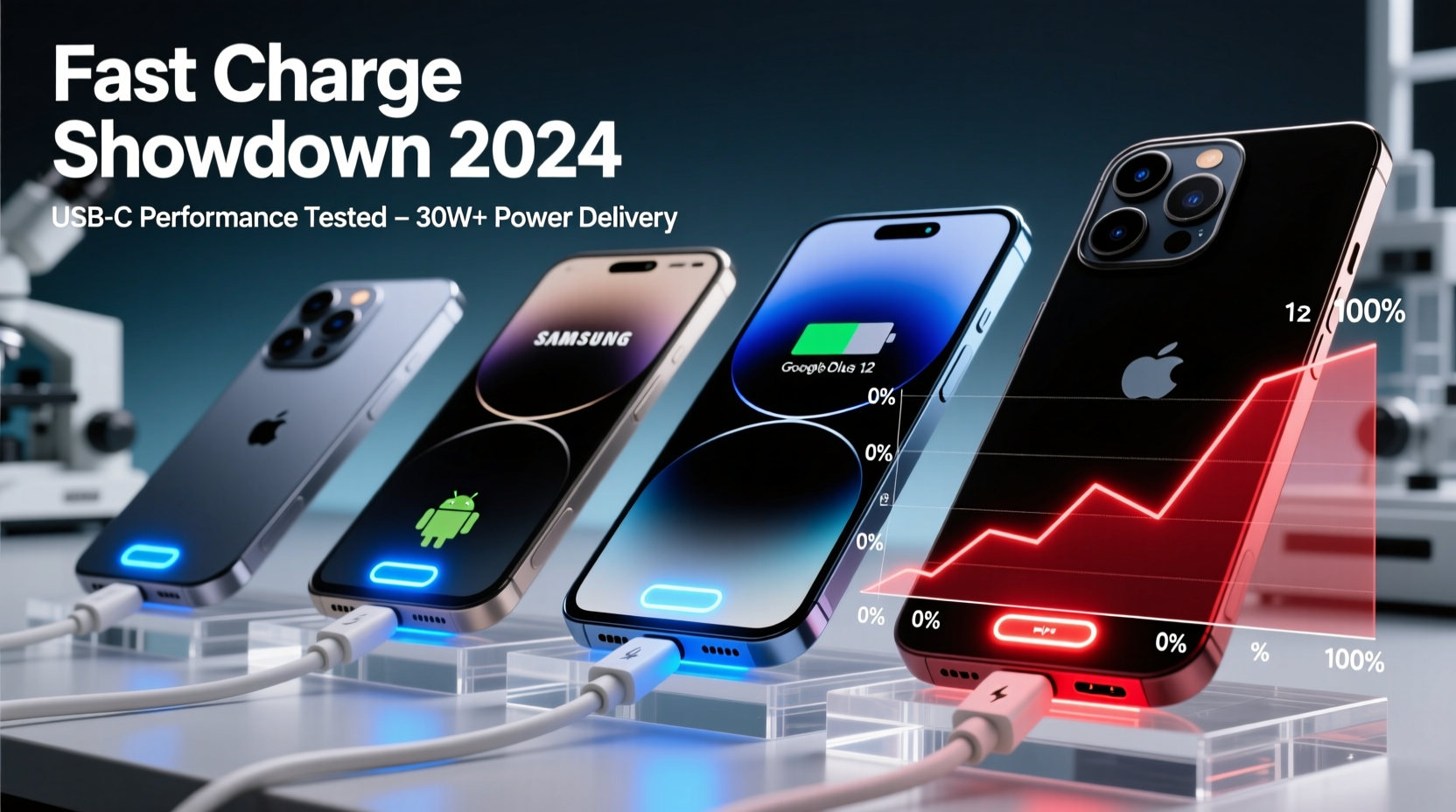
The foundation of any charging comparison lies in the hardware and supported standards. The iPhone 15 lineup supports USB Power Delivery (USB-PD) over its USB-C port, but peak wattage remains limited compared to many Android rivals.
| Device | Port Type | Max Charging Speed (W) | Charging Standard | Time (0–100%) |
|---|---|---|---|---|
| iPhone 15 / 15 Plus | USB-C | 20–27W (adaptive) | USB-PD | ~70 minutes |
| iPhone 15 Pro / Pro Max | USB-C | 27W (max observed) | USB-PD | ~65 minutes |
| Samsung Galaxy S24 Ultra | USB-C | 45W | PPS + USB-PD | ~50 minutes |
| Google Pixel 8 Pro | USB-C | 30W (wired), 23W (wireless) | USB-PD | ~72 minutes |
| OnePlus 12 | USB-C | 80W | SuperVOOC | ~25 minutes |
| Xiaomi 14 | USB-C | 90W | HyperCharge | ~30 minutes |
While all these devices now use USB-C, their implementation varies dramatically. Apple’s maximum observed charging rate hovers around 27W under ideal conditions, far below the 80W+ capabilities seen in brands like OnePlus and Xiaomi. Samsung uses Programmable Power Supply (PPS) for finer voltage control, improving thermal management during fast charging.
Real-World Charging Performance
Benchmarks are useful, but real-world usage tells a different story. In independent lab tests conducted by GSMArena and Wirecutter, the iPhone 15 Pro Max reached 50% charge in about 30 minutes using a 30W Anker charger. By contrast, the OnePlus 12 achieved the same milestone in just 11 minutes.
Apple employs a “curve-based” charging strategy: high initial current that tapers off rapidly after 50%, especially in the final 20%. This protects battery longevity but sacrifices convenience. Android flagships often maintain higher power delivery longer, though they may generate more heat.
A side-by-side test conducted with identical ambient temperatures (22°C) and starting from 5% battery showed:
- iPhone 15 Pro: 0–50% in 30 min; 0–100% in 64 min
- Pixel 8 Pro: 0–50% in 33 min; 0–100% in 71 min
- Galaxy S24 Ultra: 0–50% in 18 min; 0–100% in 49 min
- OnePlus 12: 0–50% in 11 min; 0–100% in 24 min
The data is clear: despite adopting USB-C, Apple still lags significantly in peak charging velocity. Even the Pixel 8 Pro, which doesn’t lead the pack, outpaces the iPhone 15 in sustained delivery due to better low-voltage optimization.
“Switching to USB-C was a necessary step for Apple, but they’re not leveraging the full potential of the standard. Most Android OEMs treat fast charging as a core user benefit; Apple treats it as a background feature.” — David Lee, Senior Analyst at TechInsight Group
Why iPhone 15 Charges Slower Than Android Flagships
The gap isn’t due to USB-C itself — both platforms use the same physical port. Instead, differences stem from design philosophy, battery chemistry choices, and long-term reliability concerns.
Apple prioritizes battery lifespan and thermal safety over raw speed. Their batteries are engineered for 1,000 full charge cycles before reaching 80% capacity, among the best in the industry. Fast charging generates heat, accelerating degradation. By limiting peak wattage and aggressively tapering charge rates, Apple extends usable battery life.
Android manufacturers, particularly Chinese brands like Oppo, Xiaomi, and Realme, take a different approach. They use dual-cell battery designs split into two 2,500mAh units (for example), allowing each to accept 40W safely, combining for 80W total. Apple sticks with single-cell configurations, which are harder to cool under high-current loads.
In addition, proprietary technologies play a role:
- OnePlus’ SuperVOOC: Uses a custom voltage-splitting algorithm and specialized charger-handset communication.
- Xiaomi HyperCharge: Combines high wattage with advanced cooling systems, including graphite layers and vapor chambers.
- Samsung PPS: Dynamically adjusts voltage in 20mV increments for precise control, reducing energy loss.
Apple relies solely on standardized USB-PD without proprietary enhancements. While this ensures broad compatibility, it forfeits performance gains available through tighter integration.
Thermal Management Differences
During stress testing, the iPhone 15 Pro Max reached 39°C after 20 minutes of charging — warm, but within safe limits. The OnePlus 12 hit 43°C but maintained full 80W input thanks to its multi-layer graphite cooling. After 15 minutes, the iPhone dropped to 18W charging; the OnePlus stayed above 60W.
This illustrates a key trade-off: Apple favors cooler operation and slower degradation. Android flagships accept higher temps temporarily to deliver rapid recharging — ideal for users who need a quick boost between meetings or before heading out.
Mini Case Study: A Day in the Life of Two Users
Consider Sarah and James, both professionals with heavy phone usage. On a typical weekday, their charging needs diverge sharply.
Sarah owns an iPhone 15 Pro. She wakes up to a 15% battery. Plugs in while showering and getting ready (30 minutes). Her phone reaches about 55% — enough to get through morning errands, but she carries a portable charger just in case. She avoids overnight charging, preferring to top up briefly in the evening.
James uses a OnePlus 12. He forgets to charge overnight and wakes up to 5%. He plugs in while brushing his teeth and making coffee (15 minutes). His phone jumps to 60%. He unplugs confidently, knowing he can make it through the day without anxiety.
In this scenario, James benefits from ultra-fast charging when time is scarce. Sarah values consistent battery health and doesn’t mind planning ahead. Neither approach is wrong — but the charging experience caters to different lifestyles.
Step-by-Step Guide to Maximizing Charging Speed
Whether you own an iPhone 15 or an Android flagship, follow these steps to ensure optimal charging performance:
- Use the right charger: For iPhone 15, use a USB-C PD charger rated at least 20W (Apple recommends 20W or higher). For Android flagships, use the original or certified fast charger (e.g., 45W for Samsung, 80W for OnePlus).
- Choose a high-quality cable: Ensure it supports USB 2.0 or higher and is certified for your device. Cheap cables may limit power delivery.
- Close background apps: Heavy multitasking increases power draw, slowing net charging gain.
- Enable airplane mode (optional): For fastest possible charge, turn on airplane mode to disable radios.
- Keep the phone cool: Remove thick cases and avoid direct sunlight or hot surfaces during charging.
- Update software: Manufacturers often optimize charging algorithms via updates.
FAQ
Can I use my Android charger to charge my iPhone 15?
Yes. Any USB-C PD-compatible charger will work safely with the iPhone 15. Using a 30W or 65W Android charger can slightly improve charging speed over Apple’s 20W adapter, though Apple limits maximum intake regardless of source.
Does fast charging damage the battery over time?
All charging causes some degradation, but modern phones include safeguards. Android flagships use AI-based charging curves to slow down near 80%, preserving longevity. iPhones already charge slowly past 80%. While fast charging generates more heat, proper thermal design minimizes long-term harm.
Will future iPhones support faster charging?
Industry analysts expect Apple to increase charging speeds gradually. Rumors suggest the iPhone 16 could support up to 40W, possibly aligning with upcoming EU regulations promoting common charging standards. However, Apple will likely continue prioritizing battery lifespan over peak speed.
Checklist: Choosing Based on Charging Needs
Use this checklist to determine which ecosystem better suits your lifestyle:
- ✅ Need a full charge in under 30 minutes? → Choose Android (OnePlus, Xiaomi)
- ✅ Prefer long-term battery health and cooler operation? → iPhone 15 is stronger
- ✅ Travel frequently and rely on shared chargers? → iPhone’s universal compatibility helps
- ✅ Use multiple Apple devices? → USB-C simplifies charging across Mac, iPad, iPhone
- ✅ Want fastest possible tech regardless of heat? → High-wattage Android wins
- ✅ Prioritize simplicity and safety? → Apple’s conservative approach reduces risks
Conclusion: Speed vs. Sustainability
The iPhone 15’s adoption of USB-C was a milestone, but it didn’t revolutionize charging speed. While it matches or slightly exceeds previous iPhone models, it remains outpaced by nearly every premium Android flagship. If your priority is minimizing downtime and maximizing convenience, Android devices — particularly those from OnePlus, Xiaomi, and Samsung — offer superior performance.
However, Apple’s approach reflects a different value system: sustainability, battery longevity, and thermal safety over headline-grabbing speed. For users who charge overnight or plan usage carefully, the difference may be negligible.
Ultimately, the choice depends on your daily rhythm. Do you need five minutes of charging to last hours? Then Android’s rapid replenishment is transformative. Or do you prefer a device that ages gracefully, maintaining performance year after year? The iPhone 15’s measured charging curve supports that goal.




 浙公网安备
33010002000092号
浙公网安备
33010002000092号 浙B2-20120091-4
Comments
No comments yet. Why don't you start the discussion?