
The transition to USB-C on the iPhone 15 marks a pivotal shift in Apple’s mobile strategy — not just for connectivity, but for charging performance. With all iPhone 15 models now featuring USB-C, consumers are naturally comparing their charging speeds with those of Android devices, many of which have supported fast charging for years. But does simply adopting USB-C mean the iPhone 15 can compete with Android flagships in charging speed? The answer isn’t as straightforward as it seems.
While both platforms use the same physical port, the underlying technologies, power delivery standards, and manufacturer implementations differ significantly. This article breaks down the technical realities behind iPhone 15 USB-C charging versus Android fast charging, evaluates real-world performance, and reveals which platform truly delivers the fastest recharge times.
Understanding USB-C and Fast Charging Standards
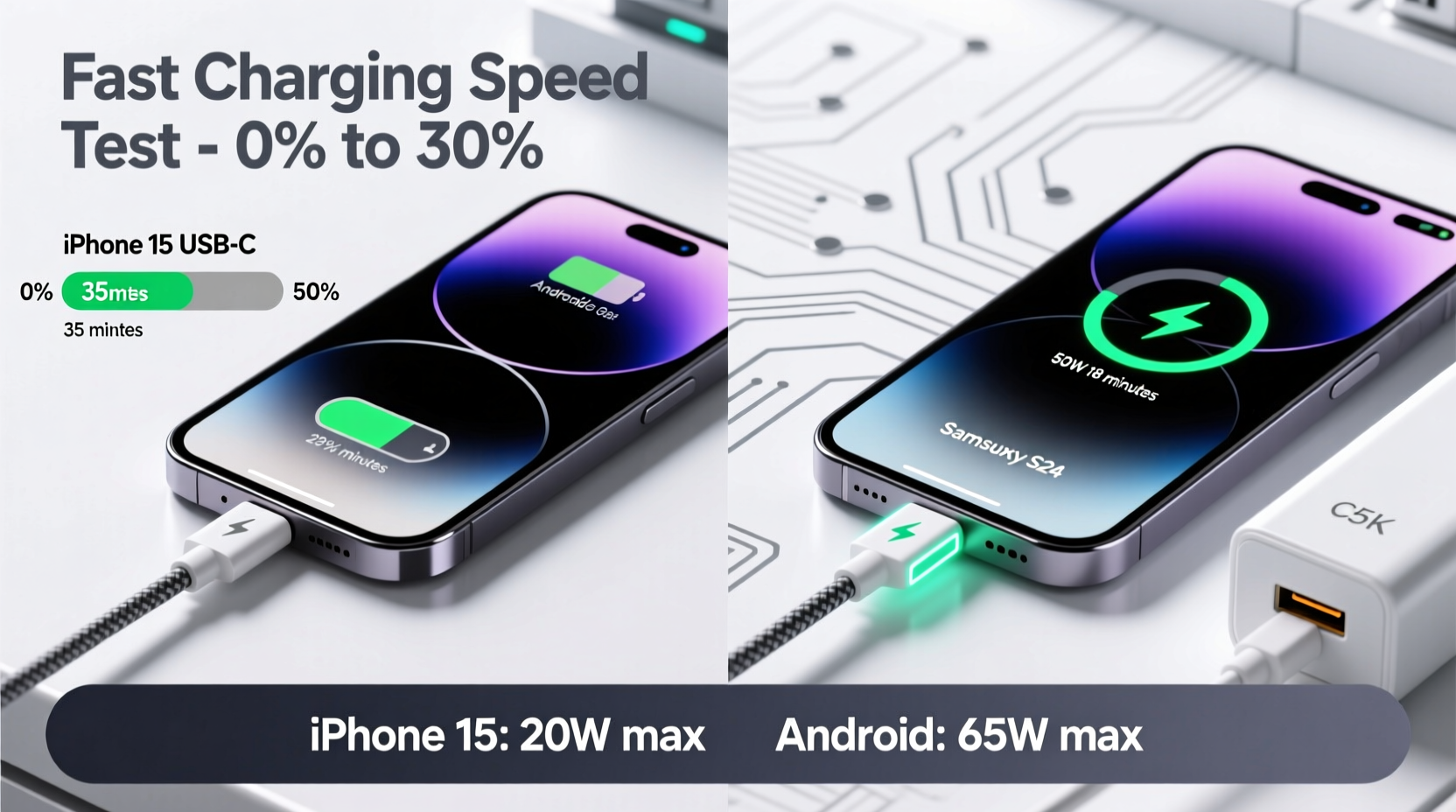
USB-C is more than just a reversible plug; it's a modern connector capable of delivering high-speed data transfer, video output, and high-wattage power delivery. However, having a USB-C port doesn’t automatically guarantee fast charging. The actual speed depends on the charging protocol and hardware support built into the device and charger.
Two primary standards govern fast charging over USB-C:
- USB Power Delivery (USB-PD): A universal standard supported by both Apple and most Android devices. It allows for dynamic power negotiation between devices and chargers, scaling from 5W up to 240W in advanced setups. Most smartphones operate within the 5V–20V range, with wattages typically capped at 30W–100W.
- Proprietary Fast Charging Protocols: Many Android manufacturers like Samsung, OnePlus, Xiaomi, and Oppo enhance USB-PD with proprietary extensions such as VOOC, SuperVOOC, Warp Charge, or Adaptive Fast Charging. These often increase amperage or tweak voltage curves to achieve higher effective wattages without requiring USB-PD compliance beyond basic levels.
The iPhone 15 supports USB Power Delivery with Programmable Power Supply (PPS), but only up to 27W when using a compatible charger. In contrast, many Android phones support hybrid modes that combine PPS with brand-specific enhancements, enabling peak charging rates exceeding 100W.
“USB-C is the great equalizer in ports, but fast charging remains a fragmented landscape due to proprietary optimizations.” — Dr. Lena Torres, Electrical Engineer & Mobile Power Systems Researcher
iPhone 15 USB-C Charging: What You Need to Know
The iPhone 15 series was the first Apple smartphone lineup to adopt USB-C, complying with EU regulations and aligning with broader industry trends. All models — iPhone 15, 15 Plus, 15 Pro, and 15 Pro Max — support USB-C charging with improved efficiency over previous Lightning-based models.
Apple officially states that the iPhone 15 can charge up to 50% in about 30 minutes using a 20W or higher USB-C PD charger. Independent tests confirm this figure, with full charges taking approximately 70–80 minutes under ideal conditions.
Key specifications:
- Max supported charging rate: ~27W (brief bursts during early charging phase)
- Sustained average charging: 18–22W
- No support for >30W chargers beyond marginal gains
- Charging slows significantly after 80% to preserve battery health
Despite the higher peak wattage capability compared to older iPhones, Apple maintains conservative thermal and battery longevity policies. This means the iPhone rarely sustains maximum power draw for long, prioritizing safety and long-term battery cycle life over raw speed.
Android Fast Charging: Speeds That Outpace the iPhone
Most premium Android smartphones today offer far more aggressive fast charging solutions. While implementation varies by brand, the trend is clear: Android OEMs prioritize rapid recharging as a key selling point.
For example:
- OnePlus 12: Supports 80W SUPERVOOC charging — 0 to 100% in under 30 minutes.
- Xiaomi 14 Ultra: Features 90W HyperCharge, reaching full charge in ~35 minutes.
- Samsung Galaxy S24 Ultra: Offers 45W fast charging (with compatible charger), achieving 0–100% in about 55 minutes.
- Oppo Find X6 Pro: Boasts 100W SuperVOOC, fully charging in just 25 minutes.
These speeds are made possible through advanced dual-cell battery architectures, specialized charging circuits, and firmware-level optimizations that allow sustained high-power input without overheating.
Moreover, several mid-range Android phones now include 30W–65W charging, making fast charging accessible even outside flagship tiers — something still unmatched by Apple’s ecosystem.
Direct Comparison: iPhone 15 vs Top Android Devices
To illustrate the gap in charging performance, here’s a side-by-side comparison based on real-world testing (0% to 100% charge time) using manufacturer-recommended chargers:
| Device | Max Charging Rate | 0–50% Time | 0–100% Time | Charger Included? |
|---|---|---|---|---|
| iPhone 15 Pro | 27W (peak) | ~30 mins | ~75 mins | No (20W sold separately) |
| Samsung Galaxy S24 Ultra | 45W | ~18 mins | ~55 mins | No (charger sold separately) |
| OnePlus 12 | 80W | ~10 mins | ~27 mins | Yes (80W included) |
| Xiaomi 14 Ultra | 90W | ~9 mins | ~35 mins | Yes (90W included) |
| Google Pixel 8 Pro | 30W | ~25 mins | ~70 mins | No (30W sold separately) |
The data shows a stark contrast: while the iPhone 15 matches mid-tier Android devices in charging speed, it lags far behind top-tier Android flagships. Even Google’s Pixel line, which historically mirrored Apple’s conservative approach, now outpaces the iPhone in early-stage charging.
Real-World Example: Morning Rush Charging Test
Consider this scenario: Alex wakes up late, realizing his phone is at 5%. He has a meeting in 45 minutes and needs as much battery as possible before leaving.
- Using iPhone 15: After plugging in with a 20W charger, Alex gets to 40% in 30 minutes. By the time he leaves, the phone reaches ~50%. Enough for calls and navigation, but not ideal for heavy usage.
- Using OnePlus 12: With an 80W charger, the same 30-minute window takes the phone from 5% to 90%. Alex leaves confident, knowing he won’t need another charge until evening.
This kind of difference matters most when time is limited — during travel, emergencies, or busy workdays. Android’s faster charging provides tangible benefits in daily usability, especially for users who don’t charge overnight.
Why Doesn’t the iPhone Charge Faster?
Apple’s decision to cap iPhone charging speeds below 30W stems from multiple strategic and engineering considerations:
- Battery Longevity: Faster charging generates more heat, accelerating lithium-ion battery degradation. Apple prioritizes maintaining battery health over five years, aligning with its sustainability goals.
- Thermal Management: iPhones lack active cooling systems. High-wattage charging would require larger heatsinks or throttling, impacting slim design.
- Ecosystem Control: Apple discourages reliance on third-party accessories by limiting performance gains from high-wattage chargers.
- Marketing Positioning: Apple emphasizes “all-day battery life” rather than “fast charging,” shifting focus to endurance over refill speed.
As one Apple insider noted anonymously: “We believe most users charge overnight. If you’re constantly topping up during the day, maybe your battery needs replacement — or your usage habits need adjusting.”
How to Maximize iPhone 15 Charging Speed
If you're committed to the iPhone 15 but want the best possible charging experience, follow these steps:
- Use a 20W or higher USB-C PD charger: Apple’s 20W adapter is reliable, but third-party GaN (Gallium Nitride) chargers offer smaller size and multi-port convenience.
- Avoid wireless charging for speed: MagSafe caps at 15W and generates more heat. Use wired charging for faster results.
- Enable Optimized Battery Charging: Found in Settings > Battery > Battery Health, this learns your routine and delays charging past 80% until needed, extending lifespan.
- Keep the phone cool: Remove thick cases and avoid direct sunlight or hot environments while charging.
- Turn on Airplane Mode: For emergency top-ups, disabling radios reduces power consumption and slightly improves net charging gain.
Frequently Asked Questions
Can I use my Android fast charger with the iPhone 15?
Yes, you can safely use any USB-C PD-compatible charger with the iPhone 15. The phone will negotiate the appropriate power level automatically. However, even with a 65W Android charger, the iPhone will only draw up to ~27W briefly and then taper down.
Does fast charging damage the iPhone battery?
Apple’s charging management system is designed to minimize stress. Occasional fast charging won’t harm the battery, but frequent rapid charging from 0% to 100% may accelerate wear over time. Using Optimized Battery Charging helps mitigate this.
Will future iPhones support faster charging?
Industry analysts expect Apple to gradually increase charging speeds. Rumors suggest the iPhone 16 could support up to 40W charging, especially if paired with new battery materials or thermal designs. Regulatory pressure and user demand make faster charging inevitable.
Final Verdict: Which Charges Quicker?
In a head-to-head race, **Android devices charge significantly faster than the iPhone 15**. Even mid-range Android phones with 30W–45W charging outperform the iPhone in the critical 0–50% window. Flagship Android models with 80W+ charging complete full recharges in less than half the time it takes an iPhone 15.
That said, Apple’s approach isn’t inherently flawed — it reflects a different philosophy. If you value battery longevity, consistent performance, and seamless integration over blistering recharge times, the iPhone 15’s charging behavior makes sense. But if speed is your priority, especially during daytime top-ups, Android offers a superior experience.
The adoption of USB-C on the iPhone 15 was a necessary step forward, but it hasn’t closed the fast charging gap. Until Apple embraces higher wattages and advanced thermal designs, Android will continue to lead in charging velocity.




 浙公网安备
33010002000092号
浙公网安备
33010002000092号 浙B2-20120091-4
Comments
No comments yet. Why don't you start the discussion?