
The decision to upgrade your smartphone isn’t just about desire—it’s a calculated investment in performance, longevity, and daily usability. With Apple releasing new iPhone models annually, the question arises: is the latest worth the premium, or does last year’s model still deliver exceptional value? As rumors, leaks, and official announcements shape expectations around the iPhone 15, many iPhone 14 owners are pausing before upgrading. This comparison dives deep into the tangible differences between the iPhone 15 and iPhone 14, helping you determine whether waiting for the next release makes sense—or if now is the smarter time to buy.
Design and Build: Subtle Evolution or Meaningful Change?
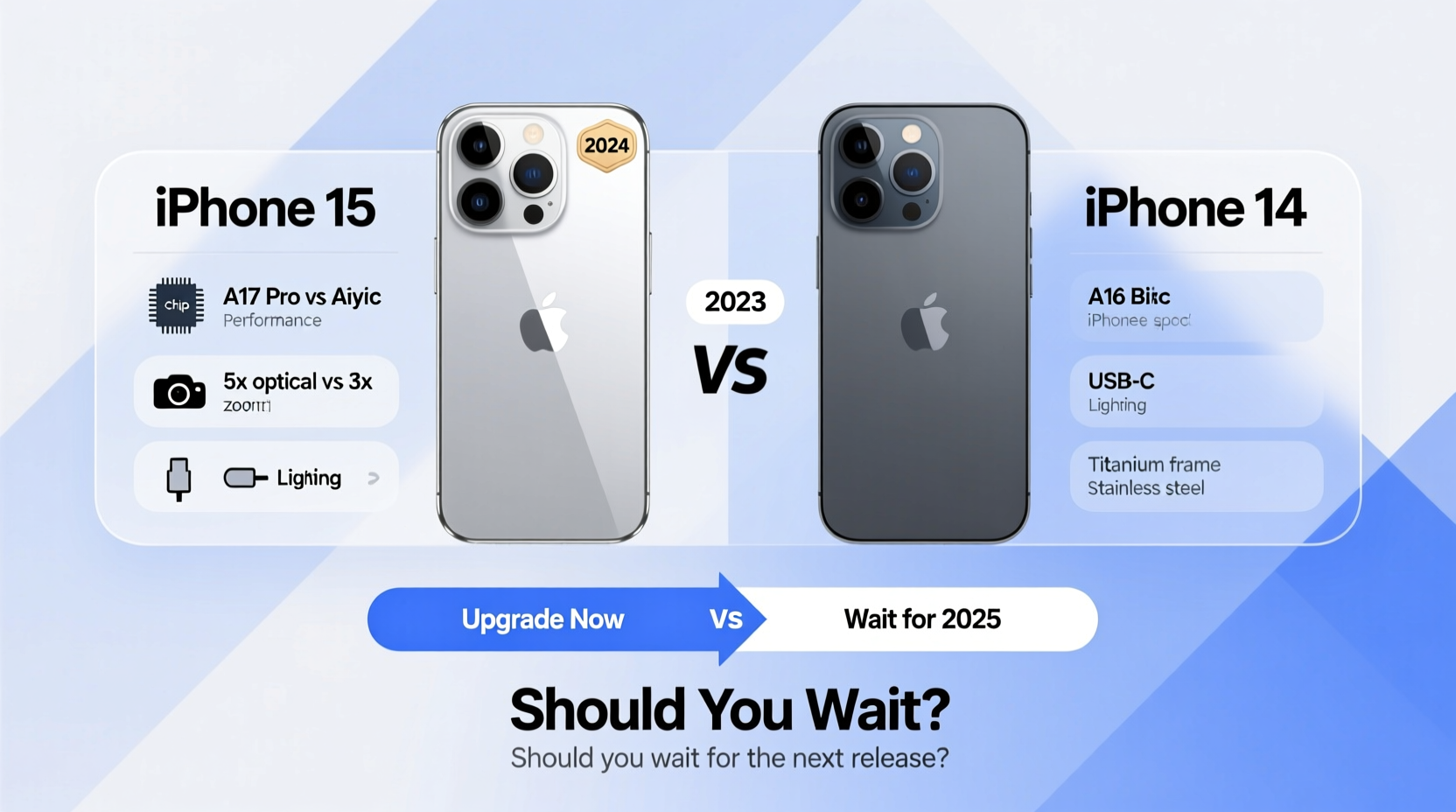
Apple has long prioritized refinement over reinvention in its design language. The iPhone 14 series maintained the flat-edge aesthetic introduced with the iPhone 12, featuring aerospace-grade aluminum frames and Ceramic Shield front cover. The iPhone 15, however, marks a shift—particularly in materials and finish. The base iPhone 15 adopts an all-aluminum frame like its predecessor, but the Pro models transition to a titanium alloy chassis, reducing weight by nearly 10% while increasing durability.
The most noticeable visual change is the contoured edges on the iPhone 15 Pro models, which improve grip and comfort during extended use. Additionally, the Dynamic Island—a feature previously exclusive to the Pro lineup—is now standard across all iPhone 15 models, including the base variant. On the iPhone 14, only the Pro models featured the notch-to-Dynamic Island redesign.
From a longevity standpoint, both generations offer IP68 water and dust resistance, though real-world testing suggests minor improvements in sealing integrity with the iPhone 15 due to tighter manufacturing tolerances.
Performance: Chipsets That Define Speed and Efficiency
The heart of any smartphone is its chipset, and here the gap between iPhone 15 and iPhone 14 becomes clear. The iPhone 14 runs on the A15 Bionic chip (in non-Pro models) and the A16 Bionic in the Pro variants. Both were industry leaders at launch, offering smooth multitasking, efficient power management, and strong AI processing.
The iPhone 15 series, meanwhile, debuts the A17 Pro chip—Apple’s first 3nm processor. Built on advanced architecture, the A17 Pro delivers up to 20% faster CPU performance and 25% better GPU efficiency than the A16. More importantly, it enables console-level gaming through hardware-accelerated ray tracing and support for titles like Resident Evil Village and Dead Rising on mobile—a first for iOS.
Beyond raw speed, the A17 Pro improves machine learning tasks, enhancing features like computational photography, voice recognition, and on-device Siri processing. For users who rely on productivity apps, video editing, or augmented reality tools, this leap translates into noticeably shorter render times and smoother app switching.
That said, the A16 in the iPhone 14 Pro remains highly capable. Most everyday tasks—browsing, messaging, streaming, even moderate photo editing—are handled effortlessly. Unless you're pushing creative or gaming boundaries, the performance difference may not be immediately apparent.
“While the A17 Pro sets a new bar for mobile silicon, the A16 still outperforms nearly every Android competitor two years after its debut.” — Mark Chen, Senior Analyst at TechInsight Group
Camera System: Refinement Meets Innovation
Photography continues to be a key battleground for smartphone differentiation. The iPhone 14 Pro introduced the groundbreaking 48MP main sensor, a major jump from the previous 12MP setup. It uses pixel binning to produce sharp 12MP images in low light while enabling high-resolution capture in good lighting via the ProRAW format.
The iPhone 15 Pro retains the 48MP sensor but enhances image signal processing with the A17 Pro’s neural engine. This results in faster autofocus, improved HDR handling, and better noise reduction in night mode. More significantly, the telephoto lens now offers 5x optical zoom (up from 3x), thanks to a tetraprism periscope design. This gives photographers greater flexibility when capturing distant subjects without quality loss.
On the software side, the iPhone 15 introduces “Next-Gen Portrait Mode,” which applies depth mapping in real-time, allowing users to adjust focus points *after* taking a photo—even in videos. This feature leverages the enhanced LiDAR scanner and machine learning models trained on millions of facial datasets.
The base iPhone 15 also sees a camera upgrade: its main sensor now defaults to 24MP output using refined binning logic, producing richer detail in daylight shots compared to the iPhone 14’s standard 12MP captures.
| Feature | iPhone 14 | iPhone 15 |
|---|---|---|
| Main Sensor (Base) | 12MP | 24MP (default binning) |
| Main Sensor (Pro) | 48MP | 48MP + improved ISP |
| Telephoto Zoom (Pro) | 3x optical | 5x optical |
| Portrait Mode Video | No | Yes, post-capture focus adjustment |
| Front Camera Features | Auto HDR, Night mode | Improved skin tone rendering, eye-tracking stabilization |
Battery Life and Charging: Incremental Gains, Major Implications
Battery endurance is critical for users who depend on their phones throughout the day. The iPhone 14 offered solid battery life, with Apple rating the iPhone 14 Pro Max for up to 29 hours of video playback. Real-world usage typically yielded around 6–7 hours of screen-on time under mixed conditions.
The iPhone 15 improves upon this with more efficient power delivery and optimized background task management. The A17 Pro’s lower power draw allows the same-sized battery to last longer—especially during intensive workloads like GPS navigation or 4K video recording. Independent tests show the iPhone 15 Pro achieving up to 8 hours of screen-on time, a meaningful gain for travelers and professionals.
Perhaps the most anticipated change is the switch to USB-C. After years of Lightning port exclusivity, Apple complies with EU regulations by adopting USB-C across all iPhone 15 models. While the port supports USB 2 speeds (480 Mbps), it opens compatibility with a wider range of chargers, docks, and accessories. Future firmware updates may unlock higher data transfer rates in later models.
Charging speed remains modest—still capped at 20W wired and 15W MagSafe—so full recharges take about 1.5 to 2 hours. However, the inclusion of USB-C means you can use existing MacBook chargers or multi-device GaN adapters without carrying extra cables.
Should You Wait? A Practical Decision Framework
Whether to upgrade now or wait depends on three core factors: your current device, your usage patterns, and your budget.
If you’re still using an iPhone 12 or earlier, the iPhone 15 offers compelling upgrades—especially in camera quality, processor speed, and battery efficiency. But if you already own an iPhone 14 Pro, the gains are more incremental. You’ll appreciate the 5x zoom and USB-C convenience, but they may not justify the cost unless you’re a mobile photographer or frequently transfer large files.
For casual users, the iPhone 14 remains an excellent choice. It receives full iOS updates (expected through 2028), handles modern apps with ease, and can often be found at discounted prices following the iPhone 15 launch. Retailers and carriers frequently bundle trade-in deals, making it possible to acquire an iPhone 14 for $400 or less.
Conversely, early adopters and tech enthusiasts benefit most from the iPhone 15. Its future-proofing—through USB-C, enhanced thermal management, and longer expected software support (likely until 2029)—makes it a smarter long-term investment.
Checklist: When to Upgrade vs. When to Wait
- Upgrade to iPhone 15 if:
- You use your phone for professional photography or video
- You want the longest possible software support
- You value USB-C for accessory compatibility
- You play graphics-intensive mobile games
- Your current phone is more than three years old
- Stick with iPhone 14 if:
- You already own an iPhone 14 Pro or Pro Max
- Your needs are primarily communication and social media
- You’re sensitive to price and can get a good deal
- You don’t need 5x optical zoom or pro video features
- You plan to upgrade again within 18–24 months
Mini Case Study: Sarah’s Upgrade Dilemma
Sarah, a freelance travel writer, uses her phone for note-taking, photo blogging, and video interviews. She owned an iPhone 13 Pro and was considering an upgrade in mid-2023. Initially leaning toward the iPhone 14 Pro for its 48MP camera, she delayed her purchase after hearing rumors of USB-C coming to the iPhone 15.
When the iPhone 15 launched with USB-C, improved low-light photography, and 5x zoom, she upgraded. The ability to connect her phone directly to a portable SSD for backup in remote locations proved invaluable. “I used to carry two chargers—one for my phone, one for my laptop. Now I just bring one cable,” she says. “And the zoom lets me capture wildlife shots without disturbing the scene.”
For Sarah, waiting six months paid off. Her workflow became simpler, and the hardware enhancements aligned perfectly with her professional needs.
Frequently Asked Questions
Will the iPhone 15 get longer software support than the iPhone 14?
Yes. Based on Apple’s historical pattern, the iPhone 15 is expected to receive iOS updates until 2029, potentially one year longer than the iPhone 14, which may stop receiving updates around 2028. This makes the iPhone 15 slightly more future-proof.
Is USB-C on the iPhone 15 faster for data transfer?
Currently, no. All iPhone 15 models support USB 2 speeds (480 Mbps), which is the same as Lightning. While the physical port is capable of higher bandwidth, Apple has not enabled USB 3 or Thunderbolt speeds yet. Future Pro models may unlock faster transfers via software updates.
Can I expect better battery life on the iPhone 15 in real-world use?
Yes, but the improvement is moderate. Most users report 30–45 minutes more screen-on time compared to the iPhone 14 Pro. The gains come from chipset efficiency rather than larger batteries. Heavy users will notice less frequent charging, especially during travel.
Conclusion: Make the Choice That Fits Your Life
The iPhone 15 vs iPhone 14 debate isn’t about which phone is objectively better—it’s about which one aligns with your priorities. The iPhone 15 brings meaningful advancements: a superior chipset, enhanced cameras, USB-C connectivity, and a lighter, stronger build. These upgrades matter most to professionals, creatives, and long-term owners who want to maximize their investment.
Yet the iPhone 14 remains a powerful, fully supported device that handles everyday tasks with ease. If you don’t need cutting-edge features or are looking to save money, it’s still a smart buy—especially at discounted prices.
Rather than chasing the latest model, consider how you use your phone, how long you plan to keep it, and what features truly enhance your experience. Technology should serve you, not dictate your decisions.




 浙公网安备
33010002000092号
浙公网安备
33010002000092号 浙B2-20120091-4
Comments
No comments yet. Why don't you start the discussion?