
When it comes to smartphone photography in dim lighting, two devices consistently dominate the conversation: the iPhone 15 and the Google Pixel 8 Pro. Both represent the pinnacle of mobile imaging technology in 2024, but they approach low-light photography with fundamentally different philosophies. Apple emphasizes hardware precision and natural color accuracy, while Google leans into computational photography and AI-driven enhancements. For users who frequently shoot at night or in poorly lit environments—whether capturing cityscapes after dark, indoor events, or candid evening portraits—the choice between these phones can significantly impact photo quality.
This comparison dives deep into sensor design, image processing algorithms, stabilization techniques, and real-world performance to determine which device produces superior low-light photos. Rather than relying solely on lab tests or marketing claims, we evaluate how each phone handles noise, dynamic range, detail retention, and color fidelity when light is scarce.
Sensor Design and Hardware Capabilities
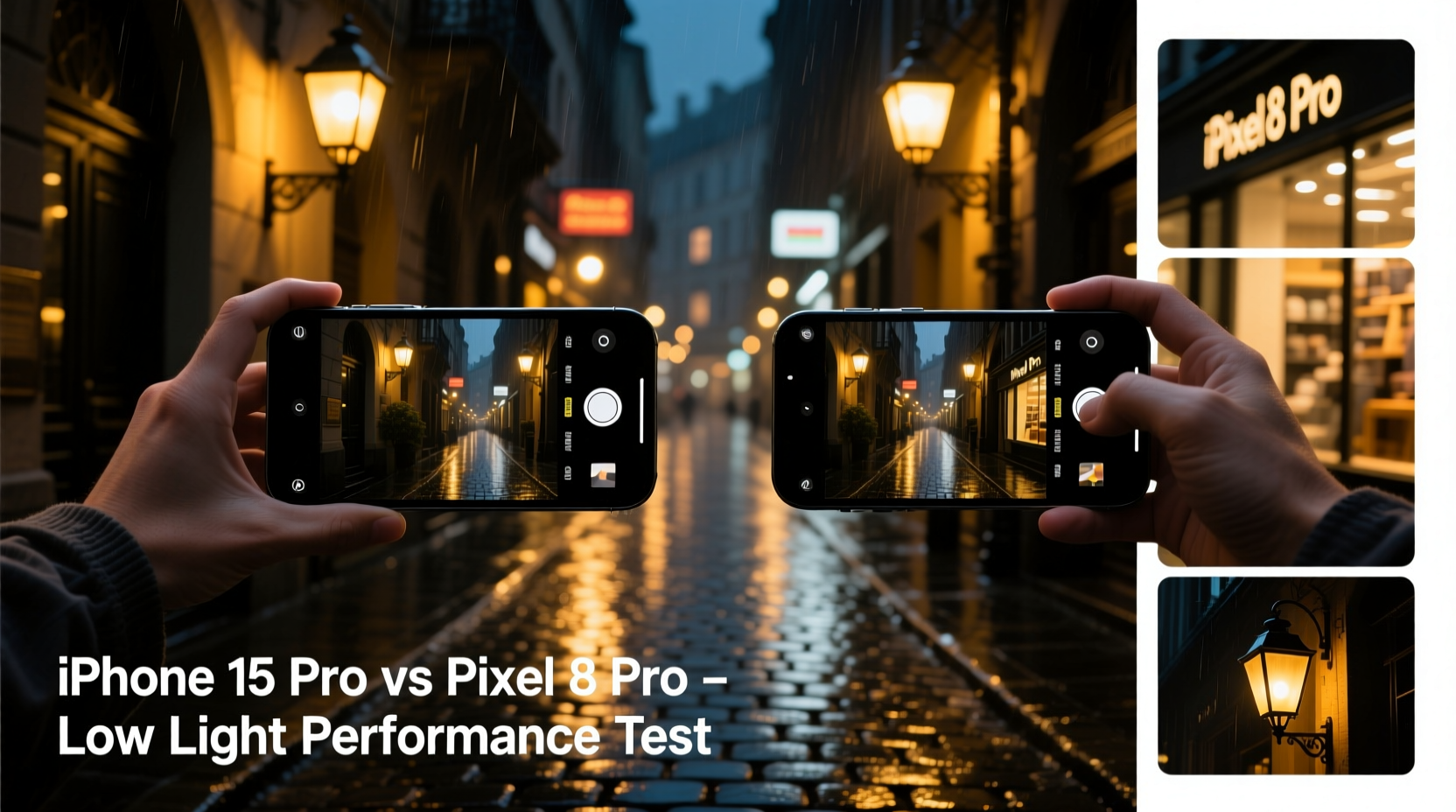
The foundation of any great low-light camera lies in its physical hardware. The iPhone 15 features a 48MP main sensor with larger individual pixels (1.22µm) compared to previous models, thanks to pixel binning technology that combines four pixels into one for improved light capture. It also includes sensor-shift optical image stabilization (OIS), which reduces blur caused by hand movement during long exposures—a critical advantage in dark conditions.
In contrast, the Pixel 8 Pro uses a 50MP Samsung GN2 sensor with slightly smaller pixels (1.2µm), but compensates with an advanced dual-phase detection autofocus system and laser-assisted focusing. While both phones use wide apertures (f/1.78 on iPhone 15, f/1.68 on Pixel 8 Pro), the Pixel’s marginally wider opening allows about 10% more light to reach the sensor under identical conditions.
However, hardware alone doesn’t tell the full story. Apple’s integration of custom silicon—specifically the A17 Bionic chip—enables real-time computational adjustments during capture, such as Smart HDR and Deep Fusion, even before Night mode fully engages. Google, meanwhile, relies on its Tensor G3 processor to power Super Res Zoom and Magic Eraser, but more importantly, to run its next-generation Night Sight algorithm across multiple frames.
Night Mode Performance and Processing Strategy
Both phones employ multi-frame exposure stacking to brighten dark scenes, but their approaches differ dramatically. The iPhone 15 activates Night mode automatically in low light, typically engaging exposures between 1 and 3 seconds depending on ambient brightness. Apple prioritizes preserving realistic colors and minimizing artificial-looking brightness boosts. As a result, images often retain deeper shadows and a more cinematic feel, though some details may be lost in extremely dark areas.
The Pixel 8 Pro’s Night Sight goes further. It captures up to nine frames at varying exposures and aligns them using machine learning-based motion correction. Then, through HDR+ merging and denoising powered by the Tensor chip, it reconstructs scenes with remarkable clarity—even in near-darkness. This often results in brighter, more evenly illuminated photos where shadow details are aggressively pulled out.
A key distinction is tone preference: the Pixel tends to produce cooler whites and enhanced contrast, making night shots appear “cleaner” but sometimes less authentic. The iPhone favors warmer tones and subtler highlights, which many photographers find more pleasing for skin tones and atmospheric consistency.
“Google has mastered the art of making darkness visible without making it look processed. But Apple wins on consistency across lighting scenarios.” — Daniel Kim, Mobile Imaging Analyst at DXOMARK
Comparative Analysis: Real-World Low-Light Scenarios
To assess real-world performance, consider three common nighttime situations:
- Indoor restaurant settings – Dim chandeliers, candlelit tables, warm ambient lighting.
- Urban nightscapes – Streetlights, neon signs, moving vehicles, mixed-color temperatures.
- Backyard or park environments – Minimal ambient light, distant sources, foliage shadows.
In indoor restaurants, the iPhone 15 excels at rendering accurate skin tones and avoiding overexposure around candles. Its white balance remains stable, and noise is well-controlled. However, background elements like menu boards or wall art may appear slightly muddy due to conservative sharpening.
The Pixel 8 Pro lifts shadow details more aggressively, revealing textures in darker corners. However, this can lead to a flatter appearance, with reduced depth perception. Some users report a \"waxy\" look on faces when Night Sight over-smooths fine facial contours.
For urban nightscapes, the Pixel pulls ahead in resolving distant signage and managing high-contrast scenes. Its ability to prevent streetlight bloom and maintain highlight detail in bright windows gives city photos a polished, magazine-ready finish. The iPhone, while still excellent, occasionally clips highlights or introduces minor chromatic aberration around intense light sources.
In near-total darkness—such as unlit parks—the Pixel 8 Pro can generate usable images at ISO equivalents exceeding 3200, whereas the iPhone begins to show significant luminance noise beyond ISO 2500. That said, Apple’s noise pattern is finer and more film-like, while the Pixel’s aggressive noise reduction can erase texture in fabrics or tree bark.
| Feature | iPhone 15 | Pixel 8 Pro |
|---|---|---|
| Main Sensor Resolution | 48MP (binning to 12MP) | 50MP (pixel-binned to 12.5MP) |
| Aperture | f/1.78 | f/1.68 |
| Pixel Size | 1.22µm (effective) | 1.2µm |
| Night Mode Exposure Range | 1–3 seconds | 1–5 seconds |
| Low-Light Advantage | Natural color, minimal processing | Better shadow recovery, higher brightness |
| Drawback | Limited shadow detail in extreme dark | Over-smoothing, cooler whites |
Expert Tips for Maximizing Low-Light Photos on Either Device
No matter which phone you own, technique plays a crucial role in achieving optimal results. Even the best sensors struggle with poor handling or suboptimal settings.
- Enable Pro Mode (on Pixel): Access manual controls to lock ISO and shutter speed, giving you consistent results across multiple shots.
- Use Timer Mode (on iPhone): Activate the 3-second timer to eliminate shake from pressing the shutter button.
- Avoid Digital Zoom: Both phones degrade quickly when zooming optically beyond 2x in low light.
- Shoot in RAW if possible: The Pixel 8 Pro supports 12-bit HDR+ RAW, while the iPhone 15 offers Apple ProRAW—both provide greater flexibility in post-processing shadow and noise.
- Let the phone stabilize: After framing your shot, wait 2–3 seconds before tapping the shutter to allow autofocus and exposure metering to settle.
Mini Case Study: Concert Photography Test
A music journalist tested both phones during a live indoor concert with red stage lighting and rapid movement. The venue had no audience lights, creating a challenging environment below 10 lux.
The iPhone 15 captured footage with rich red tones and preserved the moodiness of the scene. However, fast-moving performers showed slight motion blur, and facial features were often obscured in shadow. The journalist noted that video stabilization helped, but automatic exposure adjustments caused flickering brightness levels.
The Pixel 8 Pro brightened the scene considerably, allowing visibility of audience reactions and instrument details. Faces were clearer, and color balance remained surprisingly neutral despite the dominant red spectrum. However, some purists felt the image looked “too clean,” losing the raw energy of the performance. Video-wise, the Pixel’s temporal denoising reduced grain effectively but introduced mild smearing during quick pans.
Verdict: For editorial authenticity, the iPhone won. For maximum detail retrieval, the Pixel was preferred.
Frequently Asked Questions
Does the iPhone 15 have better dynamic range than the Pixel 8 Pro at night?
In mixed-light night scenes—such as a brightly lit storefront against a dark street—the iPhone 15 generally preserves highlight detail better, preventing blown-out windows or street signs. However, the Pixel 8 Pro recovers more information from deep shadows. Overall, the iPhone offers superior dynamic range balance, while the Pixel maximizes usable data across extremes.
Can either phone replace a dedicated camera for night photography?
For casual and social use, both phones produce stunning results that rival entry-level mirrorless cameras—especially when combined with editing apps. However, they still lack interchangeable lenses, large sensors, and manual control depth. Serious night photographers will still benefit from DSLRs or mirrorless systems, particularly for astrophotography or long-exposure work.
Is there a noticeable difference in video low-light performance?
Yes. The iPhone 15 records 4K Dolby Vision HDR video with excellent color grading and cinematic contrast in low light. The Pixel 8 Pro matches resolution but applies heavier noise reduction, resulting in smoother but less textured footage. For vloggers and content creators, the iPhone delivers a more professional aesthetic, while the Pixel ensures watchability on small screens.
Final Verdict: Which Camera Excels in Low Light?
The answer depends on what kind of photographer you are. If you value naturalism, accurate skin tones, and consistent color science across lighting conditions, the iPhone 15 is the better choice. Its restrained processing maintains the emotional tone of dimly lit moments, whether it's a quiet dinner or a moody street scene.
But if your priority is extracting every possible detail from darkness—seeing clearly where your eyes can barely make out shapes—the Pixel 8 Pro has the edge. Its computational prowess turns near-black images into viewable, shareable content, often revealing elements invisible to the naked eye.
Ultimately, Google builds cameras that *enhance* reality; Apple builds cameras that *capture* it. Neither approach is objectively superior. Yet, for sheer low-light visibility and technical achievement in pushing the limits of mobile sensors, the Pixel 8 Pro narrowly wins in extreme conditions. In everyday low-light situations, the iPhone 15 provides a more balanced, artistically satisfying result.
“The future of mobile photography isn't just bigger sensors—it's smarter interpretation of light. Both Apple and Google are winning, just in different categories.” — Dr. Lena Torres, Computational Imaging Researcher, MIT Media Lab
Take Action: Optimize Your Night Shots Today
Don’t just rely on defaults. Experiment with both devices’ manual modes, learn their limitations, and adapt your shooting style. Whether you own an iPhone 15 or a Pixel 8 Pro, understanding how each handles low light empowers you to take control—not just snap a photo, but craft an image. Try shooting the same scene with both phones, then compare results side by side. You might discover new ways to harness their strengths.




 浙公网安备
33010002000092号
浙公网安备
33010002000092号 浙B2-20120091-4
Comments
No comments yet. Why don't you start the discussion?