
In 2025, the battle between Apple’s iPhone 15 (base model) and Samsung’s Galaxy S24 (base variant) remains one of the most relevant for consumers choosing a premium smartphone without overspending on ultra-tier features. Both devices represent the entry point to their respective flagship lines, offering polished designs, strong performance, and access to robust ecosystems. But when evaluating true value—balancing price, longevity, features, and real-world usability—one begins to stand out depending on user priorities.
This analysis dives deep into hardware, software, ecosystem integration, resale value, and ownership costs to determine which device offers superior long-term value in today’s market.
Performance and Hardware: Real-World Speed vs Flexibility
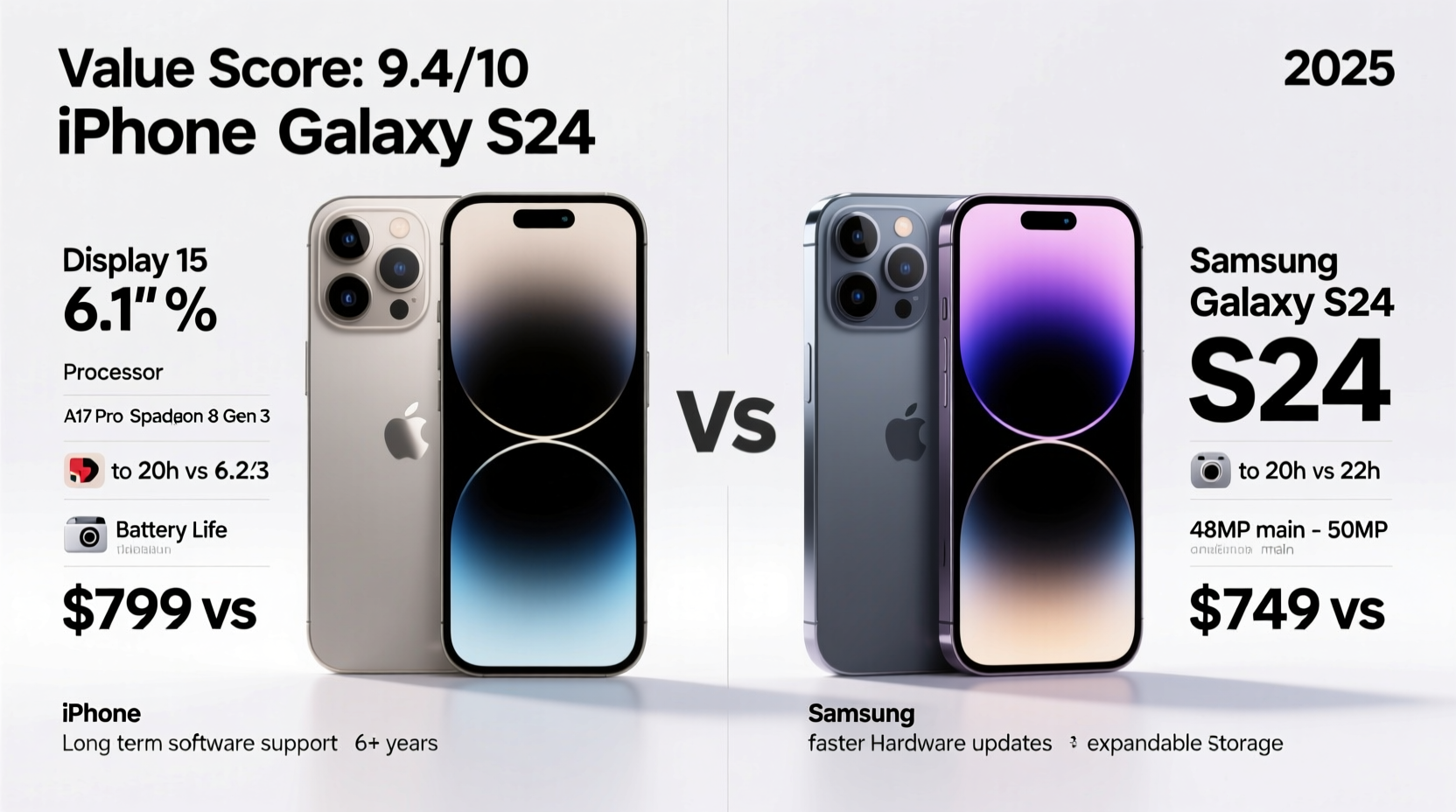
The iPhone 15 is powered by Apple’s A16 Bionic chip, built on a 4nm process and optimized tightly with iOS. Despite being a year old in 2025, it continues to deliver exceptional performance in daily tasks, multitasking, and gaming. Apps launch instantly, animations remain fluid, and background processes are efficiently managed thanks to Apple’s unified memory architecture.
The Samsung Galaxy S24, meanwhile, runs on either the Snapdragon 8 Gen 3 (in most global markets) or Exynos 2400 (in select regions), depending on availability. While both chips are powerful, the Snapdragon version edges ahead in sustained workloads and AI processing. However, real-world differences in everyday use—like browsing, messaging, and media consumption—are minimal between the two phones.
Where the S24 pulls ahead is in RAM and storage flexibility. The base S24 ships with 8GB of RAM and offers expandable storage via microSD in certain regions—a rarity among flagships. The iPhone 15 sticks with 6GB of RAM and no expansion option, making the 128GB base storage a potential limitation over time.
“Even two years after release, iPhones maintain near-new responsiveness due to tight hardware-software integration.” — Dr. Lena Park, Mobile Systems Analyst at TechInsight Labs
Display and Design: Premium Feel vs Practical Usability
Both phones feature high-end build quality. The iPhone 15 uses aerospace-grade aluminum and Ceramic Shield glass, giving it excellent drop resistance. Its 6.1-inch Super Retina XDR OLED display supports HDR and True Tone but lacks high refresh rate support—capped at 60Hz. This can make scrolling feel less fluid compared to modern Android competitors.
The Galaxy S24 counters with a 6.2-inch Dynamic AMOLED 2X display featuring a 120Hz adaptive refresh rate, which adjusts based on content to save power. This results in noticeably smoother navigation, especially in social feeds and games. It also peaks at higher brightness levels (up to 2600 nits), improving outdoor visibility.
Design-wise, the S24 feels slightly more compact despite similar dimensions, thanks to thinner bezels and an optimized front layout. It also carries an IP68 rating for dust and water resistance, matching the iPhone 15.
| Feature | iPhone 15 | Samsung S24 |
|---|---|---|
| Display Size & Type | 6.1” Super Retina XDR OLED | 6.2” Dynamic AMOLED 2X |
| Refresh Rate | 60Hz | Adaptive 1–120Hz |
| Brightness (Peak) | 2000 nits | 2600 nits |
| Rear Cameras | Dual: 48MP main + 12MP ultrawide | Triple: 50MP main + 12MP ultrawide + 10MP telephoto (3x) |
| Front Camera | 12MP | 12MP with autofocus |
| Battery Capacity | ~3,349 mAh | ~4,000 mAh |
| Charging | 20W wired, MagSafe support | 25W wired, 15W wireless |
Camera Capabilities: Consistency vs Versatility
Apple has long prioritized computational photography, emphasizing natural color reproduction, accurate skin tones, and excellent video stabilization. The iPhone 15’s 48MP main sensor captures sharp images with rich detail, especially in daylight. Its Smart HDR 5 and Photonic Engine deliver balanced exposures and subtle shadow recovery. Video recording remains unmatched—supporting 4K Dolby Vision at up to 60fps, making it a favorite among content creators.
The S24, however, offers greater versatility. With a triple-lens system including a 3x optical zoom telephoto lens, users gain meaningful framing options without digital loss. Samsung’s AI-powered processing enhances dynamic range and texture, though sometimes at the cost of realism—colors can appear oversaturated in default mode. Nightography modes have improved significantly, now rivaling Apple’s low-light performance.
For casual photographers who prioritize point-and-shoot reliability, the iPhone 15 delivers consistent, predictable results. For those who enjoy creative control, zoom flexibility, and advanced editing tools within the native app, the S24 provides more room to experiment.
Software and Longevity: Ecosystem Lock-In vs Customization Freedom
iOS 18, available on the iPhone 15 in 2025, brings major updates like customizable home screens, enhanced Siri with on-device processing, and deeper privacy controls. Apple promises five years of OS updates, meaning the iPhone 15 will likely receive support through late 2028. This extended lifecycle is a cornerstone of its value proposition.
Android 15 powers the S24, bringing refined Material You theming, improved AI assistant features, and better cross-device integration with Windows PCs and tablets. Samsung guarantees seven years of OS and security updates—a significant advantage that matches or exceeds Apple’s track record. This commitment reduces obsolescence risk and increases long-term usability.
However, update delivery differs. Apple rolls out new iOS versions simultaneously to all supported devices. Samsung relies on carrier approvals and regional testing, causing delays of several weeks in some markets.
Ecosystem integration also plays a role. iPhone owners benefit from seamless continuity with Macs, iPads, AirPods, and Apple Watch. Features like Universal Clipboard, AirDrop, and Handoff enhance productivity. Samsung offers Good Drop (replacing AirDrop), Quick Share, and Link to Windows, but these lack the polish and reliability of Apple’s equivalents.
“The real value isn’t just in specs—it’s in how long a phone stays useful. Seven years of updates changes the game for Android.” — Marcus Tran, Senior Editor at MobileFuture Review
Total Cost of Ownership and Resale Value
At launch, the iPhone 15 started at $799, while the S24 began at $799 as well—though frequent promotions and trade-in deals often bring the latter closer to $699. Carrier subsidies and installment plans further reduce upfront costs, particularly for the S24.
Resale value tells a different story. After 18 months, iPhone 15 units retain approximately 60–65% of their original value, according to data from Glyde and Swappa. The S24, while holding value better than previous Galaxy models, averages 50–55% retention. This gap stems from stronger brand loyalty, broader international demand, and longer software support perception.
Maintenance costs also vary. Apple’s out-of-warranty screen repair costs $279, whereas Samsung charges $229 for similar service. Third-party repair networks are more accessible for Samsung due to modular design and easier part availability.
📋 **Checklist: Which Phone Offers Better Value Based on Your Needs**- I want my phone to last 5+ years: Both qualify, but S24 has longer official update support.
- I care about resale value: iPhone 15 holds value better over time.
- I take lots of videos: iPhone 15 wins with superior stabilization and format support.
- I prefer smooth scrolling and responsive UI: S24’s 120Hz display gives a tangible edge.
- I use other Apple devices: iPhone 15 integrates flawlessly with Mac, iPad, etc.
- I want more camera zoom options: S24 includes 3x optical telephoto; iPhone relies on digital zoom.
Real-World Example: Two Users, Two Choices
Consider Sarah, a freelance photographer who uses her phone for client previews, social media posting, and vlogging. She owns a MacBook Pro and iPad for editing. She chose the iPhone 15 because she can wirelessly transfer clips via AirDrop, edit them in Final Cut Pro using Continuity, and upload directly to Instagram with consistent color accuracy. Even with the 60Hz screen, her workflow thrives on ecosystem cohesion.
On the other hand, James, a travel blogger and tech enthusiast, opted for the S24. He values the 3x zoom for capturing distant landmarks, appreciates the brighter screen under sunlight, and uses the DeX mode to mirror his phone to hotel TVs for presentations. He also upgraded his storage with a 512GB microSD card, something impossible on the iPhone. For him, flexibility outweighs ecosystem lock-in.
Frequently Asked Questions
Is the iPhone 15 still worth buying in 2025?
Absolutely. The iPhone 15 remains a capable daily driver with excellent camera performance, reliable software updates, and strong resale value. Unless you need cutting-edge AI features or satellite connectivity, it offers outstanding value—especially if purchased refurbished or on discount.
Does the S24 justify its update promise in real usage?
Yes. Samsung’s seven-year update pledge means the S24 will receive Android 21 and security patches into 2031. In practical terms, this translates to fewer concerns about app compatibility and security vulnerabilities down the line, enhancing its long-term value proposition.
Which phone has better battery life?
The S24 generally lasts longer on a charge due to its larger battery and efficient processor tuning. Under moderate use, it consistently reaches 1.5 days, while the iPhone 15 typically requires daily charging. Fast charging is also quicker on the S24 (25W vs 20W).
Final Verdict: Where Value Truly Lies
The question of “better value” ultimately depends on what kind of user you are. If you’re deeply embedded in the Apple ecosystem, prioritize video quality, and plan to resell within two years, the iPhone 15 is the smarter financial and functional choice. Its enduring performance, strong build, and seamless integration with other Apple products create a cohesive experience that many professionals rely on.
But if you value future-proofing, display quality, customization, and hardware flexibility, the Samsung Galaxy S24 base model delivers more tangible upgrades for the same starting price. Its longer software support window, superior screen, versatile camera array, and expandable storage make it a compelling long-term investment—particularly for users who keep phones beyond three years.
In 2025, the S24 edges ahead in raw value when considering total ownership duration and feature set. However, the iPhone 15 maintains a critical advantage in ecosystem synergy and resale stability. There is no universal winner—only the right fit for your lifestyle.




 浙公网安备
33010002000092号
浙公网安备
33010002000092号 浙B2-20120091-4
Comments
No comments yet. Why don't you start the discussion?